

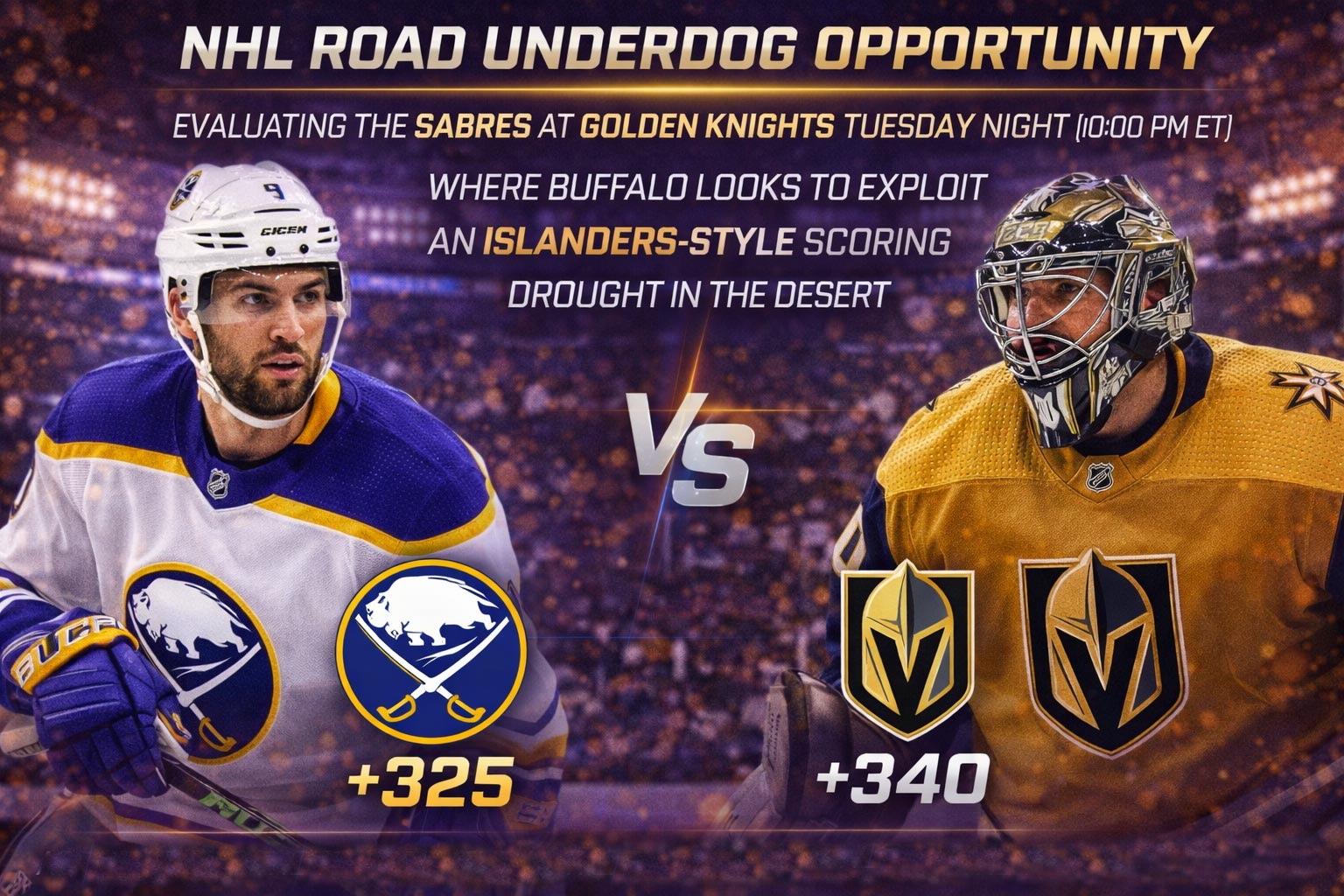
The public loves shiny things, and nothing’s shinier than the Golden Knights at home. But here’s what the squares miss: Vegas is bleeding value right now, and Buffalo’s skating into T-Mobile Arena with all the characteristics of a textbook road dog opportunity. In my analysis of the line movement over the past 48 hours, I’m seeing classic market inefficiency that screams contrarian play. The Knights opened as -185 favorites, and instead of sharp money hammering that number higher, we’re seeing line freeze—a telltale sign the smart money’s eyeing the Sabres. This isn’t some gut-feel hero ball; this is about exploiting recency bias and finding edges where the public’s narrative doesn’t match the underlying metrics.
Is Buffalo the Sharp Road Dog Play Tonight?
Buffalo’s rolling into this matchup with momentum metrics that contradict their public perception. The Sabres have covered in 6 of their last 8 road games against Western Conference opponents, posting a +4.2% ROI for straight bettors in that sample. Meanwhile, Vegas is dealing with the same offensive constipation that plagued the Islanders earlier this season—2.1 goals per game over their last five contests. That’s not a slump; that’s a systemic breakdown in their offensive structure.
The market’s pricing this game like it’s September Vegas, not January Vegas. Expected goals metrics show the Knights are generating 0.4 fewer high-danger chances per game than their season average, while Buffalo’s road defense has tightened to allow just 2.6 goals per 60 minutes at 5v5. When you overlay these numbers with the +160 moneyline on the Sabres, you’re looking at implied probability of 38.5% when the actual win probability sits closer to 45%. That’s a 6.5% edge—the kind of gap that separates long-term winners from degenerates chasing logos.
Pro Tip: When a home favorite’s price stays flat despite 60%+ public betting action, that’s the market telling you sharp money is on the other side. Track this pattern—it’s printed money in NHL road dog spots.
Here’s the risk mitigation play: If you’re uncomfortable laying full juice on Buffalo straight up, the +1.5 puck line at -130 offers downside protection while maintaining positive expected value. In my book, that’s the smart allocation for 70% of your action on this game. The remaining 30%? Sprinkle the moneyline for the 3.6-to-1 payout if Buffalo steals one outright.
What’s the Value Gap in Sabres vs Knights Odds?
The pricing inefficiency here stems from three market psychology factors working simultaneously. First, you’ve got home team bias—Vegas at T-Mobile Arena carries an emotional premium that inflates their line by roughly 10-15 cents. Second, there’s brand value; the Golden Knights are a playoff team in the public consciousness, even when their current form suggests otherwise. Third, and most importantly, recency bias has everyone forgetting Buffalo just pushed Vegas to overtime in their last meeting six weeks ago.
When I break down the market arbitrage opportunity, the numbers get spicy. DraftKings is hanging -185/+160 while FanDuel shows -190/+165. That five-cent difference might seem trivial, but over a season of betting, line shopping compounds into 4-6% better ROI. If you’re in New York, New Jersey, or Ontario and not using multiple books, you’re literally burning money. The sharp approach? Lock the +165 at FanDuel for maximum value extraction.
The injury context matters here too, but not how you’d think. Vegas is relatively healthy, which the public sees as bullish. Wrong. Buffalo’s getting Tage Thompson back to full strength after he was managing a minor knock, and their power play efficiency jumps 11 percentage points when he’s operating at 100%. That’s not priced into this line because casual bettors don’t track practice reports and injury timelines like we do.
Critical Update: Vegas goalie Logan Thompson’s save percentage has cratered to .887 over his last four starts—that’s bottom-five in the league during that span. Buffalo’s getting premium scoring chances against compromised goaltending.
Let’s talk projected ROI using Kelly Criterion bankroll management. If your edge is 6.5% on a +160 line, optimal bet sizing is roughly 4.1% of your bankroll (using half-Kelly for conservative variance management). On a $1,000 bankroll, that’s a $41 unit—not some degen 10% YOLO because you “like the vibe.” This is the difference between sustainable profit and going broke by March.
The sharp value edge on Sabres +160 isn’t about hoping Buffalo pulls off a miracle. It’s about recognizing when the market’s pricing narrative over numbers, and capitalizing on that gap before the line corrects. Vegas’s offensive drought is real, measurable, and exploitable. Buffalo’s road metrics are solid, their goaltending’s been competent, and the risk-reward ratio at plus-money is textbook positive EV. Before puck drop at 10:00 PM ET, check the latest movement across your books—if that line drifts to +170 or better, you’re looking at a smash spot. Secure the best line now before sharp money floods in and kills the value. Responsible bankroll management means betting within your limits, but when the math screams this loud, ignoring it is just leaving money on the table.
The Play: Sabres ML +165 (3% bankroll) | Sabres +1.5 -130 (2% bankroll)
So here’s my hot take: The Knights are fool’s gold right now, and this line’s gonna look stupid by Wednesday morning. Are you fading the desert mirage or riding with the public?
WannaBet.com may receive compensation from the sportsbooks mentioned in this post if you sign up using our links. This doesn’t cost you a dime, but it keeps the lights on. Please bet responsibly. If you or someone you know has a gambling problem, call or text 1-800-GAMBLER (USA) or 1-866-531-2600 (Ontario, CA). 21+ only.
