
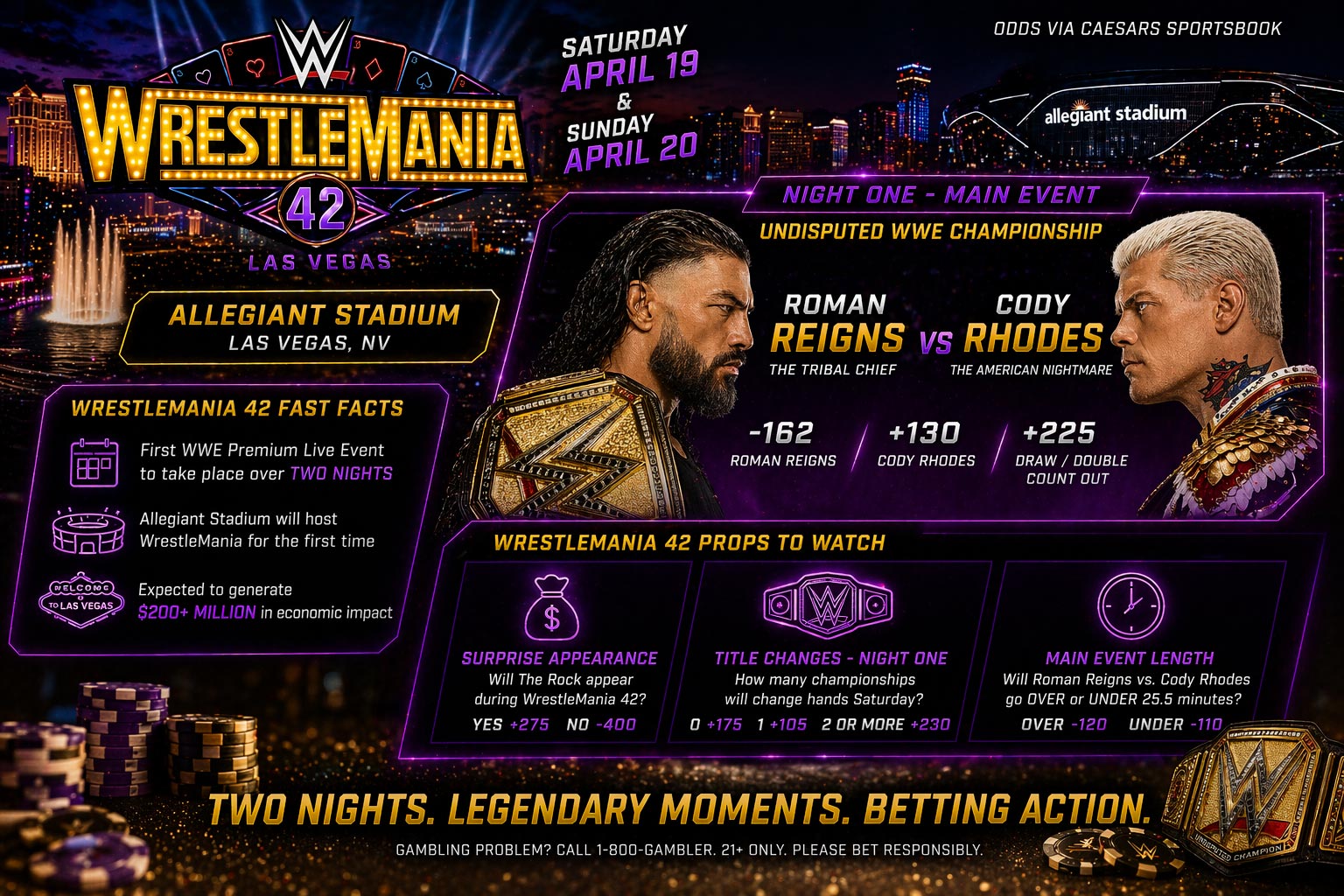
The House of Mouse just turned Vegas into the house of madness. WrestleMania 42 kicks off tonight at Allegiant Stadium, and for the first time in history, the sportsbooks are treating WWE like it’s the Super Bowl of spandex and steel chairs. We’re talking specialized prop markets on everything from match outcomes to surprise celebrity appearances to total title changes across both nights. The books have opened Pandora’s box here, and if you know where to look, there’s actual EV hiding in the chaos of predetermined entertainment. Yeah, I said it—predetermined doesn’t mean unpredictable when you understand how WWE operates as a business.
WrestleMania 42 Props: Finding Value in Vegas Chaos
The traditional sports bettor sees WWE props and immediately thinks “this is rigged, why would I bet on this?” That’s exactly the cognitive bias that creates opportunity. Sure, the outcomes are scripted, but the scriptwriters aren’t the ones setting the lines—some 24-year-old trading desk analyst in Jersey who’s never watched an episode of Raw is doing that. The information asymmetry is insane here.
Think about it from a market efficiency perspective. NFL lines get beaten into submission by billions of dollars in handle and thousands of sharp bettors with proprietary models. WrestleMania props? The books are flying blind, setting lines based on casual fan sentiment and whatever Reddit threads their interns found. The public money is coming from two groups: die-hard WWE fans who bet with their hearts, and degenerate sports bettors who just need something to bet on in April.
The real edge comes from understanding WWE’s business incentives. They’re a publicly-traded company (well, technically owned by TKO now, but same principle). They care about ratings, merchandise sales, and building to the next major event. That means certain outcomes are telegraphed weeks in advance if you’re paying attention to the right signals. When Roman Reigns starts showing up on every promotional video and his merch gets a refresh on WWE Shop, that’s not an accident—that’s your thesis.
Why the Books Are Sweating More Than Roman Reigns
Let’s talk about why Vegas is actually nervous about this weekend. The total handle on WrestleMania props is projected to hit $50M+ across regulated markets, which sounds like peanuts compared to March Madness—until you realize the books have zero historical data to price these markets efficiently. They’re essentially running a startup with no product-market fit testing.
The risk management here is a nightmare for sportsbooks. In traditional sports, they can hedge their exposure through professional betting syndicates and adjust lines based on sharp money. With WWE? There’s no sharp money ecosystem, no injury reports, no weather conditions. Just a bunch of extremely online wrestling fans who might know something the books don’t. The asymmetric information risk is all on the house.
Here’s where it gets spicy: the books are terrified of insider information. WWE employs hundreds of people who know the finishes in advance. Sure, they sign NDAs, but you think some production assistant isn’t texting his boys in the group chat when he finds out Cody Rhodes is winning the belt? The books can’t move lines based on sharp action because they can’t distinguish between “sharp” and “this guy’s cousin works catering at Allegiant.” It’s beautiful chaos.
The Market Psychology Play
The public is hammering the favorites in every marquee match. Why? Because casual fans bet on who they want to win, not who’s going to win. It’s the same reason why every March Madness pool is filled with people picking Duke because they recognize the name. The books know this, so they’ve juiced the favorite lines into oblivion.
Look at the title changes over/under prop sitting at 2.5. The casual money is slamming the over because “it’s WrestleMania, titles always change hands!” That’s recency bias meeting availability heuristic. Yes, WrestleMania historically features big moments, but WWE also knows they need to save some title changes for their Saudi Arabia shows (that’s where the real money is, follow the incentives).
The contrarian play here is finding the undervalued underdogs in matches where the favorite has too much juice. If you’re laying -400 on a predetermined outcome, you’re not finding value—you’re just lighting money on fire with extra steps. The math doesn’t math unless your win probability is north of 80%, and nothing in WWE is that certain.
The Surprise Appearance Trap
Every book in New Jersey and Ontario is offering props on surprise celebrity appearances. The Rock? Dwayne’s already on the card, so that’s not a surprise. John Cena? He’s been teasing retirement for two years. The books are baiting you into parlaying these “lock” appearances at -200 odds, effectively creating a vig sandwich.
Here’s the thing about WWE surprises: they’re only surprising if you’re not paying attention. WWE has to coordinate with celebrity agents, clear appearances with other studios, and handle travel logistics. That leaves a paper trail. When Logan Paul’s podcast suddenly goes on hiatus the week of WrestleMania, that’s not a coincidence—that’s your signal. The market hasn’t priced in basic investigative work.
The real value is in the “No Surprise Appearance” props that some books are offering at plus-money. WWE has learned from past WrestleManias that jamming too many celebrity spots into the show kills pacing and pisses off the hardcore fans. They’re running a tighter ship now. If you can find +150 on “No Unannounced Celebrity Appearance,” that’s actually got positive expected value when you model it out.
The Data Edge Nobody’s Using
WWE’s YouTube analytics are public. You can see which wrestlers are driving the most views, which storylines are getting engagement, and which merch is trending. This is literally free market research that tells you who WWE is pushing. When a wrestler’s highlight packages start getting promoted heavily three weeks before Mania, that’s the company telling you they’re invested in that character’s trajectory.
Social media sentiment analysis is another underutilized tool. Not the vibes-based “everyone’s tweeting about this” stuff, but actual data scraping on engagement rates and follower growth. WWE makes booking decisions based partly on social media metrics because that’s what their sponsors care about. If a heel turn is getting 3x the normal engagement, that character is staying heel longer than the betting markets expect.
The injury replacement market is where the real chaos lives. WWE wrestlers work hurt all the time, but occasionally someone can’t go and they need to pivot. If you’re monitoring talent wellness reports (yes, these leak) and betting live during the show, you can catch line movements before the general public realizes what’s happening. It’s basically insider trading but legal and for fake fighting.
Where the Sharp Money Is Going
The actual sharp bettors (all twelve of them who take WWE seriously) are focused on total match time props. These are easier to predict because WWE has strict TV timing requirements and you can analyze historical WrestleMania pacing. The main event always gets 25-30 minutes. The opener usually goes 15-20. There’s your baseline.
Match result parlays are sucker bets unless you’re getting massive plus-money. The correlation between outcomes isn’t random like in real sports—WWE books the entire show as a narrative arc. If you’re parlaying four favorites, you’re essentially betting that WWE runs the most predictable, boring show possible. That’s not how they operate at their biggest event.
The live betting opportunities are where the real money gets made. Once the show starts, you can gauge crowd reactions and adjust accordingly. If a face is getting booed, WWE might audible the finish (yes, this happens). If a match is running long, you can bet the under on remaining match times because they’ll need to make up time. It’s not about predicting the script—it’s about predicting how WWE adapts in real-time.
Risk Management for the Degen
Position sizing matters even more with WWE props because the variance is unknowable. You can’t calculate standard deviations on scripted outcomes. My framework: never bet more than 2% of your bankroll on any single WWE prop, and cap your total WrestleMania exposure at 10%. This isn’t the NFL where we have decades of data—this is venture capital betting.
Diversification across books is crucial. DraftKings might have -150 on a Cody Rhodes win while FanDuel has -130. That 20 cents of line value adds up, especially if you’re betting multiple props. Some of the Ontario books are particularly soft on WWE markets because they’re newer to entertainment betting. Shop around like you’re buying a used car.
The hedge strategy: if you’re deep on a two-night outcome prop (like total title changes), consider live hedging after Night One. If three titles change on Saturday, you can hedge your over/under position Sunday morning when the lines adjust. It’s not sexy, but it’s effective risk mitigation when you’re betting on something with this much uncertainty.
WrestleMania props are either the dumbest thing you’ll bet on this year or a masterclass in finding market inefficiencies—depends on whether you’re doing the work. The books are operating with one hand tied behind their backs here, pricing markets they don’t understand for an audience they can’t profile. That creates gaps. That creates opportunity. Just remember: betting on predetermined outcomes isn’t about predicting the future, it’s about understanding the incentives of the people writing that future. WWE is a business first and entertainment second. Follow the money, not the storylines. Now if you’ll excuse me, I’ve got some +200 “No Surprise Appearance” action to lock in before the sharp money (all three of them) catches on. What’s your spiciest WrestleMania prop play? Drop it in the comments—unless you’re scared the books are reading this.
WannaBet.com may receive compensation from the sportsbooks mentioned in this post if you sign up using our links. This doesn’t cost you a dime, but it keeps the lights on. Please bet responsibly. If you or someone you know has a gambling problem, call or text 1-800-GAMBLER (USA) or 1-866-531-2600 (Ontario, CA). 21+ only.
