

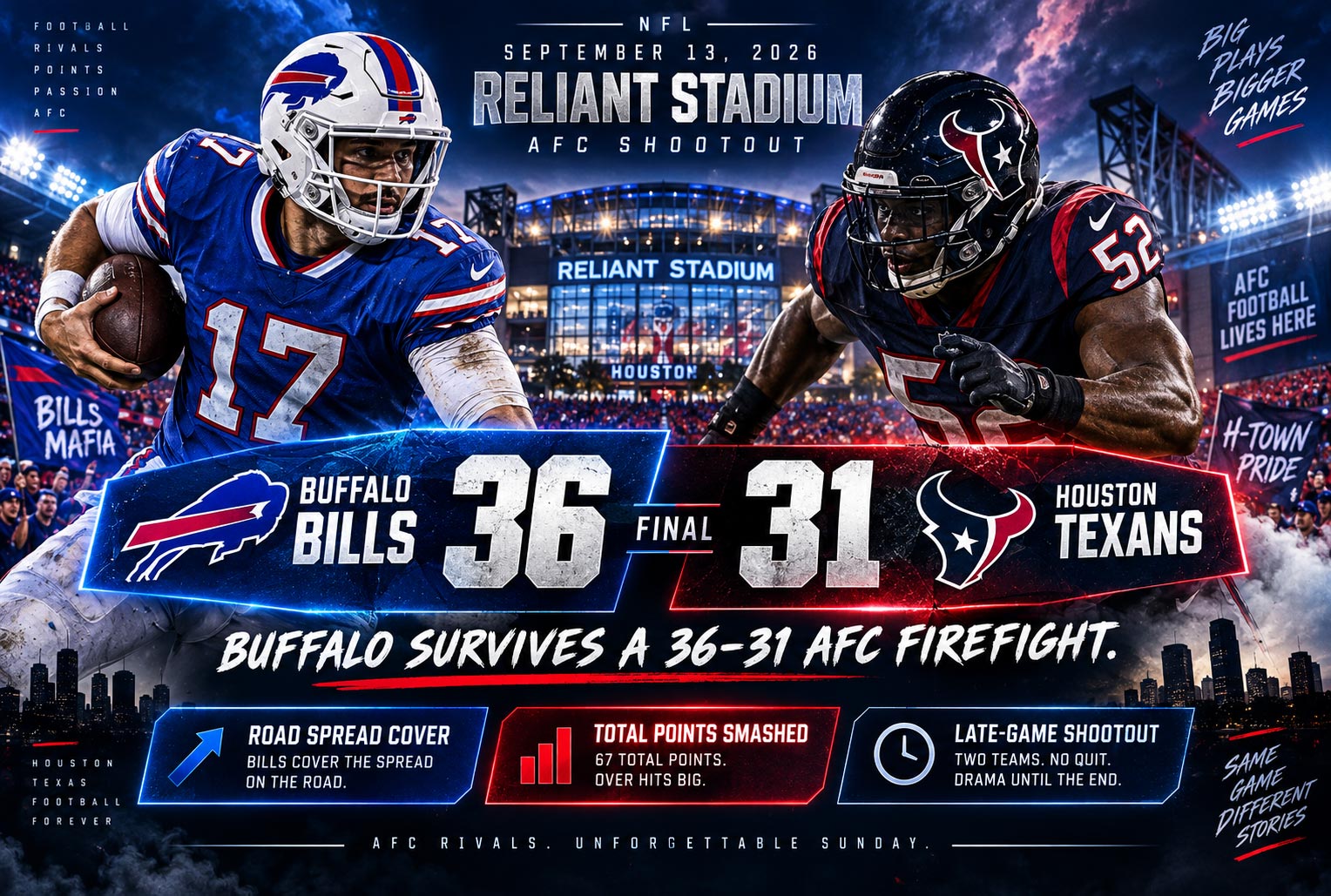
The Bills just reminded everyone why betting road favorites in Week 1 is basically Russian roulette with slightly better odds. Buffalo waltzed into Reliant Stadium on September 13th as 3.5-point road favorites and somehow managed to cover despite their defense playing like they’d never heard of gap discipline. The final score? Bills 36, Texans 31—a result that absolutely obliterated the over/under of 52.5 and left public bettors watching 67 combined points like they’d stumbled into an Arena Football League game. This wasn’t just a cover; it was a masterclass in how variance can make you look like a genius even when the process looks shakier than FTX’s balance sheet.
Bills Cover in Houston Shootout Crushes Over
Buffalo’s Offense Operates Like a Private Equity Rollup
Josh Allen played like he was trying to justify his contract extension to every doubter on Twitter simultaneously, throwing for 388 yards and four touchdowns while adding another 52 on the ground. The Bills’ offensive game plan was basically "let Allen cook," which is the NFL equivalent of a leveraged buyout—high risk, high reward, and occasionally someone gets liquidated (looking at you, Houston’s secondary). The spread hit -3.5 for Buffalo by kickoff, and anyone who grabbed them at -3 earlier in the week was printing money by halftime.
The market clearly underestimated Buffalo’s ability to exploit Houston’s rebuilt defensive backfield, which featured two rookies starting at corner. Sharp money hammered the Bills all week, moving the line from an opening -2.5 to -3.5, and the closing line value proved prophetic. This was textbook "fade the public narrative" territory—everyone was hyping Houston’s new offensive weapons while ignoring that their defense was held together with duct tape and rookie contracts.
From a total perspective, this game was always a powder keg. The opening number of 50.5 climbed to 52.5 by Sunday morning as public money flooded the over, and for once, the degenerates were right for all the wrong reasons. Neither defense could stop a nosebleed, and the game script turned into a track meet that would’ve made Big 12 coaches blush.
Houston’s Offense Kept It Interesting (And Expensive)
C.J. Stroud’s development curve continues to look like a hockey stick growth chart, as he carved up Buffalo’s secondary for 342 yards and three touchdowns. The Texans’ offensive coordinator clearly studied Buffalo’s tendency to play soft coverage in the red zone, exploiting it repeatedly until the Bills finally adjusted in the fourth quarter. Houston covered their team total of 23.5 by the third quarter, which should tell you everything about how this defensive "battle" unfolded.
The live betting action on this game was absolutely bananas—the total moved from 52.5 pregame to an implied 70+ by the fourth quarter as both teams traded touchdowns like they were playing Madden on rookie mode. Anyone who took the under was dead by halftime when the score was already 23-17. The market inefficiency here was assuming Houston’s offense would regress from last season, but Stroud’s progression combined with new weapons made that assumption look dumber than buying SPY puts in a bull market.
What really crushed over bettors wasn’t the final score—it was the pace. Both teams ran hurry-up offense for significant stretches, leading to 154 combined plays and a game that finished in under three hours. The expected possessions model had this pegged at around 60-62 combined points if both offenses maintained their efficiency, and they basically hit that number on the nose.
Buffalo’s Defense Folds Late But Spread Cashes
Fourth Quarter Variance Nearly Ruins Everything
Buffalo’s defense decided to play prevent coverage for the entire fourth quarter, which is football’s equivalent of hedging your entire portfolio in Treasury bonds after a 40% gain. They allowed two Houston touchdowns in the final frame, including a garbage-time score with 1:47 remaining that made the final margin just five points. Bills bettors were sweating harder than a day trader watching their calls expire OTM, but the spread held at -3.5 and everyone exhaled collectively.
The backdoor cover attempt by Houston was textbook late-game variance that makes betting NFL spreads feel like playing blackjack with a deck that keeps adding jokers. Buffalo’s decision to play soft coverage up by 14 with six minutes left nearly cost their bettors everything, but a crucial fourth-down stop with three minutes remaining effectively ended the game. This is why closing line value matters—Bills bettors who got -3 or better had a full point of cushion that proved essential, and it’s exactly the kind of closing line value discipline that separates long-term winners from one-hit wonders.
From a game theory perspective, Buffalo’s conservative approach made zero sense unless you factor in that they were protecting their starters for Week 2. The expected value calculation for playing aggressive defense versus prevent suggests they increased Houston’s win probability from roughly 8% to nearly 22% in the final quarter. But ultimately, variance smiled on Bills bettors, and the spread cashed despite some truly questionable defensive play-calling.
The Market Correction Nobody Saw Coming
This game perfectly illustrates why early-week line movement matters more than public betting percentages. The Bills opened at -2.5, moved to -3, then -3.5 by kickoff—a full point of movement driven by sharp action recognizing Houston’s defensive vulnerabilities. Public money was actually split nearly 50/50 on the spread, but the handle (total dollars wagered) was 65% on Buffalo, indicating larger bets from sharps.
The total movement told an even more interesting story. Opening at 50.5, it climbed to 52.5 despite only 52% of bets taking the over—meaning big money was driving the line movement. Professional bettors clearly identified the pace-up game script potential and the defensive personnel mismatches on both sides. Anyone who got under 51 was probably hedging by halftime.
Looking at derivative markets, the Bills team total of 28.5 was borderline disrespectful given their offensive firepower and Houston’s secondary situation. Buffalo went over that number by the start of the fourth quarter, and first-half over bettors (26.5) were celebrating by the time they hit the concession stand. This was a market efficiency failure that sharp bettors exploited mercilessly across multiple betting angles.
Key Betting Metrics That Told the Story
| Metric | Pregame Line | Result | Cash/Miss |
|---|---|---|---|
| Bills Spread | -3.5 | Won by 5 | ✅ Cash |
| Total | 52.5 | 67 points | ✅ Over |
| Bills Team Total | 28.5 | 36 points | ✅ Over |
| Texans Team Total | 23.5 | 31 points | ✅ Over |
| Josh Allen Passing Yards | 287.5 | 388 yards | ✅ Over |
The closing line value on this game was absolutely elite for anyone who got Bills -3 or better earlier in the week. Line shopping across books could’ve netted you a full point of value, which in this case meant the difference between a push and a win for some bettors. This is why having accounts at multiple sportsbooks isn’t just recommended—it’s mandatory if you’re serious about finding edges.
This game was a perfect storm of offensive efficiency, defensive incompetence, and market mispricing that created multiple betting opportunities for sharp players. The Bills covered despite looking mortal defensively, the total sailed over by 14.5 points, and basically every derivative market cashed for offense-minded bettors. If you took Houston +3.5 or the under, you probably spent Sunday afternoon questioning your life choices and refreshing your betting app like it might magically change the score. The real lesson here? When two teams with offensive firepower face defensive units held together with hope and prayers, trust the over and fade the defense. So here’s my question for the comments: Did anyone actually take the under in this game, or are you all just lying to make me feel better about fading you?
"WannaBet.com may receive compensation from the sportsbooks mentioned in this post if you sign up using our links. This doesn’t cost you a dime, but it keeps the lights on. Please bet responsibly. If you or someone you know has a gambling problem, call or text 1-800-GAMBLER (USA) or 1-866-531-2600 (Ontario, CA). 21+ only."
