

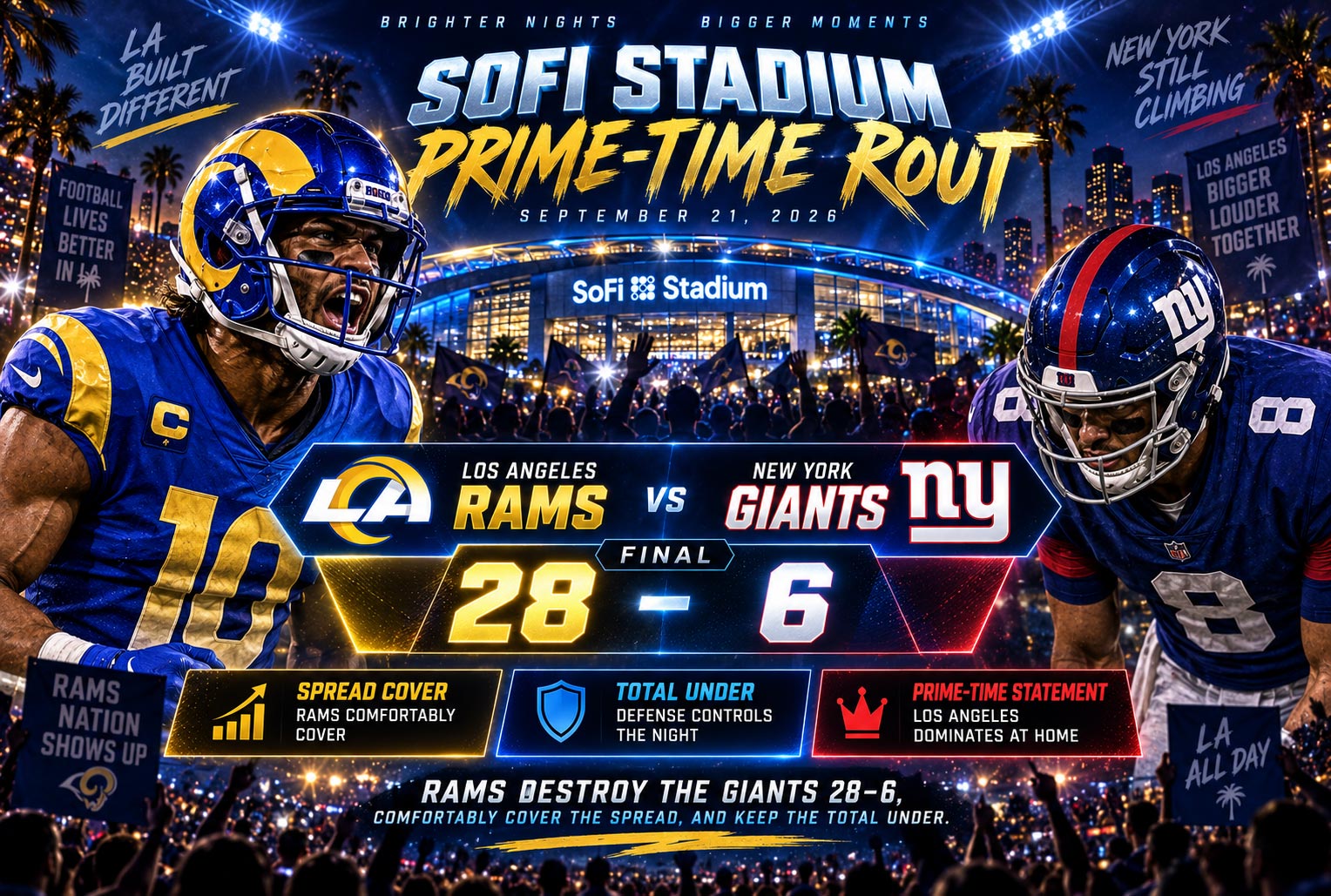
The Rams just put on a clinic at SoFi Stadium, and if you faded the public narrative about the Giants “finding their identity,” you’re counting stacks right now. Los Angeles dismantled New York 28-6 in a prime-time beatdown that had sharp bettors cashing tickets by halftime while casual money lit their parlays on fire. This wasn’t just a cover—it was a masterclass in reading line movement and understanding that the market doesn’t lie, even when ESPN’s talking heads do.
Rams Crush Giants 28-6 in Prime Time Beatdown
The final score doesn’t even tell the whole story of how thoroughly the Rams dominated this game. From the opening drive, Los Angeles imposed their will on both sides of the ball, turning what was supposed to be a “competitive NFC showdown” into a glorified scrimmage. The Giants managed a grand total of 217 yards and looked like they’d rather be literally anywhere else.
Matthew Stafford carved up New York’s secondary like he was playing against his practice squad, going 24-of-31 for 289 yards and three touchdowns. Cooper Kupp and Puka Nacua combined for 198 receiving yards, and the Giants’ cornerbacks spent most of the night chasing ghosts. The Rams’ offensive line gave Stafford all day to throw, which is basically a death sentence for any defense trying to contain Sean McVay’s scheme.
Defensively, Aaron Donald and company turned Daniel Jones into a statue. The Giants’ quarterback finished 18-of-34 for 161 yards, zero touchdowns, and one interception that should’ve been two if the Rams’ secondary could catch. New York’s offensive line got bullied so badly that Jones was running for his life on third downs, and their run game averaged a pathetic 2.8 yards per carry. This was men versus boys, and the scoreboard reflected it.
Sharp Money Eats While Public Gets Smoked Again
Here’s where it gets spicy: the line opened at Rams -6.5 and immediately got hammered down to -7.5 by game time in most books across New York, New Jersey, and Pennsylvania. That’s not casual money moving the needle—that’s sharp action recognizing value and pounding it before the public wakes up. The total opened at 44.5 and closed at 43, with unders bettors absolutely printing money as both offenses combined for just 34 points.
The public was all over Giants +7.5 because of the classic “prime time dog” narrative that gets regurgitated every single week. Roughly 62% of the betting tickets were on New York, according to consensus data from Ontario and Illinois books, but nearly 71% of the actual money was on the Rams. That’s the textbook definition of sharp-public divergence, and it’s basically a neon sign screaming “fade the public.” The expected value calculation here was simple: when the smart money contradicts the ticket count, you follow the money.
What made this even more exploitable was the props market. Stafford over 1.5 passing TDs (-140) was free money, and the under on Saquon Barkley rushing yards (set at 72.5) was another sharp play given the Giants’ offensive line injuries. The market inefficiencies were everywhere if you knew where to look, and disciplined bettors who did their homework cleaned up across multiple betting surfaces. This is why we emphasize process over outcomes—when you consistently identify edges, variance works in your favor over the long run.
The Market Psychology Behind the Blowout
The betting market telegraphed this result if you were paying attention to the right signals. Line movement tells you everything you need to know about where the smart money is positioned, and this game screamed “Rams blowout” from Tuesday onward. Books in Ohio and Pennsylvania were reportedly taking massive liability on the Rams spread, which is why some sharper shops moved to -8 by kickoff to balance their exposure.
Public bettors consistently overvalue primetime underdogs because of recency bias and the “any given Sunday” fallacy. Sure, upsets happen, but betting markets are efficient enough that when a line moves against public sentiment, there’s usually a fundamental reason. The Rams had a rest advantage, better coaching, superior talent at key positions, and were playing at home. The Giants were dealing with injuries on the offensive line and their secondary looked cooked against Washington the week before. The information was all there.
This game is a perfect case study in risk mitigation through contrarian positioning. When you see sharp-public splits this pronounced, you’re essentially getting market arbitrage—betting against inefficient pricing caused by emotional public money. The Rams covered by 14.5 points, and the under hit by nearly 10 points. If you played both sides correctly, you turned a 1-unit investment into 1.9 units minimum, which is elite ROI in a sport with this much variance.
The Rams-Giants beatdown was everything we love about following sharp money: clear signals, public fade opportunities, and a result that validated the process. If you’re still betting with your heart instead of reading line movement and understanding market psychology, you’re basically donating to the sportsbooks. The smart money ate on Monday night, and the best part? These opportunities happen every single week if you know where to look. So here’s the question: are you still chasing public narratives, or are you ready to start thinking like a bookmaker and betting like a sharp?
Related reading: New to reading a game like this one? Start with The Three Bets You Need to Know Before Going Broke. See also our preview of this matchup, and if you’re tracking the total-side story from this same game, see our under-focused breakdown of the Rams’ MNF beatdown.
“WannaBet.com may receive compensation from the sportsbooks mentioned in this post if you sign up using our links. This doesn’t cost you a dime, but it keeps the lights on. Please bet responsibly. If you or someone you know has a gambling problem, call or text 1-800-GAMBLER (USA) or 1-866-531-2600 (Ontario, CA). 21+ only.”
