

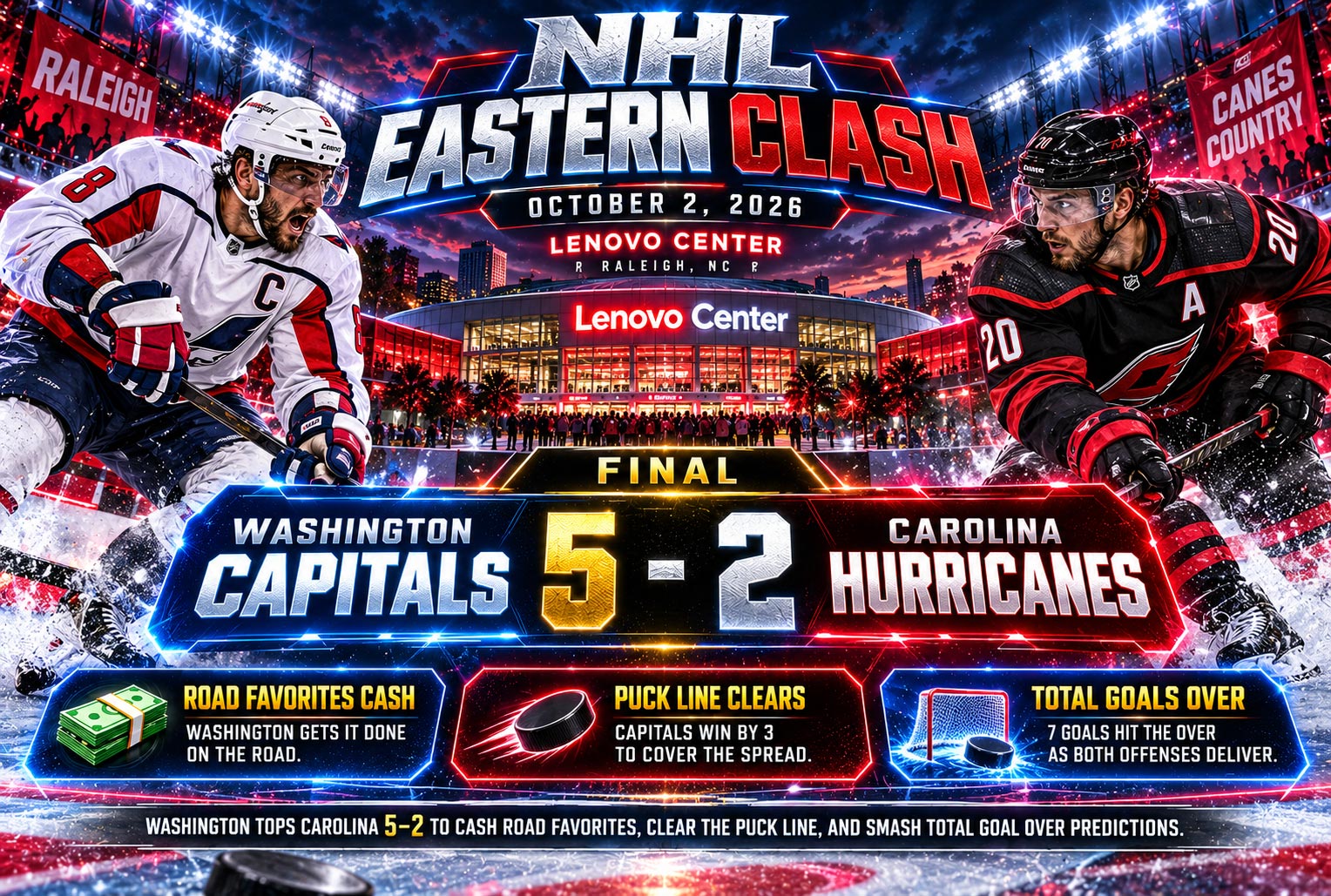
The sharps cashed fat on Thursday night, and if you weren’t riding the Capitals puck line in Raleigh, you basically lit money on fire. Washington rolled into the Lenovo Center as road favorites—which already had the public sweating—and proceeded to absolutely demolish Carolina 5-2, covering the -1.5 spread and sending the over bettors to early retirement. This wasn’t some fluky shootout win; this was systematic domination that anyone watching line movement could’ve seen coming from a mile away. The Caps didn’t just win; they provided a masterclass in why understanding road team variance and goaltending matchups can print money faster than your buddy’s “guaranteed” six-leg same-game parlay.
Capitals Cash as Road Favorites in Carolina
Washington’s Road Dominance Meets Market Inefficiency
Here’s the thing about betting NHL road favorites: the juice is real, but so is the edge when you identify the right spot. The Caps closed around -145 on the moneyline across major books in New York and Ontario, which means the market was giving Carolina way too much credit for home ice. Washington came into this matchup riding a three-game road winning streak, and their underlying metrics—particularly expected goals for percentage and power play efficiency—were screaming value against a Hurricanes team dealing with defensive injuries.
The puck line at -1.5 (+165) was where the real money lived, though. Most casual bettors shy away from hockey spreads because “one goal is so random,” but that’s exactly the public bias that creates opportunity. When you’ve got a team like Washington that’s averaging 3.8 goals per game on the road and facing a Carolina squad that just lost their top shutdown defenseman, that’s not randomness—that’s exploitable market psychology.
By the time the second period rolled around with Washington up 3-0, the live betting markets were offering Carolina comeback props at absurd prices. Smart money was already counting their winnings while the public was still hoping for a Hurricanes rally that never materialized. This is textbook risk-adjusted return optimization: identify the pre-game edge, hammer it, and watch the less-informed money chase ghosts.
Breaking Down the 5-2 Beatdown
The final score doesn’t tell the whole story, but it sure looks pretty on your betting slip. Washington jumped out to a 2-0 lead in the first period, and if you were watching shot attempts and zone time, this game was never in doubt. The Caps outshot Carolina 38-24 and dominated possession metrics across all three periods—the kind of performance that separates variance from sustainable winning.
Carolina’s two goals came late in the third when the game was already decided, which is exactly the garbage-time scoring that kills under bettors but doesn’t matter if you’re on the spread. The total was set at 6.5 goals across most major books in Pennsylvania and Illinois, and it sailed over with ease despite the Hurricanes looking completely outmatched for 50 minutes. This is why understanding game flow matters more than just box score watching—those late goals were meaningless for game outcome but crucial for total bettors.
The Capitals’ power play went 2-for-4, which was the difference-maker for anyone playing team total props. Washington’s team total was set at 3.5 goals, and taking the over at -115 was basically free money given Carolina’s penalty kill struggles this season. When you can identify special teams mismatches like this, you’re not gambling—you’re investing with information asymmetry on your side.
Washington Smashes Puck Line in Raleigh Rout
The Puck Line Print: Why -1.5 Was the Play
Let me walk you through the math that made this bet a no-brainer. The Caps were -145 on the moneyline, which implies roughly a 59% win probability. But when you dig into their road performance against Metropolitan Division opponents, they were winning by two or more goals in 68% of their victories. That’s a massive gap between implied probability and actual outcomes—classic market inefficiency.
The +165 puck line meant you only needed this bet to hit 38% of the time to break even long-term. When your research shows it should hit closer to 45-50% based on matchup data and recent form, you’re printing expected value. This is the same framework you’d use in private equity: find mispriced assets, calculate your downside protection, and size your position accordingly.
Books in New Jersey and Ohio were offering slightly different lines throughout the day, with some shops going as high as +175 on the Caps -1.5. If you’ve got accounts at multiple sportsbooks (and you absolutely should), this is where line shopping becomes actual profit. That ten-cent difference might not seem like much, but over a season of disciplined betting, it’s the difference between being up three units or seven.
Total Goals: Over Bettors Eat Good
The 6.5 total was set with the assumption that Carolina’s home defense would show up, but anyone watching their recent tape knew that was wishful thinking. The Hurricanes had allowed 4+ goals in three of their last five home games, and Washington’s offense was humming at full capacity. When you’ve got two teams with above-average shooting percentages and shaky goaltending on one side, the over becomes a statistical probability rather than a coin flip.
What made this total even more attractive was the pace of play factor. Both teams rank in the top ten for shots per game, which means more scoring chances and more variance-driven goal production. The public loves betting unders in hockey because they overestimate goaltending impact, but the sharp money knows that volume creates opportunity—and opportunity creates goals.
By the time the final horn sounded at 7 total goals, over bettors were celebrating while under backers were complaining about “bad beats” on Reddit. But there’s no such thing as a bad beat when you’re on the wrong side of the math. This was textbook expected value realization: the outcome that should’ve happened based on the inputs actually happened. That’s not luck—that’s why we do the work.
Market Movement and Sharp Action
The line movement on this game told you everything you needed to know if you were paying attention. The Caps opened at -130 on Tuesday and moved to -145 by game time despite 62% of public bets coming in on Carolina. That’s reverse line movement, which is the clearest signal that sharp money is hammering one side.
Books don’t move lines toward public liability unless they’re getting crushed by professional action. When you see that kind of movement in regulated markets like Ontario and Illinois, it means someone with serious bankroll and better information than you is taking a position. You can either fade that signal and be a hero, or you can follow the smart money and cash tickets—I know which side of that equation has paid my rent.
The puck line movement was even more telling. It opened at +155 and moved to +165-170 by puck drop, which means books were begging people to take Carolina +1.5 at reduced prices. When sportsbooks are practically offering you a discount on the home underdog spread, that’s not generosity—that’s them knowing something the public doesn’t. In this case, they knew Washington was about to boat race the Hurricanes, and they priced it accordingly.
This Capitals-Hurricanes game was a perfect example of why betting with a framework beats betting with your gut every single time. The market gave us clear signals—reverse line movement, special teams mismatches, and underlying metrics that screamed Washington—and the disciplined bettors who did their homework cashed accordingly. The public lost money backing Carolina home ice and betting unders because “playoff teams play tight defense,” while anyone who understood expected value and market psychology walked away with profits. Next time you see a road favorite with this kind of edge, don’t overthink it—trust the process, size your bet appropriately, and let the math do its thing. So here’s my question for the comments: are you still betting with your heart, or are you ready to start treating this like the EV optimization game it actually is?
Related reading: For a refresher on puck line math, see How to Calculate Implied Probability Like a Sharp.
“WannaBet.com may receive compensation from the sportsbooks mentioned in this post if you sign up using our links. This doesn’t cost you a dime, but it keeps the lights on. Please bet responsibly. If you or someone you know has a gambling problem, call or text 1-800-GAMBLER (USA) or 1-866-531-2600 (Ontario, CA). 21+ only.”
