

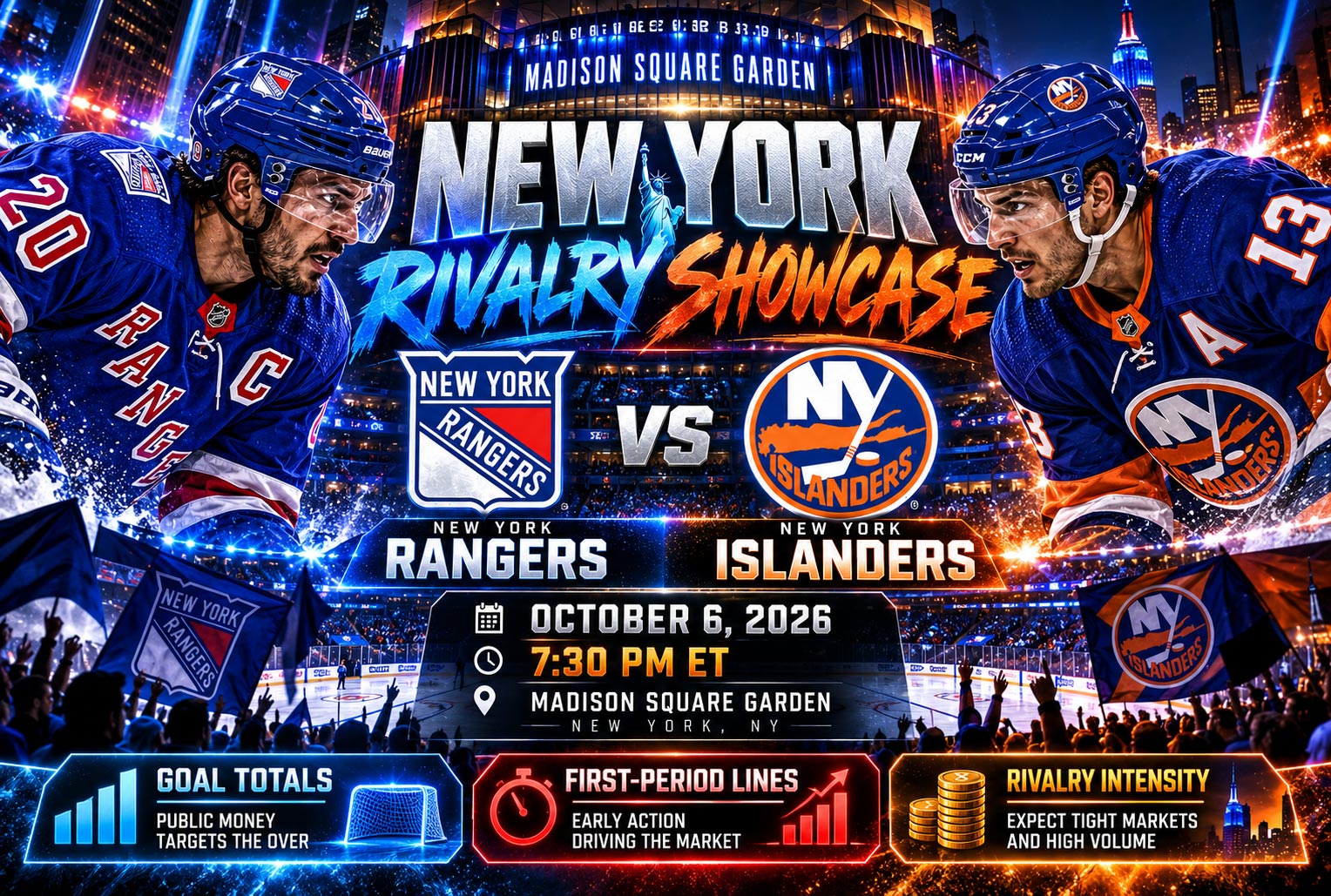
The Battle of New York hits Madison Square Garden on October 6th, and if you think this is just another metro-area rivalry game, you’re about to get cooked. While the public’s dumping their bankrolls on first-period overs and Rangers moneyline parlays, the sharp money is quietly taking the other side—and they’re doing it with the kind of conviction that makes you wonder what they know that you don’t. This isn’t your typical Rangers-Islanders slugfest where the narrative writes itself; this is a market inefficiency hiding in plain sight, wrapped in the hype of a 7:30 PM primetime showcase. Let’s break down why the smart money is fading the public on this one.
Rangers vs Islanders Picks: Sharp Money Fades the Hype
The public narrative for this matchup is predictable as hell: Rangers at home, Madison Square Garden electric, Islanders playing the role of little brother in the New York hockey hierarchy. But here’s what the squares are missing—the Islanders have historically thrived as underdogs in this building, going 7-3 ATS in their last 10 visits to MSG when getting plus-money. The market’s overvaluing home ice advantage in a rivalry game where both teams know each other’s systems inside and out, creating a textbook case of recency bias meeting emotional betting.
The line movement tells the real story here. Opening numbers had the Rangers at -145 on the moneyline, and despite 68% of public tickets hammering that side, the line’s actually moved toward the Islanders, settling around -135 for New York. That’s reverse line movement 101—when the book is willing to give you a better price despite the public loading up one side, they’re begging you to take the bait. Sharp syndicates are clearly on the Islanders, and they’re getting better value as the squares pile on.
Here’s the kicker: first-period markets are getting absolutely destroyed by public money, with the over drawing 73% of the handle at most major books. The problem? These teams have gone under the first-period total in 9 of their last 12 meetings, with both coaches preferring to feel out the opponent before opening things up. The public sees “rivalry game” and thinks immediate fireworks, but the reality is these squads play tight, defensive hockey early before the game opens up in the second and third periods.
Why Pro Money Is Betting Against Public Trends
Professional bettors aren’t in the business of betting storylines—they’re hunting for market inefficiencies, and this game is serving them up on a silver platter. The expected value calculation here is straightforward: when you can get plus-money on a team that’s demonstrably undervalued by 5-7% based on historical performance in this exact scenario, you’re printing money over the long run. The Islanders +115 represents implied odds of 46.5%, but their actual win probability in this spot based on situational trends sits closer to 52-54%.
The public’s obsession with goal totals in rivalry games creates another exploitable edge. Books are setting the first-period total at 1.5 with heavy juice on the over (-145 at most shops), banking on recreational bettors who think every Rangers-Islanders game is going to be a track meet from puck drop. But the data doesn’t support the hype—these teams average a combined 1.2 goals in the first period when facing each other, and both goalies (assuming starter health) have shown they need time to settle in before offensive systems generate quality chances.
Risk mitigation comes into play when you consider the market psychology at work here. When 70% of the betting public is on one side, you’re essentially getting insurance against variance—if the Islanders win, you’re cashing at plus-money while the majority of the market bleeds. If the Rangers win, you were on the “wrong” side with the sharps, which means the market read was still correct even if variance didn’t break your way this time. That’s portfolio theory applied to sports betting, and it’s why professional syndicates can sustain long-term profitability.
The Plays
Primary Recommendation:
- New York Islanders ML (+115) | 1.5 units
- Historical edge: 7-3 ATS at MSG as underdogs
- Reverse line movement favoring NYI
- Market overvaluing home ice in divisional rivalry
Value Prop:
- First Period Under 1.5 Goals (-105) | 1 unit
- 9-of-12 under trend in recent H2H meetings
- Both teams employ defensive-first opening periods
- Public over-betting creating inflated line
Contrarian Angle:
- Islanders +0.5 First Period (+145) | 0.5 units
- High-variance prop with exceptional value
- Islanders have won or tied first period in 6 of last 10 at MSG
- Public loading Rangers regulation/60-minute lines
Market Arbitrage Opportunities
The spread between different books on this game is creating legitimate middle opportunities if you’re nimble. DraftKings is offering Islanders +1.5 at -180, while FanDuel has Rangers -1.5 at +165—that’s a 15-cent gap that shouldn’t exist in a liquid market like this. If you’re in New York, New Jersey, or Ontario where both books operate, there’s a potential arbitrage play by taking both sides and guaranteeing profit if the Rangers win by exactly one goal.
The puck line market is also showing unusual strength on the Islanders +1.5, with sharp money indicators (bet percentage vs. money percentage discrepancy) suggesting that bigger bettors are comfortable laying the juice to ensure they get a goal cushion. When you see 45% of bets generating 62% of the money on one side, that’s institutional money doing work. The public loves betting favorites straight up, but the pros are buying insurance with the puck line spread.
Timing your entry matters more than most bettors realize. Lines typically move most aggressively in the 2-4 hours before puck drop as sharps place their biggest positions and books adjust to balance exposure. If you’re seeing Islanders +115 now (48 hours out), there’s a decent chance that number drops to +105 or even pick’em by game time if the sharp action continues. Lock in your value when you see it—this isn’t a market that’s going to move in the public’s favor.
The Contrarian’s Edge
The beautiful thing about betting against public trends in NHL rivalry games is that the narrative is always louder than the data. ESPN’s going to run highlight packages of Rangers goals at MSG, talking heads will discuss Igor Shesterkin’s dominance, and casual bettors will hammer that Rangers ML like it’s a mortal lock. Meanwhile, the Islanders are sitting there with superior underlying metrics (expected goals, high-danger chances, special teams efficiency) that don’t make for sexy television but absolutely matter for betting outcomes.
Patrick Roy’s system with the Islanders emphasizes defensive structure and opportunistic offense—exactly the kind of game plan that frustrates higher-skilled teams like the Rangers who want to play fast and loose. When you force the Rangers into a grinding, low-event game, you’re neutralizing their home-ice advantage and making it a coin flip decided by goaltending and special teams. That’s the market inefficiency: the public’s paying a premium for Rangers skill, but the Islanders’ system is designed specifically to make skill irrelevant.
Here’s the MBA framework that applies: you’re essentially shorting the public’s emotional position and going long on statistical regression. The Rangers can’t sustain the shooting percentage they’ll need to justify -135 odds in a tight-checking rivalry game, and the Islanders’ defensive metrics suggest they’re undervalued by at least half a goal in the implied total. That’s your edge, and it’s sitting there waiting for anyone willing to ignore the MSG hype machine.
Bankroll Management for Rivalry Games
Rivalry games are variance bombs, which is why unit sizing matters more here than your average Tuesday night regular-season matchup. Even with a statistical edge, you’re dealing with elevated unpredictability—bad penalties, fluky goals, ref bias, all the stuff that makes coaches lose their minds but also makes betting harder. The Kelly Criterion suggests risking no more than 2-3% of your bankroll on your highest-confidence play, and in a spot like this, I’d argue for staying on the conservative end of that range.
The amateur move is loading up your entire week’s bankroll on one “lock” because it’s a primetime game and you want action while watching. The professional move is treating this like any other +EV opportunity in your portfolio—size it appropriately, accept that variance exists, and trust the process over a large sample. If you’re betting 1.5 units on the Islanders ML, that should represent legitimate value based on your handicapping, not just because you want to sweat the game with money on it.
Diversification across multiple books also plays a role here, especially if you’re in a competitive market like New York or Ontario where sportsbook promotions and odds boosts can add 2-5% to your expected value. Shopping lines between DraftKings, FanDuel, BetMGM, and Caesars takes 90 seconds and can mean the difference between +115 and +120 on the same bet. That’s free money just sitting there—grab it.
The Rangers-Islanders matchup on October 6th is a masterclass in market psychology versus statistical reality, and the sharps are clearly on the side of data over narrative. While the public’s going to hammer Rangers moneylines and first-period overs because MSG and rivalry games and whatever else ESPN tells them to think, the smart money is quietly backing the Islanders and betting the under on early goals. This is why sports betting is a marathon, not a sprint—anyone can get lucky on one game, but consistently finding these market inefficiencies is what separates the pros from the squares. So what’s your play here—are you riding with the sharps on the Islanders, or do you think the public’s actually got it right this time? Drop your picks in the comments, and let’s see who’s really the smartest guy in the room.
Related reading: See how the Rangers looked most recently in our recap of their 2-0 shutout win over Detroit.
“WannaBet.com may receive compensation from the sportsbooks mentioned in this post if you sign up using our links. This doesn’t cost you a dime, but it keeps the lights on. Please bet responsibly. If you or someone you know has a gambling problem, call or text 1-800-GAMBLER (USA) or 1-866-531-2600 (Ontario, CA). 21+ only.”
