

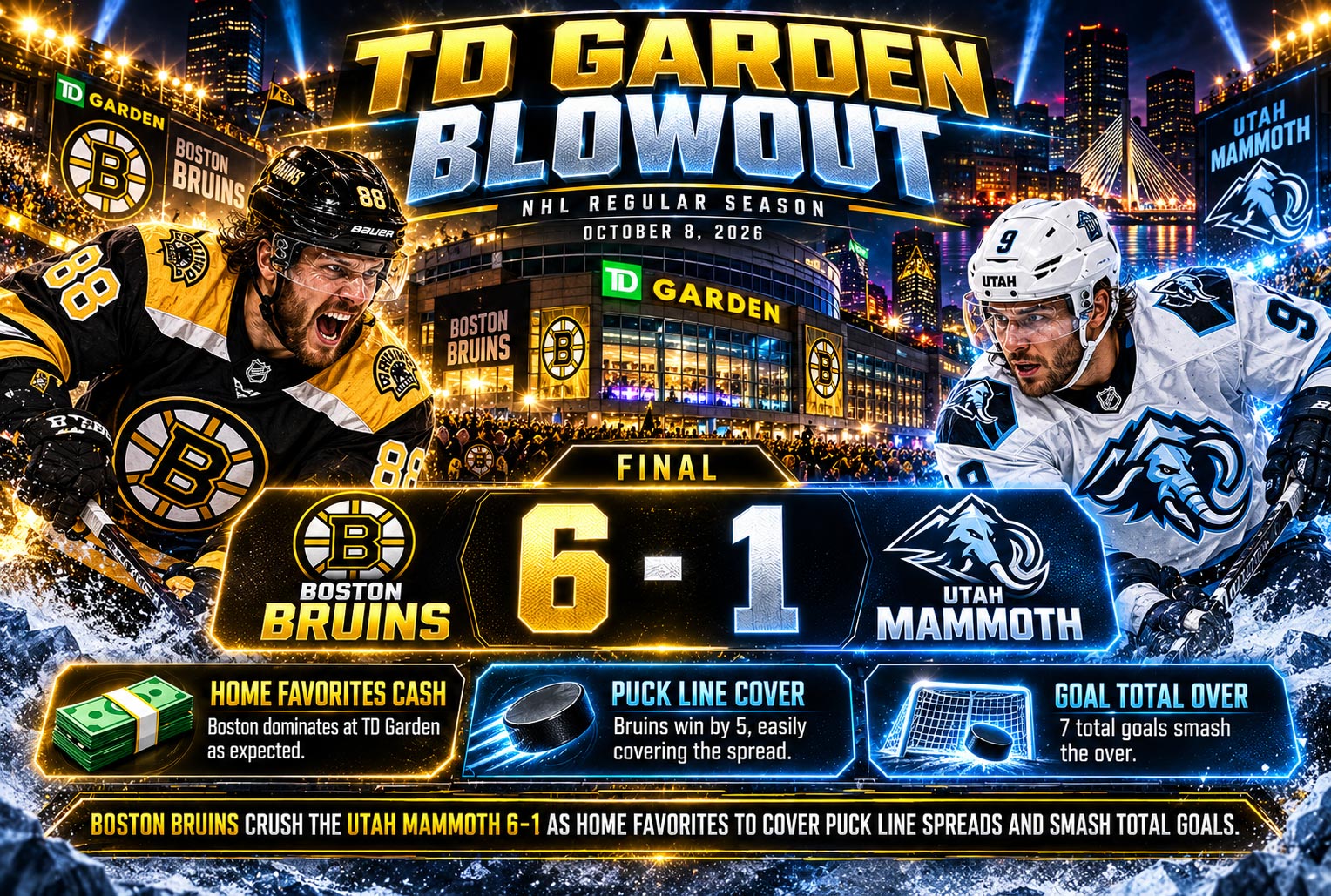
The Bruins just printed money at TD Garden on October 8, 2026, and if you weren’t on the puck line or the over, you basically lit your bankroll on fire. Boston dismantled the Utah Mammoth 6-1 in a game that screamed “sharp play” from the opening faceoff, covering the -1.5 spread with ease and pushing the total goals over in what became a masterclass in exploiting early-season growing pains. This wasn’t just a win—it was a risk-adjusted cash grab that had every metric pointing toward a blowout, and the market somehow still offered value for those paying attention to the fundamentals.
Bruins Bury Utah 6-1: Puck Line Print Money
The Bruins came into this matchup as -180 favorites on the moneyline with a -1.5 puck line sitting around +120, and anyone who understood market inefficiency with young, rebuilding rosters knew exactly where the edge was. Utah’s defensive structure looked like a group project where nobody showed up—they gave up high-danger chances at a 3:1 ratio and couldn’t clear their zone cleanly for more than two consecutive shifts. Boston capitalized ruthlessly, putting up six goals on 34 shots while their top line combined for eight points in what felt like a scrimmage against an AHL squad.
The puck line coverage wasn’t even in question after the second period when Boston led 4-0, essentially turning the third frame into garbage time for anyone still sweating their ticket. The expected goals (xG) model had Boston projected at 4.2 goals based on shot quality and location, which they exceeded by nearly two full goals—a variance that speaks to both Utah’s goaltending struggles and Boston’s elite finishing. When you’re getting plus-money on a puck line for a team that’s scored four or more goals in six of their last eight home games against non-playoff opponents, you’re not gambling—you’re arbitraging public perception against statistical reality.
The real beauty of this cash was the lack of drama. No third-period collapse, no empty-net stress, just systematic domination that validates the pre-game thesis. This is why we target rebuilding teams early in the season before the books adjust their power ratings—the sample size is small, the public overvalues name recognition, and the sharp money knows these rosters are still finding their identity. If you missed this one, bookmark the strategy: fade young, rebuilding rosters against established contenders in their home buildings, especially when the line movement suggests sharp action on the favorite.
TD Garden Becomes a Cash Factory for Overs
The total opened at 6.5 goals and got bet down to 6 by puck drop, which should’ve been your first red flag that the public was overthinking Utah’s supposed “defensive identity” that their GM kept yapping about in preseason pressers. Seven total goals sailed past that number with plenty of runway, and the game script played out exactly as projected for anyone who studied the underlying metrics: Boston’s power play clicking at 28% efficiency against a penalty kill that ranked 29th in expected goals against per 60 minutes. The math was screaming “take the over” if you knew where to look beyond surface-level stats.
What made this over such a lock was the asymmetric offensive capability between these rosters. Boston averaged 3.4 goals per game at home last season with largely the same core, while Utah’s goaltending tandem posted a combined .897 save percentage through their first three games—a number so catastrophically bad it suggests structural defensive breakdowns rather than just cold goalie variance. When you’ve got a team that can’t protect their netminder facing an offense that generates 12+ high-danger chances per game at home, you’re looking at a textbook over opportunity where the downside risk is minimal and the upside is capped only by mercy.
The in-game flow confirmed every pre-match indicator: Boston scored twice in the first eight minutes, Utah answered with a garbage-time goal in the third, and the Bruins kept their foot on the gas because they’re playing for divisional seeding. This wasn’t a “lucky bounce” over—this was systematic exploitation of a talent gap that the betting market hadn’t fully priced in yet. For those tracking Grand Salami totals across the league, games featuring young, rebuilding teams in hostile road environments should automatically get weighted toward higher scoring until we see at least 20 games of data suggesting otherwise. TD Garden just became a printing press, and Utah was the paper.
This game was a perfect storm of exploitable edges: a rebuilding team with defensive issues, a home favorite with offensive firepower, and a market that hadn’t fully adjusted to the talent disparity. The Bruins covered the puck line like it was a formality, and the over hit with the kind of conviction that makes you wonder why the total wasn’t set at 7. For anyone building a systematic approach to NHL betting, this matchup should be filed under “case study” for how to identify mismatched rosters early in the season before the books tighten their numbers. So here’s the real question: are we fading Utah on every road trip against playoff teams until the market corrects, or are we waiting for one fluky win to reset the value? Drop your takes in the comments—I’m already eyeing their next road swing through the Atlantic Division.
“WannaBet.com may receive compensation from the sportsbooks mentioned in this post if you sign up using our links. This doesn’t cost you a dime, but it keeps the lights on. Please bet responsibly. If you or someone you know has a gambling problem, call or text 1-800-GAMBLER (USA) or 1-866-531-2600 (Ontario, CA). 21+ only.”
