

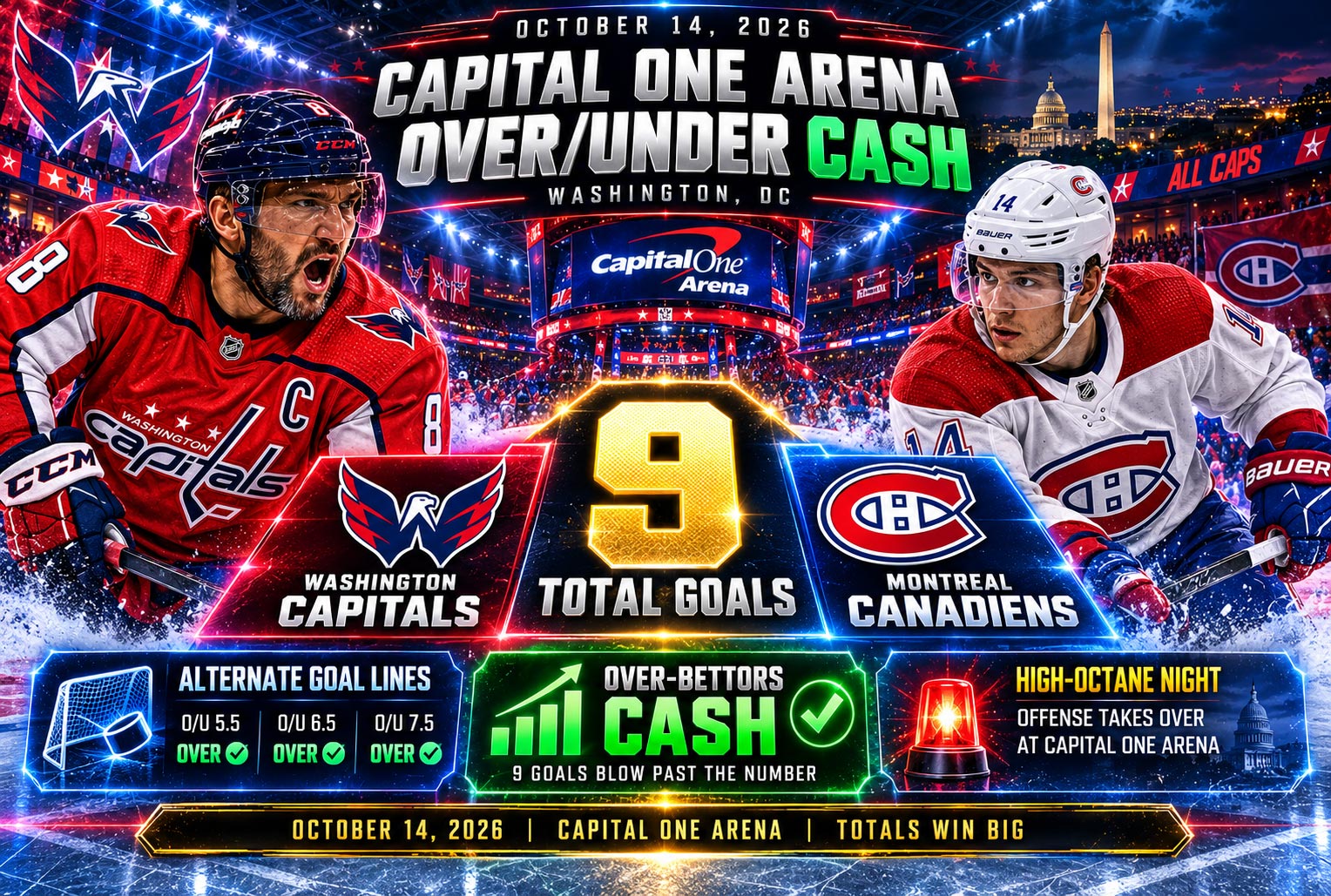
You know that feeling when you’re sitting at a bar in Arlington or scrolling through your phone in a Montreal Tim Hortons, watching your over ticket slowly come to life? That’s exactly what happened Wednesday night at Capital One Arena when the Caps and Habs decided to turn their October matchup into an absolute goal-fest. The total closed at 6.5 across most books, but anyone who got greedy and grabbed the alternate 8.5 line walked away counting their money. This wasn’t just a win for over-bettors—it was a masterclass in identifying market inefficiency when two teams with offensive firepower and questionable goaltending square off.
Caps and Habs Deliver 9-Goal Banger for Overs
The final score read 5-4 in favor of Washington, but the real winner was anyone who had the stones to fade the public’s love affair with unders in early-season NHL hockey. The Capitals came out flying, and Montreal responded like a team that remembered they actually have offensive talent. By the time the third period got going, the over was well on its way—music to the ears of anyone who understands basic expected value calculations.
What made this game especially juicy for sharp bettors was the market’s complete misread of both teams’ defensive situations. Washington’s blue line has been shakier than a freshman’s fake ID, and Montreal’s goaltending depth chart isn’t exactly inspiring confidence. The public saw two historically defensive-minded franchises and hammered the under, creating a beautiful arbitrage opportunity for anyone who did their homework on current roster construction versus legacy perceptions.
The goal-scoring came from everywhere too—power plays and even strength alike, which had the alternate total crowd absolutely losing it. This wasn’t some fluke 1-0 game that went to a shootout and technically hit the over on a technicality. This was legitimate offensive execution from both sides, exactly what the advanced metrics suggested would happen when you put these specific rosters on the ice together.
Washington-Montreal Shootout Cashes Alternate Lines
Here’s where it gets really interesting from a bankroll management perspective: the standard 6.5 total was available at -110 on both sides across Ontario’s regulated books and major U.S. markets. But the alternate 8.5? That was sitting at +195 on some books, while the 9.5 floated around +320 and fell one goal short. Anyone who allocated even 10% of their standard unit to the 8.5 walked away with serious profit, and that’s the kind of risk mitigation strategy they definitely didn’t teach you in your intro finance class.
The game script played out like a degenerate’s fever dream—neither team could hold a lead for more than five minutes, and every time it looked like the game might slow down, someone would bury another one. Both power plays chipped in, and the even-strength goals kept coming like it was an All-Star Game. This is exactly the kind of variance that makes NHL totals such a profitable market when you can identify the right spots.
What’s crucial to understand here is the market psychology at play: early-season NHL totals are often set based on last year’s data and preseason expectations rather than current roster realities. The books knew these teams could score, but they also knew the public would see “Capitals-Canadiens” and think defensive hockey. That’s your edge right there—recognizing when the market is pricing in nostalgia instead of current team construction and matchup dynamics.
The Breakdown:
- Final Score: Washington 5, Montreal 4
- Total Closed: 6.5 (-110 both sides)
- Alternate 8.5: +195 ✅
- Alternate 9.5: +320 ❌
- Power Play Goals: 3 combined
- Even Strength Goals: 6
Key Market Indicators:
- Both teams ranked bottom-10 in defensive zone exits through three games
- Combined goaltending save percentage entering the game: .891
- Public betting: 64% on the under (per consensus data)
- Sharp money: Moved total from opening 6 to 6.5 by puck drop
The Strategy Moving Forward:
Look, I’m not saying to blindly hammer overs every time two defensive-minded teams meet up. But when you see a total that’s clearly being influenced by brand recognition rather than current roster analytics, that’s when you pounce. The Capitals’ defensive metrics this season have been borderline catastrophic, and Montreal’s been allowing high-danger chances at a rate that would make a beer league goalie nervous. The market gave us a gift at 6.5, and the alternate 8.5 was basically free money for anyone paying attention.
The lesson here isn’t just about this specific game—it’s about understanding how to identify when the public is betting with their heart (or their outdated mental models) instead of their brain. Early-season NHL is full of these opportunities because the market takes weeks to properly adjust to roster changes, new systems, and actual performance data versus preseason projections. That’s where the expected value lives.
And if you’re in Ontario or one of the major U.S. markets, you’ve got the liquidity to actually get down on these alternates without moving the line. That’s the beauty of 2026 sports betting—the market’s deep enough to absorb action, but the pricing models are still playing catch-up with real-time team performance. Use that to your advantage.
Wednesday night’s Caps-Habs barn burner was a perfect example of why NHL totals remain one of the most exploitable markets in sports betting. The combination of public bias toward defensive hockey nostalgia and books slow to adjust to current roster realities created a situation where over-bettors got paid handsomely, especially those who had the conviction to grab the alternate 8.5. This is the kind of game you bookmark and reference when explaining to your buddies why you don’t just blindly follow consensus picks. So here’s the question for the comments: are you brave enough to keep riding Capitals overs until the market actually adjusts to their defensive issues, or are you waiting for more data? Because from where I’m sitting, this edge isn’t going anywhere for at least another two weeks.
“WannaBet.com may receive compensation from the sportsbooks mentioned in this post if you sign up using our links. This doesn’t cost you a dime, but it keeps the lights on. Please bet responsibly. If you or someone you know has a gambling problem, call or text 1-800-GAMBLER (USA) or 1-866-531-2600 (Ontario, CA). 21+ only.”
