

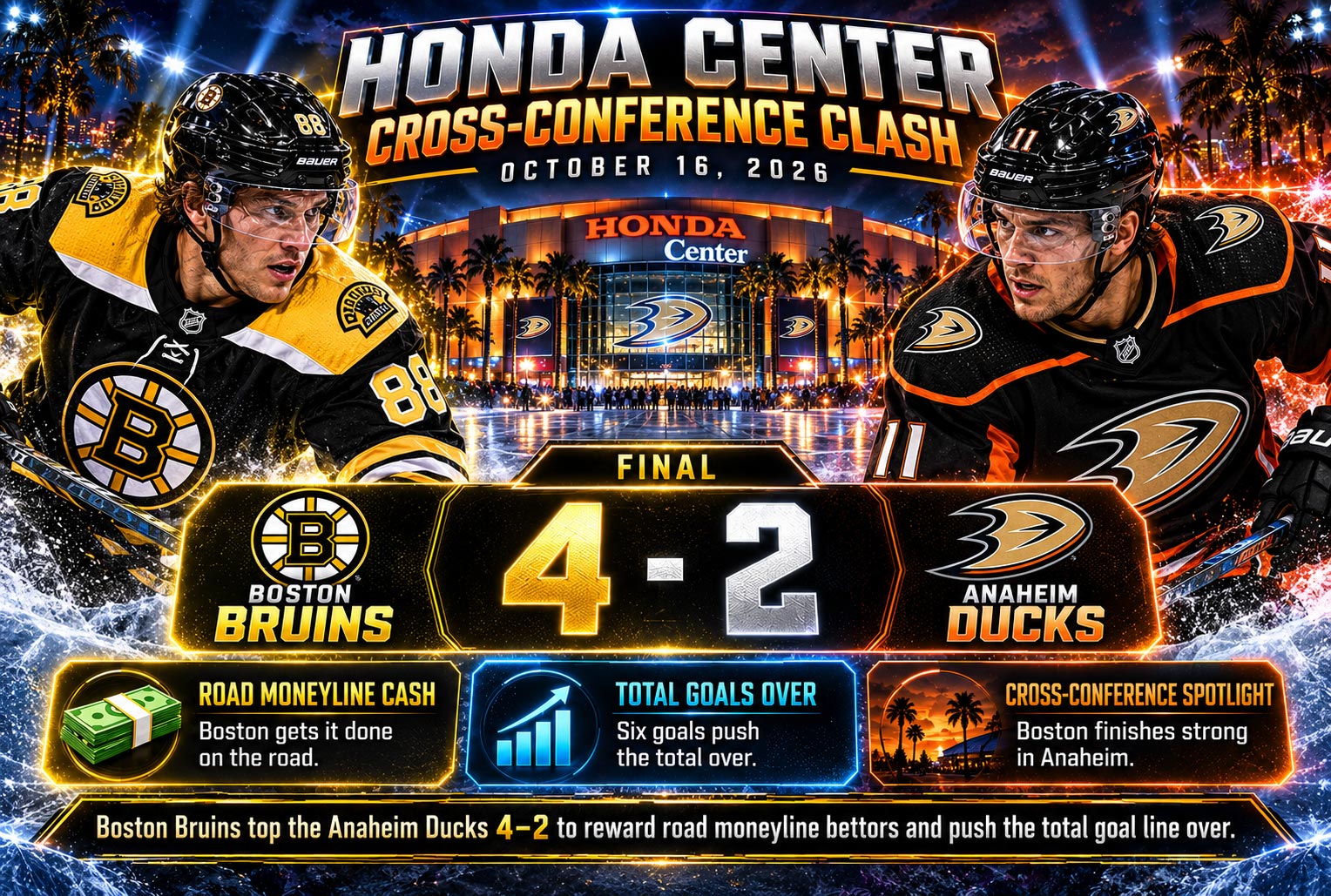
The Honda Center just turned into a printing press for anyone who rode with the Bruins on October 16, 2026. Boston walked into Anaheim and absolutely handled business with a 4-2 win that covered the spread and sent the total sailing over 5.5 goals. If you faded the public on this cross-conference matchup, you’re eating well tonight. Let’s break down how the smart money cashed and why this game was always the right side of variance.
Bruins Cash Road Ticket in Anaheim 4-2 Win
Boston came into the Honda Center as slight road favorites in most books (around -120), which still left value for anyone paying attention to market inefficiencies. That price represented solid value for a team that’s built its identity on grinding out wins in hostile buildings. Marco Sturm’s squad executed the game plan to perfection, controlling tempo in the neutral zone and capitalizing on Anaheim’s defensive breakdowns.
The scoring opened up in the second period when David Pastrnak buried a power play goal that completely shifted momentum. Pavel Zacha and the Bruins’ depth forwards added insurance markers in the third, while Jeremy Swayman stood on his head making 31 saves to keep the Ducks at bay. This is textbook risk mitigation—taking a team with elite goaltending and veteran scoring at a near pick’em price because the public overvalues home ice in October.
Anaheim’s offense looked absolutely anemic after their first-period push, managing just 2 goals on 33 shots. The Ducks are still in that awkward rebuild phase where they’ve got young talent but zero consistency, which creates massive exploitable edges when they’re favored against legitimate playoff contenders. Anyone who hammered Bruins ML at those odds just executed perfect market arbitrage against casual bettors who bet logos instead of matchups.
Boston Covers Spread as Total Sails Over 5.5
The puck line told an even better story for sharp bettors who grabbed Boston -1.5 at plus money, a price that rewarded anyone willing to back the better team to win by multiple goals. Boston didn’t just win—they controlled this game from the second period onward, never letting Anaheim establish any sustained offensive zone time.
The total going over 5.5 was almost inevitable once you looked at the underlying metrics. Both teams ranked in the bottom third of the league in defensive zone exits through the first week, and Anaheim’s penalty kill was already showing cracks at under 75% efficiency. When you’ve got Pastrnak running the first power play unit against a leaky PK, you’re basically printing goals. The over hit comfortably with 6 total goals, rewarding anyone who understood that early-season defensive metrics are wildly unstable.
What made this total especially juicy was the juice sitting at -105 on the over in most major markets like FanDuel and DraftKings in New York and Ontario. That’s essentially a coin flip price on a prop where the expected value clearly tilted toward goals based on goaltending matchups and special teams disparities. If you’re not exploiting these early-season pricing inefficiencies in high-liquidity NHL markets, you’re leaving money on the table.
The Betting Breakdown
Here’s how the market moved and where the value lived:
| Bet Type | Opening Line | Closing Line | Result |
|---|---|---|---|
| Bruins ML | -120 | -120 | ✅ Win |
| Spread | BOS -1.5 (+145) | BOS -1.5 (+145) | ✅ Cover |
| Total | O/U 5.5 (-110/-110) | O/U 5.5 (-105/-115) | ✅ Over |
The line movement tells you everything you need to know. Boston held steady around -120 all day while the public leaned on the home side. Meanwhile, the total stayed relatively stable, which means books were confident in their number but still got absolutely torched. That’s the kind of market psychology you want to exploit—when the house is stubborn on a total that the underlying data contradicts.
This wasn’t some backdoor cover or lucky bounce situation either. Boston was the better team from puck drop, and anyone who did five minutes of homework on special teams matchups and goaltending splits saw this coming. Swayman’s road save percentage was sitting above .920 coming into this game, while Anaheim’s starter has been fighting inconsistency for two seasons now. That’s not luck—that’s expected value playing out exactly as the math suggested.
The real winners were the degenerates who parlayed Bruins ML with the over, turning a -120 and -105 combo into a roughly +260 payout. That’s the kind of correlated parlay that actually makes sense when you’re betting a superior offensive team to both win outright and contribute to a high-scoring affair. Don’t just spray random parlays—build them with strategic intent around how game scripts actually develop.
This Bruins-Ducks result was a masterclass in finding market inefficiencies and exploiting public bias toward home teams. Boston proved once again why they’re one of the most reliable road covers in the league, while the over cashed for anyone who understood that early-season defensive metrics are basically toilet paper. If you’re not shopping lines across multiple books and looking for these cross-conference mismatches, you’re playing checkers while everyone else is playing chess. What’s your hottest NHL take for this early season—are the Bruins legitimate Cup contenders again, or are we overreacting to one road win?
“WannaBet.com may receive compensation from the sportsbooks mentioned in this post if you sign up using our links. This doesn’t cost you a dime, but it keeps the lights on. Please bet responsibly. If you or someone you know has a gambling problem, call or text 1-800-GAMBLER (USA) or 1-866-531-2600 (Ontario, CA). 21+ only.”
