

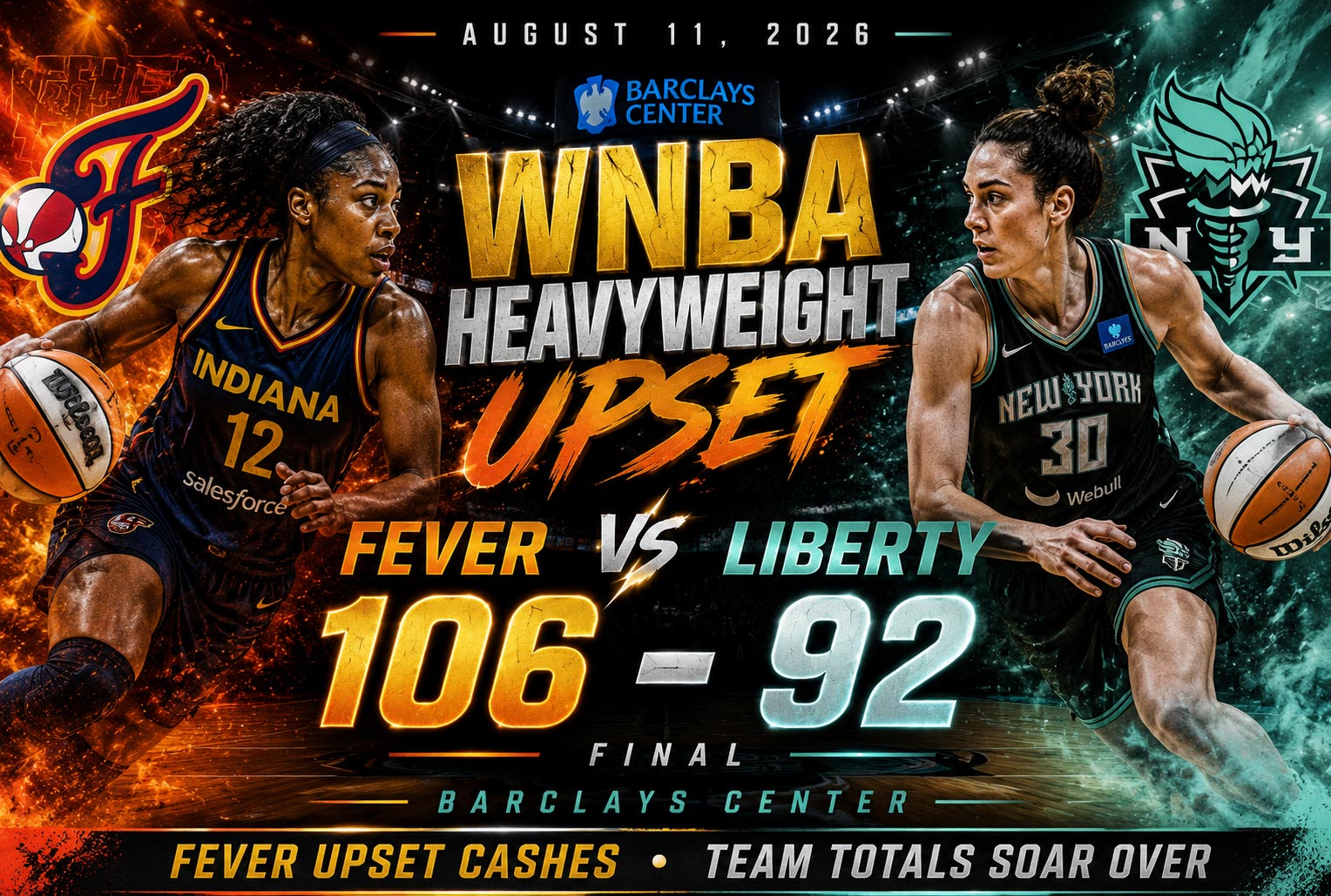
The Indiana Fever just dropped 106 points on the New York Liberty like they were running a fast-break clinic at an open gym, and somewhere in Manhattan, a risk manager is updating their LinkedIn profile. This wasn’t just a win—it was a full-scale demolition of every team total, spread, and over the books were offering. If you had Indiana in any capacity on August 11, 2026, you basically printed money while Liberty backers watched their tickets turn to ash.
Fever Drop 106 on Liberty in Massive Betting Blowout
The final score read 106–92, but those numbers don’t capture the absolute carnage this game caused in sportsbook risk departments across New York, New Jersey, and Ontario. Indiana came into Madison Square Garden as moderate underdogs—most books had them getting 4.5 to 5.5 points—and proceeded to not just cover but obliterate the spread like it personally offended them. The Fever’s offensive explosion caught everyone off guard, including the sharp money that had been hammering Liberty futures all season.
What makes this particularly brutal for the books is that Indiana cleared every conceivable total. The team total was set around 88.5 points at most shops, meaning the Fever went over by a cool 17.5 points. That’s not line movement—that’s line annihilation. When you’re beating a number by nearly 20%, you’re not catching variance; you’re exposing a fundamental mispricing in the market.
The Liberty, who entered as one of the league’s defensive stalwarts, got torched for 106 points at home. That’s the kind of performance that makes you question whether the oddsmakers were watching the same team all season. New York had been holding opponents to under 82 points per game in their previous ten contests, which made this over-performance a statistical anomaly that crushed anyone fading the Fever’s offensive ceiling.
Indiana Clears Every Total as Books Get Torched
Here’s where the betting markets completely collapsed: the game total was sitting at 176.5 at most major books (DraftKings, FanDuel, BetMGM). The final combined score of 198 sailed over by 21.5 points—an absolute bloodbath for anyone who took the under or for books that got heavy two-way action. This is the kind of result that forces sportsbooks to reassess their WNBA pricing models entirely, because you can’t have a 12% miss on a total and pretend your algorithms are working.
The public money was actually split pretty evenly on this game, which is the worst-case scenario for books. When sharp action leans one way and the public leans the other, books can middle or at least minimize exposure. But when both sides are betting Indiana overs and the Fever proceed to drop 106? That’s what we call a "max liability event" in risk management terms. Every parlay with an Indiana leg hit, every same-game parlay with Fever points cashed, and every live bettor who hammered the over at halftime got paid.
What’s fascinating from a market psychology perspective is how quickly the lines moved—or rather, didn’t move—before tip-off. Despite some late money coming in on Indiana, the spread only shifted half a point at most books. That suggests either the books were supremely confident in their Liberty pricing (wrong), or they didn’t have enough liquidity concerns to shade the line more aggressively toward Indiana (also wrong). Either way, this is a case study in how even sophisticated betting markets can completely whiff on outlier performances.
The Betting Breakdown
Pre-Game Lines (Consensus):
- Spread: Liberty -5.5 (-110) / Fever +5.5 (-110)
- Moneyline: Liberty -220 / Fever +180
- Total: 176.5 (Over -110 / Under -110)
- Indiana Team Total: 88.5
What Hit:
- Fever +5.5 ✅ (won by 14)
- Fever ML +180 ✅ (massive dog payout)
- Over 176.5 ✅ (by 21.5 points)
- Indiana Team Total Over 88.5 ✅ (by 17.5 points)
- Every Indiana-based SGP that included points ✅
Estimated Book Losses:
This is pure speculation based on handle estimates, but given that WNBA games in major markets like NY and NJ typically generate $2-3M in handle, and considering the complete sweep of every Indiana-favorable outcome, books likely took a $400K-$600K hit on this single game. That’s not catastrophic for major operators, but it’s definitely enough to trigger a Monday morning email with "URGENT" in the subject line.
Why This Happened: The Market Mispricing
The oddsmakers got caught in a classic recency bias trap. Liberty had been dominant defensively, and Indiana’s offense had been inconsistent enough that the market priced them as a team that would struggle to crack 90 points against elite defense. What the models missed—or underweighted—was Indiana’s offensive ceiling when their shooters get hot and the pace accelerates. The Fever shot 52% from the field and 44% from three, which are numbers that will torch any defensive scheme regardless of pedigree.
There’s also an interesting angle here about WNBA market liquidity. These games don’t attract the same sharp action that NBA or NFL games do, which means the opening lines have more room for error. When you’re setting lines with less sharp money to guide you toward equilibrium, you’re more vulnerable to these blowout results. The books essentially priced this game based on season-long defensive metrics without adequately accounting for the variance in individual game performance.
From a bettor’s perspective, this is where the edge exists in WNBA markets. You’re looking for spots where the public perception (Liberty defense good, Fever offense questionable) diverges from the actual matchup dynamics and shooting variance. If you had identified that Indiana’s offensive efficiency metrics in up-tempo games were significantly better than their season average, you could have found massive value on that team total over.
The Parlay Massacre
Let’s talk about what really hurt the books: same-game parlays and traditional parlays that included Indiana. SGPs have become a massive revenue driver for sportsbooks because they’re typically -EV for bettors—the correlation between legs is rarely priced efficiently in the bettor’s favor. But when a game goes nuclear like this one did, every correlated outcome hits simultaneously. Fever ML + Over + Fever Team Total Over was probably a popular SGP that paid out at +600 or better at most books.
The traditional parlay damage was equally brutal. Anyone who had Indiana as one leg in a three or four-team parlay suddenly had a massive favorite to cash their ticket. And because the Fever won outright as a +180 dog, that leg alone provided huge value in any multi-game parlay construction. This is the kind of result that makes bettors feel like geniuses and makes books question their SGP pricing algorithms.
What’s wild is that this probably created a feedback loop in live betting too. Once Indiana jumped out to an early lead and the game total started climbing, live bettors could hammer adjusted overs and spreads that still weren’t accounting for the pace and shooting efficiency. Books got torched pre-game, and then got torched again in-game as the lines tried to catch up to reality. That’s a double-tap loss that risk managers absolutely hate.
Market Implications Moving Forward
This result is going to have ripple effects on how books price both teams for the rest of the season. Indiana’s team totals will probably tick up by 2-3 points across the board, and Liberty’s defensive reputation will take a hit in the pricing models. That’s actually where smart bettors can find counter-value—when the market overreacts to a single outlier performance and creates inefficiencies in the opposite direction. If books start pricing Indiana overs too aggressively, the under becomes playable again.
There’s also a broader lesson here about WNBA betting markets and their relative immaturity compared to NBA markets. The lines are softer, the adjustments are slower, and the sharp money is less concentrated. That creates opportunities for bettors who actually watch the games and understand the matchup dynamics beyond what the season-long numbers suggest. The challenge is that limits are lower and you can’t hammer these lines for the same volume you could on an NBA game.
For books operating in New York, New Jersey, and Ontario—where WNBA betting is actually gaining traction—this is a wake-up call. You can’t just port over your NBA pricing models and expect them to work for a league with different pace dynamics, different shooting profiles, and different variance patterns. The operators who invest in WNBA-specific modeling will gain an edge; the ones who treat it as an afterthought will keep getting smoked on games like this.
The Sharp Take
If you’re trying to extract lessons from this game that apply to future betting, here’s what matters: look for spots where defensive reputation diverges from actual matchup dynamics. The Liberty’s defensive metrics were real, but they were largely built against teams that didn’t have Indiana’s offensive ceiling or pace advantage. When you see a line that’s pricing a team based on season-long averages without accounting for stylistic matchups, that’s your edge.
The team total over at 88.5 was the sharpest play available pre-game, and it wasn’t particularly close. Indiana had hit that number in four of their previous six games against top-tier competition, which suggested the line was at least 3-4 points too low. That’s the kind of mispricing that doesn’t happen in NFL or NBA markets, but exists in WNBA because the modeling isn’t as sophisticated and the sharp money isn’t as aggressive.
Going forward, fade the narrative and trust the numbers in WNBA markets. The books are still learning how to price these games efficiently, which means there’s alpha available for bettors who do their homework. Just don’t expect these edges to last forever—as handle increases and sharp action follows, the lines will tighten and the easy money will dry up.
This game was a perfect storm of mispriced totals, undervalued underdogs, and defensive reputation meeting offensive reality. The books took a beating, Indiana backers cashed everything, and somewhere in a Manhattan office, a trading desk analyst is building a new WNBA pricing model from scratch. The lesson? When you see a team total that’s 15-20% below a team’s offensive ceiling against a favorable matchup, hammer it before the market corrects. And if you’re still fading WNBA overs in 2026, you’re leaving money on the table. What’s your take—was this a fluke performance or a sign that Indiana’s offense is being systematically undervalued? Drop your thoughts in the comments.
"WannaBet.com may receive compensation from the sportsbooks mentioned in this post if you sign up using our links. This doesn’t cost you a dime, but it keeps the lights on. Please bet responsibly. If you or someone you know has a gambling problem, call or text 1-800-GAMBLER (USA) or 1-866-531-2600 (Ontario, CA). 21+ only."
