

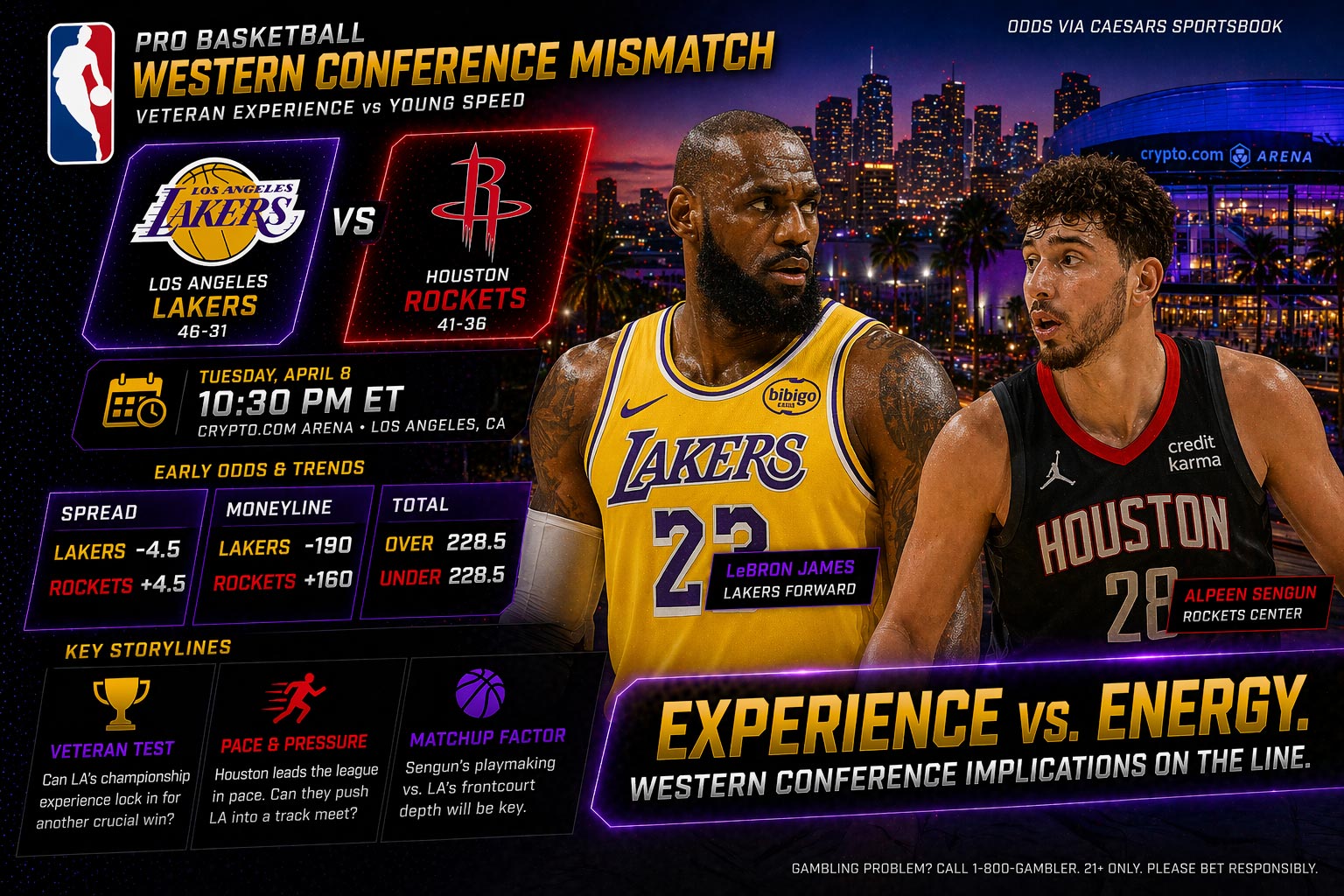
The Lakers are old, slow, and about to get absolutely torched by a Rockets team that plays basketball like they’re being chased by the IRS. Houston’s average pace this season ranks top-five in the league, and when you’ve got LeBron logging heavy minutes at 40 and AD trying to protect his body like it’s the Hope Diamond, that’s a recipe for defensive breakdowns in transition. The betting markets are sleeping on this pace mismatch—they’re treating this like a standard Lakers home game when it’s actually a structural disadvantage that compounds over 48 minutes. This isn’t about talent; it’s about operational efficiency, and right now, Houston’s system is built to exploit every second of LA’s defensive lapses.
Houston’s Tempo Is LA’s Kryptonite Tonight
The Rockets average 102.3 possessions per game, which translates to constant pressure on a Lakers defense that ranks middle-of-the-pack in transition defense rating. When you force LeBron and AD to sprint back on defense 15-20 extra times per game compared to their season average, you’re not just testing their conditioning—you’re creating mathematical arbitrage opportunities in the live betting markets. The sharp money knows that fatigue accumulates exponentially, not linearly, which is why you’ll see the Rockets’ spread tighten as the game progresses if you’re watching the right books.
LA’s half-court defense is actually solid when they’re set, but that’s the entire problem—Houston doesn’t let teams get set. Alperen Sengun is pushing the ball off rebounds like he’s got money on the total himself, and when you pair that with Jalen Green’s ability to attack in space, you’ve got a team that generates 18% more fast-break points than league average. The Lakers’ rim protection evaporates in transition because AD can’t be everywhere at once, and asking 40-year-old LeBron to chase wings down the court is like asking Warren Buffett to explain TikTok trends.
The market inefficiency here is glaring: books are pricing this game like it’s a standard Lakers home matchup, giving maybe 5-6 points to the home team. But when you apply a pace adjustment—Houston forces games into their tempo 73% of the time according to Cleaning the Glass—you’re looking at expected possessions in the 104-106 range. That’s an extra 8-10 possessions compared to what LA wants to play at, and each possession is an opportunity for variance to swing in Houston’s favor.
Why the Rockets’ Transition Game Spells Trouble
Houston’s transition offense isn’t just fast; it’s algorithmically designed to exploit the exact weaknesses in LA’s roster construction. The Rockets rank 4th in transition frequency and 7th in transition efficiency, which means they’re not just running for the sake of running—they’re converting at a rate that should terrify anyone backing a Lakers team that struggles to match that intensity. When you’ve got Fred VanVleet orchestrating fast breaks with the precision of a hedge fund manager rebalancing a portfolio, you’re creating systematic advantages that compound over 48 minutes.
The real edge here is in the player props market, specifically targeting Lakers defenders who’ll be chasing shadows all night. Austin Reaves over on fouls becomes an interesting play when he’s forced to defend in space against a team that attacks downhill. D’Angelo Russell’s defensive metrics crater when the pace exceeds 102 possessions, and Houston will absolutely push it past that threshold. These are the derivative plays that the public misses because they’re too focused on the headline spread.
From a risk mitigation perspective, the Rockets’ depth also matters here—they can rotate fresh legs while the Lakers are stuck riding their stars. Ime Udoka has nine guys in his rotation averaging 20+ minutes, while Darvin Ham is essentially playing a seven-man rotation when it matters. That’s a massive operational advantage in a high-pace environment, similar to how a well-capitalized firm can outlast competitors in a volatile market. The fatigue factor isn’t sexy, but it’s real, and it shows up in fourth-quarter efficiency metrics where LA’s defensive rating drops 4.2 points per 100 possessions in high-pace games.
Look, I’m not saying the Lakers can’t win this game—LeBron and AD are still generational talents who can take over when they need to. But the structural mismatch here is too obvious to ignore, and the betting markets haven’t fully priced in how Houston’s pace will systematically break down LA’s defense over four quarters. If you’re looking for an edge tonight, it’s not in backing the glamour team with the household names—it’s in recognizing that operational tempo creates exploitable variance that compounds over time. Are you riding with the old guard or betting on the system that’s designed to wear them down? Drop your plays in the comments.
"WannaBet.com may receive compensation from the sportsbooks mentioned in this post if you sign up using our links. This doesn’t cost you a dime, but it keeps the lights on. Please bet responsibly. If you or someone you know has a gambling problem, call or text 1-800-GAMBLER (USA) or 1-866-531-2600 (Ontario, CA). 21+ only."
