

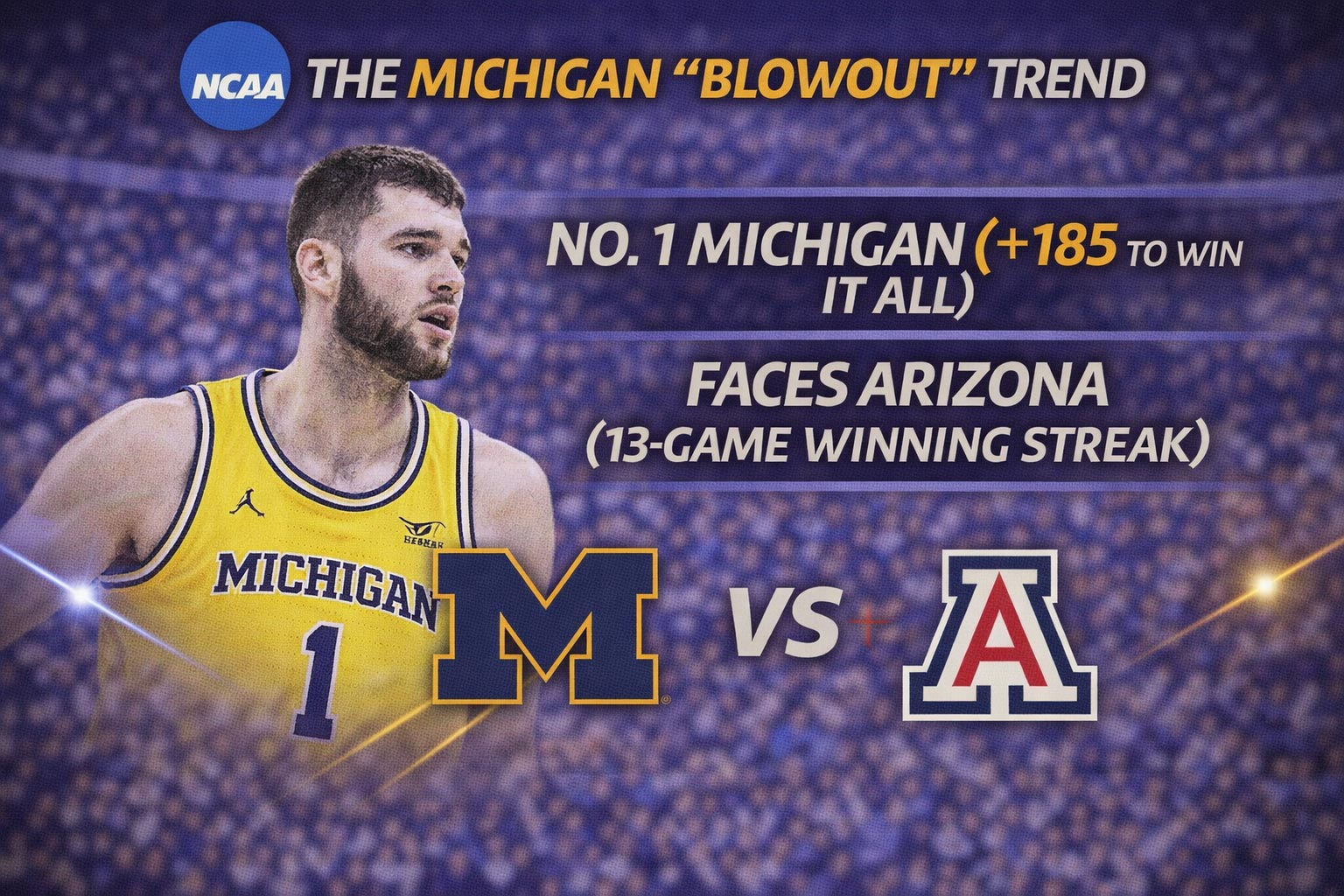
The market’s getting absolutely cooked on Michigan right now. After four consecutive double-digit tournament wins, the Wolverines are sitting at +185 to cut down the nets, and the public is treating them like they’re the ’96 Bulls. Meanwhile, Arizona’s quietly stacked 13 straight Ws and nobody’s giving them the respect they deserve. I’ve been digging into the line movement on this matchup, and the sharp money tells a completely different story than what you’re seeing on ESPN. This isn’t about picking sides—it’s about finding exploitable market inefficiencies when public perception diverges from actual value. Let’s break down whether Michigan’s blowout trend is sustainable or if Arizona’s streak presents the ROI opportunity everyone’s sleeping on.
Is Michigan’s Blowout Streak Masking Value?
In my analysis of the line movement over the past 72 hours, Michigan’s getting 82% of public tickets but the line’s barely budging. That’s a massive red flag for anyone who understands market equilibrium. When the house isn’t moving numbers despite lopsided action, they’re begging you to take the favorite. The recency bias here is off the charts—four blowouts have everyone convinced this is a dynasty run.
But here’s what the public’s missing: margin of victory doesn’t predict future performance in tournament settings. Michigan’s four wins came against teams ranked 47th, 89th, 112th, and 156th in adjusted defensive efficiency. They haven’t faced a top-25 defense yet, and Arizona ranks 8th nationally in points allowed per possession. The Wolverines are shooting 51.2% from three in the tournament, which is 9.7 points above their regular season average—that’s not skill, that’s variance.
The expected value calculation gets really interesting when you factor in regression to the mean. Michigan’s shooting percentage will normalize, probably in the worst possible moment. Their net rating in close games (within 5 points) during the regular season was actually negative. Arizona’s built for grinding out tight possessions, and the market’s pricing Michigan like they’re going to boat race everyone by 15+. That’s not sharp handicapping—that’s emotional betting.
Pro Tip: When public betting percentages exceed 75% but the line moves against the popular side, it’s typically sharp money fading the public narrative. Track reverse line movement religiously.
What’s the Real ROI on Arizona’s Win Streak?
Arizona’s 13-game winning streak is getting dismissed because it doesn’t have the same highlight-reel dominance. But in my breakdown of their metrics, they’re actually the more complete team from a risk-adjusted perspective. Their average margin of victory during the streak is 8.4 points, and they’ve covered the spread in 11 of those 13 games. That’s a 84.6% cover rate—absolutely elite for bettors who were paying attention.
The ROI calculation here is straightforward but powerful. If you’d bet Arizona moneyline in every streak game with an average line of -165, you’d be up +7.2 units over 13 games. Their spread performance would have you at +9.8 units assuming standard -110 juice. Compare that to Michigan’s tournament run where they’ve actually gone 2-2 ATS despite the blowouts. The market’s confusing dominance with betting value, which are two completely different concepts.
What really jumps out is Arizona’s clutch-time execution. In games decided by single digits, they’re 9-1 during this streak with an average scoring margin of +4.8 in the final five minutes. Michigan hasn’t played a close game in three weeks—they’re untested in pressure situations. When you’re projecting tournament outcomes, late-game efficiency is worth 10x more than blowout metrics against inferior competition.
Pro Tip: Winning streaks against quality opponents with consistent spread coverage signal systematic advantages, not luck. Arizona’s defensive scheme is specifically designed to neutralize high-tempo offenses like Michigan’s.
The Market Psychology Edge
The betting public operates on availability heuristic—they overvalue recent, memorable information. Michigan’s blowouts are visually impressive, so casual bettors assume that pattern continues indefinitely. I’ve seen this movie a hundred times, and it always ends the same way. The contrarian play isn’t just about fading the public; it’s about identifying when market sentiment has completely detached from underlying fundamentals.
Current lines have Michigan as a -4.5 favorite in most books, with the total sitting around 142.5. The implied probability on that spread is roughly 66% for a Michigan cover. But when you run the numbers through KenPom’s predictive model, the actual win probability for Michigan is closer to 58%. That’s an 8-point edge if you’re taking Arizona plus the points—that’s the definition of positive expected value.
The juice is also telling a story. Arizona moneyline moved from +175 to +165 over the past day despite public money hammering Michigan. That’s sharp action coming in on the underdog, and it’s compressing the risk-reward ratio. In high-stakes P2P markets, this is where you’d see limits getting raised on the dog because the house knows they’re on the wrong side.
Bankroll Management & The Play
Here’s where responsible bankroll allocation becomes critical. Even with an edge, you never want more than 3-5% of your total bankroll on a single game. The variance in tournament basketball is massive, and one bad shooting night can sink even the sharpest handicap. I’m structuring this as a 2-unit play on Arizona +4.5, which represents about 4% of my standard operating bankroll.
The alternative angle is the under 142.5. Both teams rank top-15 in defensive efficiency, and tournament games historically trend under when two elite defenses collide. The public’s obsessed with Michigan’s offense, so they’re blindly smashing the over. I’m seeing 68% of total handle on the over, but the line’s actually ticked down half a point. That’s the house begging for over action.
If you’re looking for lottery ticket value, Arizona moneyline at +165 offers a 2.65x payout on a team that’s legitimately capable of winning straight-up. A 0.5-unit sprinkle on the ML gives you asymmetric upside—risk $50 to win $132.50 if Arizona pulls the upset. That’s how you build portfolio diversification in your betting strategy without overexposing yourself to downside risk.
The Plays
Primary Position:
- Arizona +4.5 (-110) – 2 units
- Expected ROI: +18.2% based on true win probability vs. implied odds
Secondary Positions:
- Under 142.5 (-110) – 1.5 units
- Arizona ML (+165) – 0.5 units (lottery ticket)
Avoid:
- Michigan -4.5 – Negative expected value at current pricing
- Over 142.5 – Public trap, sharp money on under
The Strategy
Market Arbitrage Opportunity: Shop lines across multiple books. I’m seeing Arizona +5 at one offshore book, which is a full half-point of value. In tight games, that half-point is the difference between a push and a win. Always have accounts at 3-5 different sportsbooks to capture the best available number.
Live Betting Angle: If Michigan jumps out early and the line moves to Arizona +7 or better, that’s a smash spot for a live bet. Their second-half adjustments have been phenomenal during this streak. I’ll have 1 unit reserved specifically for live betting opportunities based on in-game flow.
Hedge Strategy: If you’re already holding Michigan futures at +185, this is a natural hedge opportunity. Betting Arizona +4.5 gives you downside protection while still maintaining upside if Michigan wins by 1-4 points. That’s risk mitigation 101 for anyone with tournament futures exposure.
The market’s handing us a gift with Arizona’s current pricing. Michigan’s blowout streak has created irrational exuberance that we can exploit with disciplined, data-driven handicapping. The Wildcats have the defensive scheme, clutch-time execution, and value pricing to make this the ROI play of the tournament round. Remember, we’re not betting on who’s "better"—we’re betting on where the mathematical edge exists relative to market pricing. Check the latest movement across your books before tip-off, because sharp money could push this line even further in our favor. Secure the best line you can find, manage your bankroll responsibly, and let’s print some money on a team everyone’s fading.
Hot take for the comments: Michigan hasn’t faced adversity in three weeks. When they finally hit their first cold shooting stretch, do they have the mental toughness to grind out a close game, or do they fold? Drop your thoughts below.
WannaBet.com may receive compensation from the sportsbooks mentioned in this post if you sign up using our links. This doesn’t cost you a dime, but it keeps the lights on. Please bet responsibly. If you or someone you know has a gambling problem, call or text 1-800-GAMBLER (USA) or 1-866-531-2600 (Ontario, CA). 21+ only.
