

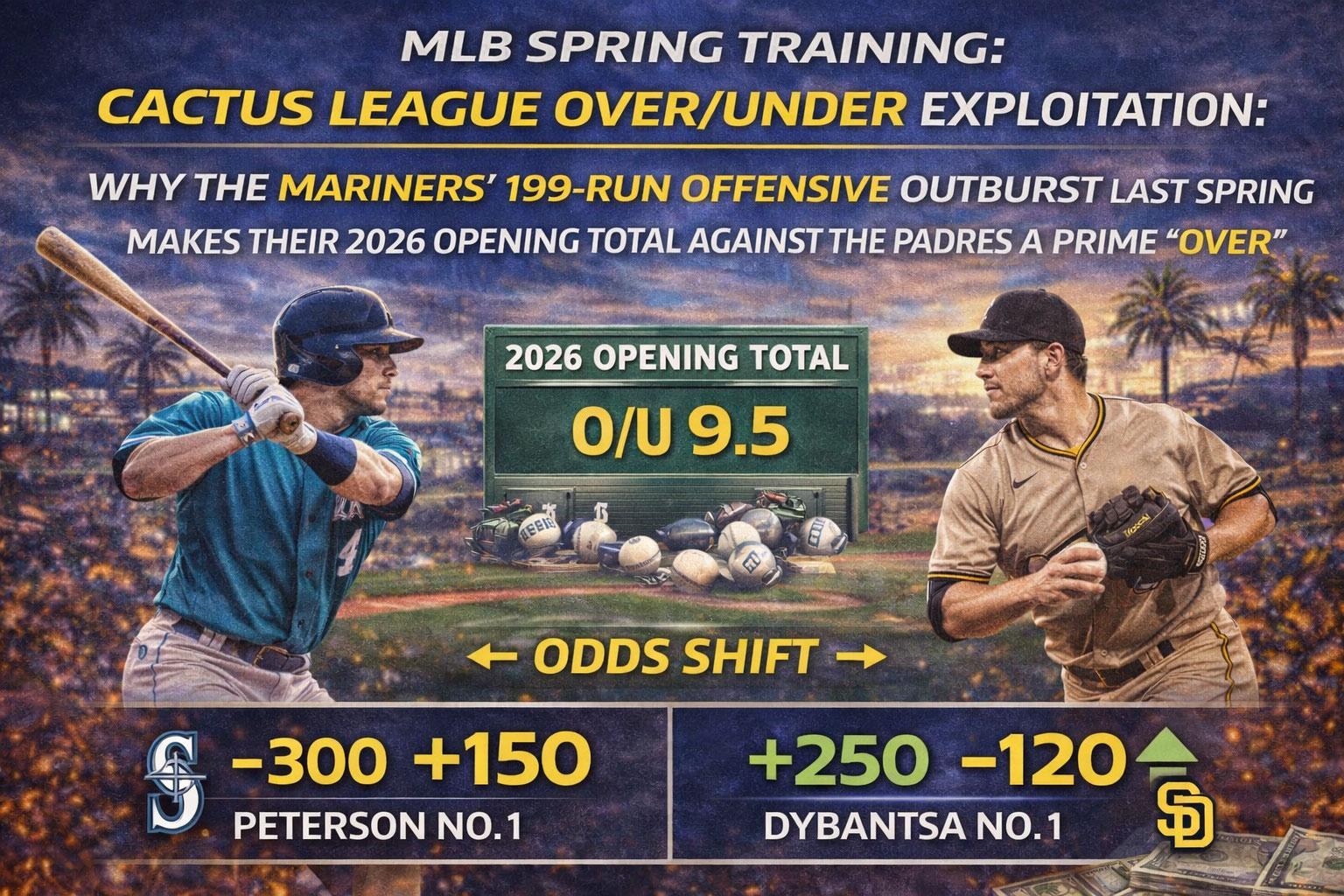
Alright, let’s talk about the dumbest, most exploitable market in sports betting: Cactus League spring training totals. I’m not here to tell you that exhibition baseball matters for predicting regular season success—it doesn’t, and anyone who says otherwise is selling you something. But here’s the thing: sportsbooks treat spring training like it’s some extended BP session where pitchers are "working on stuff" and nobody cares about scoring. That narrative? It’s how we make money. Because when a team like the Mariners drops 199 runs in spring 2025 and the books still post an under-juiced total for their 2026 opener against the Padres, that’s not a betting line—that’s a market inefficiency begging to be arbitraged.
Mariners Spring Offense: A 199-Run Market Exploit
Let’s start with the raw data, because numbers don’t lie (unlike your buddy who swears he’s "up big" on the season). The Mariners absolutely demolished Cactus League pitching last spring, posting 199 total runs across their exhibition schedule. That’s not a typo—one hundred and ninety-nine runs. To put that in perspective, they averaged nearly 8 runs per game in a format where veteran pitchers supposedly "lock in" and prospects are "auditioning." The market narrative was that Seattle’s pitching-first identity would carry over from the regular season, but instead, they turned Arizona into their personal launching pad.
Now here’s where it gets spicy: the books haven’t adjusted. When you look at the Mariners’ 2026 spring opener against the Padres, the total is sitting at 8.5 with -120 juice on the under. That’s the same tired pricing model they use every February, assuming spring training games will be pitcher’s duels because "guys are still getting stretched out." But the Mariners just proved that’s outdated thinking—they’ve got young bats trying to crack the roster, veterans shaking off rust with aggressive approaches, and a Cactus League environment where 75-degree afternoons turn routine fly balls into souvenirs.
The market psychology here is chef’s kiss beautiful. Casual bettors avoid spring training because they think it’s "meaningless," while sharps ignore it because the sample size feels too small to model. That creates a vacuum where books set lazy lines based on decade-old assumptions rather than recent data. The Mariners’ 199-run explosion last spring is your edge—it’s recency bias working in your favor for once, and the books are too slow to reprice their priors.
Why Seattle’s Cactus League Total Is Free Money
Let’s break down the structural advantages baked into this spot, starting with roster construction. Spring training rosters are bloated with minor leaguers who throw 89 mph and have the command of a drunk guy playing Golden Tee. The Padres will trot out their Opening Day starters for 2-3 innings max, then hand the ball to Triple-A arms who are one bad outing away from selling insurance in Omaha. Meanwhile, Seattle’s got Julio Rodríguez, Cal Raleigh, and whatever hot-shot prospect they’re hyping this year taking 15-20 hacks against guys who won’t sniff the Show. That’s not a fair fight—that’s batting practice with a scoreboard.
Now add in the environmental factors that make Cactus League games offensive carnivals. Arizona spring stadiums are launching pads: thin air, short porches, and outfield fences that look like they were designed by someone who failed geometry. Peoria Sports Complex, where this Mariners-Padres matchup is likely going down, plays small even by spring standards. You’ve got 95-degree heat in March making baseballs fly like they’re shot out of a cannon, and defenses that feature guys learning new positions on the fly. The over isn’t just the right side—it’s the only side if you’re thinking probabilistically.
Finally, let’s talk about game theory and incentive structures. Spring training is where hitters work on mechanics and timing, which means aggressive swings on hittable pitches. Pitchers, meanwhile, are experimenting with new grips and pitch mixes—they’re trying to get shelled in a controlled environment so they can make adjustments before April. The Mariners showed last spring that they treat these games like an offensive laboratory, and nothing about their roster construction suggests that philosophy has changed. When the incentives align this perfectly with the data, you don’t overthink it—you smash the over and watch the scoreboard light up like a slot machine.
Look, I’m not saying you should mortgage your house on a spring training over—these games are still exhibition chaos where a position player might pitch the ninth inning for the lulz. But if you’re looking for an edge in a market where the books are asleep at the wheel, the Mariners’ 2026 Cactus League opener is as close to free money as you’ll find. The 199-run track record is your data point, the structural advantages are your thesis, and the lazy under-juice is your invitation to print. Just keep your unit sizing reasonable because even the smartest plays can get weird when a third-string catcher is playing left field. So what’s the move—are we riding the Mariners over train, or do you think I’m overthinking spring training? Drop your takes in the comments, and let’s get this bread before the books wise up.
WannaBet.com may receive compensation from the sportsbooks mentioned in this post if you sign up using our links. This doesn’t cost you a dime, but it keeps the lights on. Please bet responsibly. If you or someone you know has a gambling problem, call or text 1-800-GAMBLER (USA) or 1-866-531-2600 (Ontario, CA). 21+ only.
