

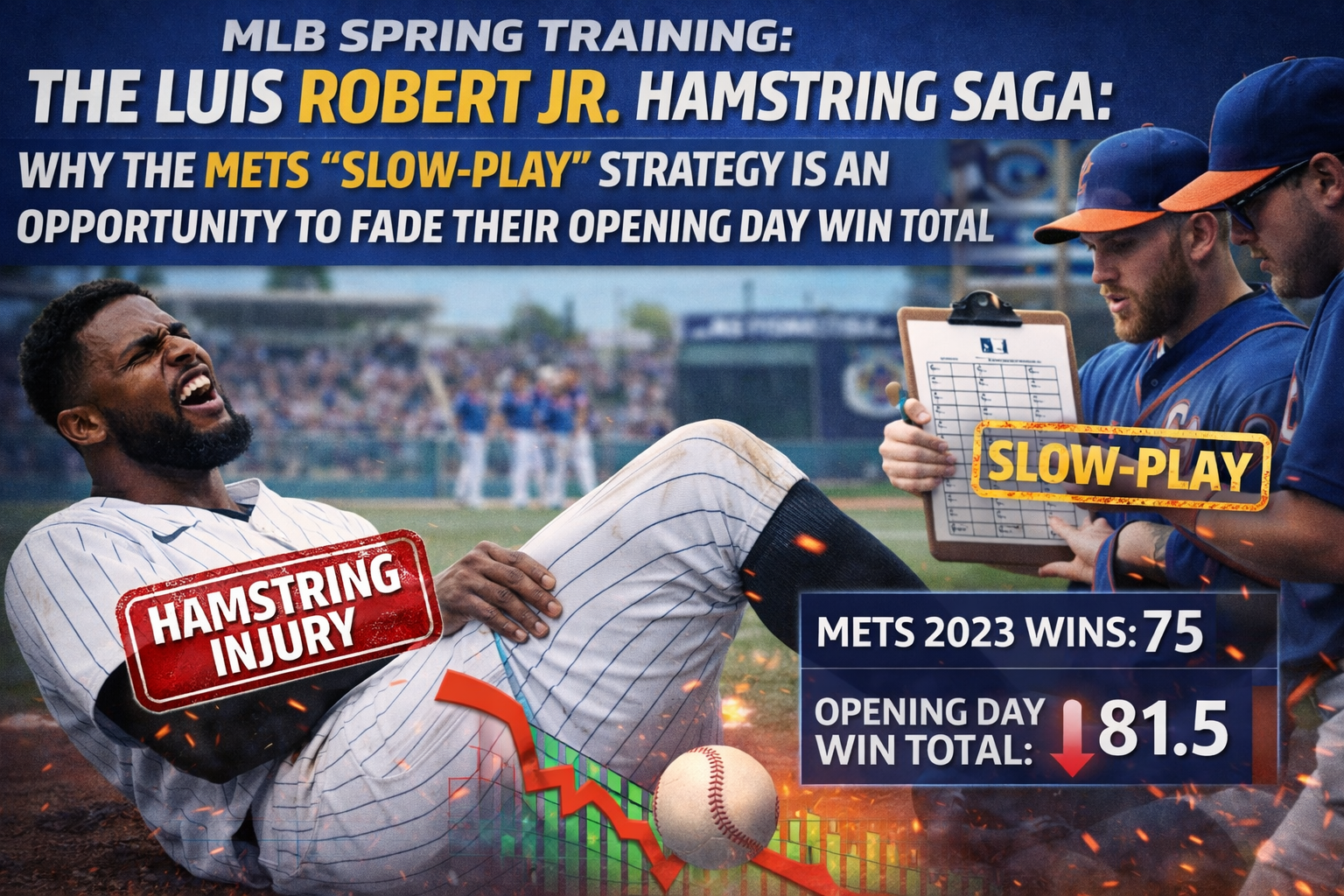
Alright, let’s talk about the most Mets thing to happen this Spring Training that doesn’t even involve the actual Mets. Luis Robert Jr., the White Sox center fielder who was supposed to be the crown jewel of Steve Cohen’s shopping spree, ended up in Queens after all—but now he’s dealing with hamstring tightness that has the front office talking about "load management" like he’s Kawhi Leonard in 2019. The public sees "cautious optimism" and thinks the Mets are being smart; sharp bettors see a massive red flag wrapped in PR spin. When a team that just dropped $400M+ on payroll starts slow-playing their marquee acquisition before Opening Day, that’s not prudence—that’s panic wrapped in a press release.
Here’s the thing: the betting market hasn’t fully adjusted to this yet. Opening Day win totals got set when Robert was supposed to be healthy, locked in, and ready to patrol center field from Day 1. Now we’re getting "day-to-day" updates and vague timelines that scream "we have no idea when this guy will be 100%." This is textbook market inefficiency—the kind of arbitrage opportunity that separates guys who check their bets on their phone from guys who actually understand expected value. Let’s break down why Robert’s hamstring is your license to print money fading the Mets’ win total.
Robert’s Hamstring = Mets Win Total Arbitrage
The Mets’ Opening Day win total sits around 88.5 wins across most books in New York and New Jersey, priced when everyone assumed Robert would be patrolling center field and batting third from Game 1. That number was already borderline inflated—we’re talking about a team that added Robert but also has Francisco Lindor coming off a career year that probably isn’t repeatable and a starting rotation held together with duct tape and prayers after Kodai Senga’s shoulder issues. Now add the fact that their biggest offseason acquisition might miss the first 2-3 weeks (or more, because hamstrings are liars), and suddenly 88.5 looks like the public’s hopium, not a sharp number.
Here’s the market psychology play: casual bettors in the NYC metro see "Luis Robert Jr. + Mets" and think World Series, not "injury-prone speedster with a sketchy soft tissue history." The books know this, which is why they haven’t moved the line as aggressively as they should. They’re banking on public money hammering the over because "it’s the Mets, bro, they spent a billion dollars!" Meanwhile, anyone who’s watched Robert’s career knows hamstring injuries for a guy whose game is built on explosive speed is like a starting pitcher with elbow soreness—it’s never "just tightness." This is your edge: the market is slow to react because the public doesn’t want to believe their shiny new toy is already broken.
The math is simple. Robert was projected to be worth roughly 4-5 WAR over a full season, which translates to about 15-20 games in the win column when you account for replacement level. If he misses even three weeks, you’re looking at 15-18 games gone, which shaves off 1-1.5 wins right there. But here’s the kicker: hamstring injuries don’t just cost you games—they cost you production because guys come back at 85% and either re-injure or underperform for weeks. The Mets’ win total was priced for peak Robert, not "playing through tightness in May" Robert. That’s your arbitrage window.
Why "Load Management" is Your Fade Signal
When a team starts using NBA terminology like "load management" for a baseball player in Spring Training, that’s not a strategy—that’s a euphemism for "we’re scared this thing is worse than we’re letting on." The Mets didn’t spend trade capital and take on Robert’s contract to have him DH twice a week and sit out day games after night games. They need him in center field every day, batting third, being the dynamic threat that justifies the 88.5 win total. The fact that they’re already talking about "ramping him up slowly" before the season even starts is a massive tell that they don’t trust the hamstring, and neither should you.
Here’s the business framework angle: load management works in the NBA because you play 82 games in six months, and you can afford to sit guys for 15-20 games without tanking your season. Baseball plays 162 games in six months, which sounds like more cushion, but the margin for error in the NL East is razor-thin. The Braves and Phillies are both better constructed rosters top to bottom, and the Mets’ playoff hopes hinge on banking wins early while their rotation is still healthy. If Robert isn’t contributing in April and May—the months where the Mets’ schedule is softest—you’re basically lighting 10-12 winnable games on fire. The public sees "cautious," sharps see "we’re already behind schedule."
The real fade signal here is the cognitive dissonance between what the Mets are saying and what the market is pricing. If Robert were truly fine, he’d be playing every other Spring Training game and ramping up at-bats. Instead, we’re getting "he’s progressing well" updates with no actual timeline, which is PR-speak for "we have no clue, but we can’t say that out loud because season ticket holders will riot." When there’s a gap between public narrative and private reality, that’s where you make your money. The sharps in the Meadowlands sportsbooks aren’t touching Mets over 88.5—they’re hammering the under and waiting for the public to push the juice even further.
Look, I get it—betting against the Mets when they’ve spent like a Russian oligarch at Art Basel feels wrong. But this isn’t about rooting interest; it’s about finding market inefficiencies that the public is too emotionally invested to see. Robert’s hamstring saga is a flashing neon sign that the Mets’ win total is overpriced by at least 2-3 games, and in a market as efficient as MLB futures, that’s a Grand Canyon-sized edge. The "load management" talk is your confirmation that even the front office doesn’t believe their own hype right now.
The play here is simple: fade the Mets’ Opening Day win total under 88.5 (shop around—some books in PA and Ohio are still at 89), and if you’re feeling spicy, sprinkle some action on Mets "miss playoffs" at plus money. This isn’t a hot take; it’s basic risk-reward math when you’ve got a team whose entire upside case is predicated on a guy with a bum hamstring who hasn’t played a full season since 2022. The market will adjust eventually, but right now, you’ve got a 48-72 hour window before the sharps move the line. Don’t overthink it.
What’s your take—are you fading the Mets, or do you think Cohen’s checkbook can overcome a hobbled Robert? Drop your thoughts below, and let’s argue about it like adults (or at least like degenerate gamblers).
WannaBet.com may receive compensation from the sportsbooks mentioned in this post if you sign up using our links. This doesn’t cost you a dime, but it keeps the lights on. Please bet responsibly. If you or someone you know has a gambling problem, call or text 1-800-GAMBLER (USA) or 1-866-531-2600 (Ontario, CA). 21+ only.
