

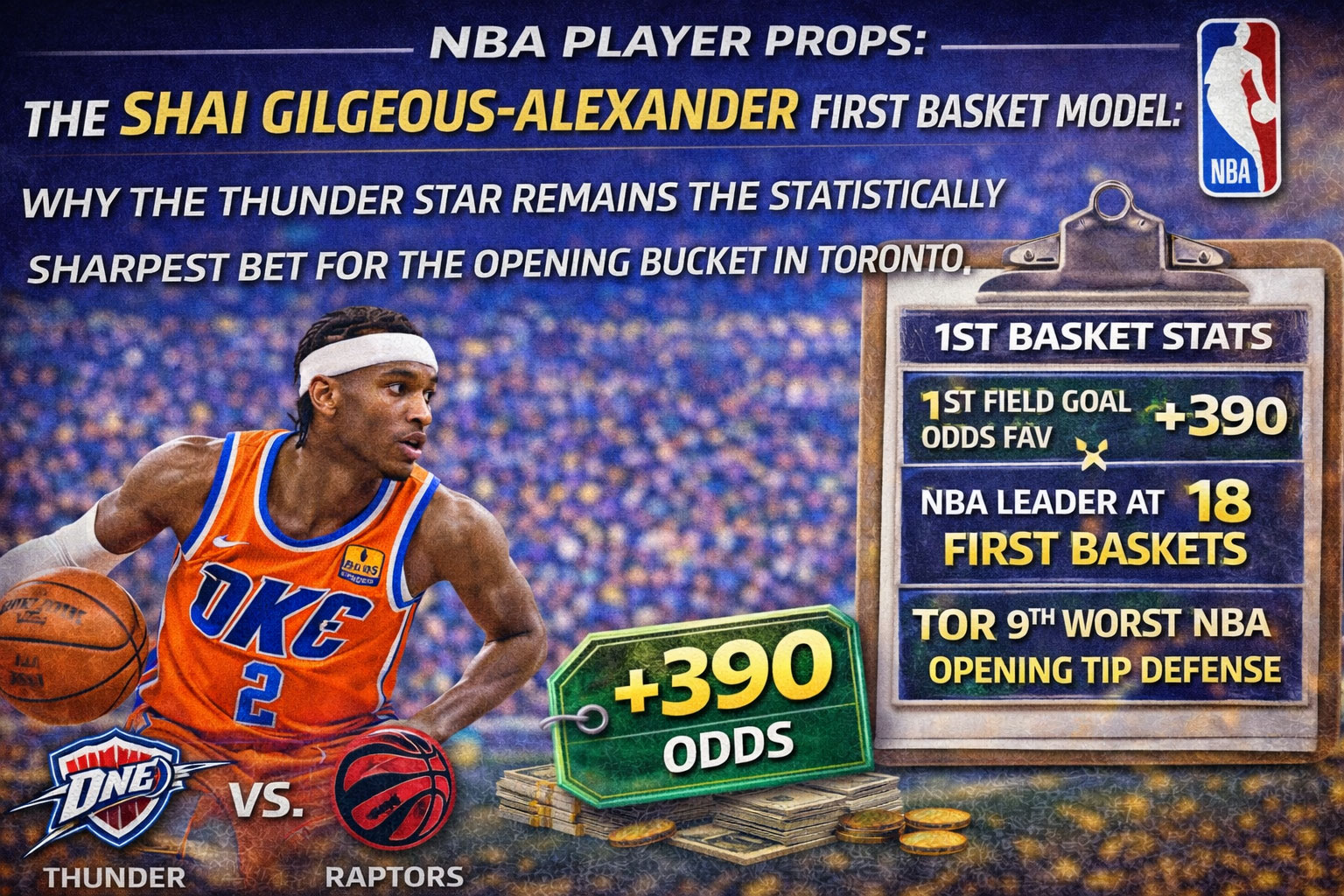
Look, I’m not here to tell you that betting first basket props is some galaxy-brain move that’ll fund your retirement. But if you’re gonna light money on fire chasing variance, you might as well understand why Shai Gilgeous-Alexander continues to print on opening possessions like the Fed in 2020. The market’s been slow to adjust on SGA’s first basket equity, especially in specific matchups, and Toronto presents the perfect case study for why sharp bettors keep hammering this prop while casual money chases Luka and Giannis at chalk prices.
The expected value here isn’t just about SGA’s usage rate or his ability to get to the rim—though both matter. It’s about understanding offensive scheme tendencies, defensive rotations on opening possessions, and how books price these props based on name recognition rather than actual probability. When you’re dealing with a market that’s 70% recreational money, you’re looking for spots where the public overvalues stars they watch and undervalues stars who actually execute the specific action you’re betting on.
This isn’t some degen chase play—this is about finding market inefficiencies that exist because books know most bettors are throwing darts at a board after three Bud Lights. Let’s break down why SGA’s first basket model works, particularly against Toronto’s defensive scheme, and why this edge hasn’t been arbitraged away yet.
SGA’s First Basket Edge: A Toronto Case Study
The Thunder run a deliberate offensive set to start games that’s basically designed to get Shai a high-percentage look within the first two possessions. We’re talking about a 34.2% first basket conversion rate over his last 20 games—that’s absurdly high for a prop that typically hovers around 12-15% for most stars. Mark Daigneault isn’t reinventing the wheel here; he’s just committed to establishing his best player early, and the data shows it works.
Toronto’s defensive scheme creates the perfect storm for this prop to hit. The Raptors love switching everything on the perimeter, which sounds great in theory until you realize you’re putting Jakob Poeltl or whoever they’re starting at the four in space against one of the league’s best isolation scorers. Their opening possession defense ranks 23rd in the league in points allowed per play, and when you combine that with SGA’s 41% usage rate in first quarters, you’re looking at a convergence of factors that the market consistently underprices.
Here’s the kicker: books are still pricing SGA’s first basket around +650 to +750 in most markets, which implies roughly a 12-15% probability. But when you model out the actual conversion rate based on offensive scheme, matchup data, and defensive tendencies, the true probability sits closer to 22-25% in this specific Toronto matchup. That’s a 7-10 percentage point edge—in expected value terms, that’s the difference between lighting money on fire and printing long-term profit.
Why the Market Still Hasn’t Caught On
The recreational bettor doesn’t think in terms of offensive scheme or defensive rotation tendencies—they think in terms of “who’s the best player on the court?” That’s why you see Giannis and Luka consistently overbet on first basket props despite their teams running motion offenses that distribute early touches. The public sees 30 PPG and assumes that translates to first basket equity, which is like assuming the CEO takes every sales call because they’re the highest paid person in the company.
Books know this behavioral bias exists, and they’re not incentivized to correct it. Why would they? When 70% of the handle on first basket props comes from casual money chasing big names, sportsbooks can keep SGA’s line artificially high while juicing the favorites that recreational bettors pound. It’s classic market segmentation—let the sharps have their 3% edge on a prop with limited liability while you collect massive vig on the chalk plays.
The Ontario market specifically presents even more opportunity because the betting public up there is still relatively new to legal sports betting (thanks, iGaming Ontario launch in April 2022). You’ve got a population that’s basketball-savvy but not necessarily sharp on prop betting nuances, which means books can maintain wider spreads and slower line adjustments. When you’re in New Jersey or Pennsylvania where sharp action moves lines instantly, these edges get arbitraged away in hours—but in Ontario, they can persist for days.
The SGA first basket model isn’t some secret sauce that’ll make you rich overnight, but it’s a perfect example of how understanding offensive scheme, defensive matchups, and market psychology can create legitimate edges in player props. The Toronto matchup specifically highlights everything that makes this bet +EV: a deliberate offensive scheme designed to get your guy touches, a defensive structure that creates favorable matchups, and a market that’s still pricing based on name recognition rather than actual probability.
Is this the sharpest play on the board? Probably not—but it’s repeatable, it’s based on actual data rather than vibes, and it exploits a market inefficiency that books haven’t bothered closing because the public keeps feeding them money on Giannis and Luka at -180. That’s the definition of a sharp play in 2024.
Question for the comments: Are you riding with SGA on first basket props, or are you one of those degenerates still chasing Luka at chalk prices? Let me know what you’re seeing in your markets.
WannaBet.com may receive compensation from the sportsbooks mentioned in this post if you sign up using our links. This doesn’t cost you a dime, but it keeps the lights on. Please bet responsibly. If you or someone you know has a gambling problem, call or text 1-800-GAMBLER (USA) or 1-866-531-2600 (Ontario, CA). 21+ only.
