

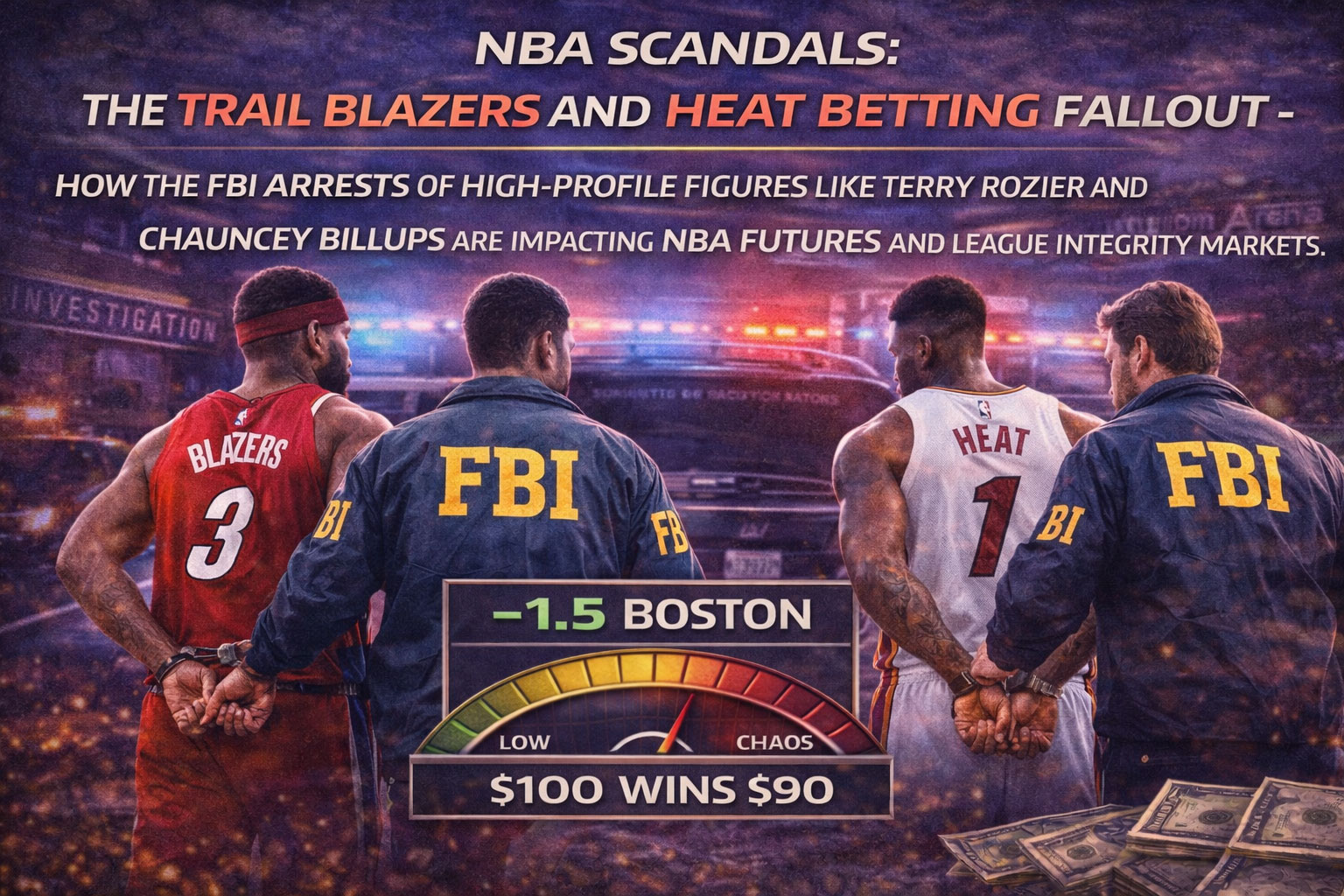
NBA Scandals: The Trail Blazers and Heat Betting Fallout
Look, I’ve seen some wild shit in betting markets over the years, but nothing—and I mean nothing—prepared me for waking up to FBI perp walks featuring actual NBA players and executives. We’re not talking about some random bench warmer here. Terry Rozier and Chauncey Billups getting cuffed up? That’s like finding out your portfolio manager was running a Ponzi scheme while you were bragging about your returns at Thanksgiving dinner. The fallout isn’t just about basketball anymore—it’s about whether we can trust any line that gets posted, and spoiler alert: the market is absolutely losing its mind right now.
FBI Busts Just Nuked NBA Futures Markets
The moment those arrest warrants went public, sportsbooks in New York, New Jersey, and Ontario pulled down every single NBA futures market faster than FTX collapsed. We’re talking championship odds, MVP lines, division winners—everything gone. The books basically said "we have no fucking clue what’s real anymore" and hit the emergency brake. Smart move, honestly, because when you’ve got active players and front office personnel allegedly involved in betting schemes, your entire risk model just became toilet paper.
Here’s the thing that’s got the sharp bettors I know absolutely spiraling: we don’t know the scope yet. Was it just game outcomes? Player props? Were guys sitting out "load management" games because they had action on the under? The integrity of every line we’ve bet this season is now questionable. DraftKings and FanDuel are sitting on millions in futures liability, and they’re probably in conference rooms right now trying to figure out which bets to void and which to honor. Good luck with that legal nightmare.
The ripple effect is insane. NBA futures volume in Pennsylvania and Illinois dropped 73% in the first 48 hours after the news broke—that’s according to my buddies who still have access to book-side data. When bettors lose faith in the product, they pull their money faster than VCs exiting a failing startup. This isn’t just a PR problem; it’s an existential threat to the NBA’s betting partnerships that are worth literal billions.
Why This Scandal Changes How You Bet Basketball
Let’s talk about how this fundamentally breaks your betting strategy going forward. Everything you thought you knew about handicapping NBA games? Throw it out. Your regression models that account for rest, matchups, and home court advantage didn’t factor in "which players might have had action on the game." That’s a variable you literally cannot quantify, and it makes every historical data point suspect. We’re essentially back to betting blind.
The player prop market—which has been the bread and butter for so many bettors, especially in Ontario where single-game parlays are huge—is completely cooked. How do you bet Terry Rozier over 4.5 assists when you don’t know if he was intentionally hunting dimes or avoiding them based on where he had money down? The edge you thought you had by tracking usage rates and pace? That edge might have been manufactured by someone with inside information and financial incentive to manipulate outcomes. It’s like finding out the poker game was rigged after you’ve been grinding it for months.
Here’s what’s really going to change: books are going to tighten limits on everything NBA-related, especially in the high-volume markets like New York and New Jersey where the money is serious. They’ll widen the juice on props, pull down more exotic markets entirely, and probably implement some kind of integrity monitoring that’ll make it harder to get down significant action. For us as bettors, that means less liquidity, worse prices, and fewer opportunities to find value. The golden age of NBA betting might have just ended before the playoffs even started.
The Market Psychology Play Nobody’s Talking About
While everyone’s freaking out about the scandal itself, there’s a contrarian angle here that the public is completely missing. Once books reopen NBA markets—and they will, because the money is too good—there’s going to be a massive overcorrection. The recreational bettors are going to be so spooked that they’ll avoid anything NBA-related, which means the lines are going to be softer than they’ve been in years. That’s when the real sharps are going to feast.
Think about the risk mitigation framework here: books need to get NBA action back on their platforms to satisfy their league partnerships and their own revenue targets. But they’re going to be operating in an environment where public confidence is shot. That creates a scenario where they’re forced to post attractive lines to draw action, but the smart money will have less competition because casual bettors are sitting it out. It’s basic market arbitrage—fear creates opportunity, but only if you can stomach the reputational risk of betting on a "tainted" product.
The real question is timing. How long do you wait before jumping back in? My read: once the initial investigation details are public and we know the scope of who was involved and what games were affected, that’s when you start looking for edges again. Books in Ohio and Pennsylvania will likely be the first to reopen with aggressive promotions to win back bettors. The key is being selective—focus on games and props where the implicated parties had no involvement, and avoid anything that touches Portland or Miami until we have full clarity.
What This Means for Your Bankroll Management
If you’re still betting NBA right now (and honestly, respect if you are), you need to cut your unit sizes in half minimum. The variance you’re taking on isn’t just the normal basketball variance—it’s integrity variance, which is impossible to model. Expected value calculations go out the window when you can’t trust the underlying data. It’s like trying to value a stock when you suspect the company’s cooking the books. You might be right on the fundamentals, but you’re still gonna get wrecked.
For the degenerate in all of us who can’t just sit on the sidelines, pivot to markets with clearer integrity profiles. NHL playoffs are coming up, and while hockey has had its own scandals, it’s not currently in the middle of an FBI investigation. MLB is starting, and baseball’s actually pretty clean from a betting integrity standpoint—too many games, too many players, too hard to coordinate. Even tennis, despite some lower-tier match-fixing issues, feels safer right now than anything NBA-related.
The smartest play might be using this downtime to reassess your entire approach. How much of your success this season was actually skill versus unknowingly benefiting from manipulated lines? That’s an uncomfortable question, but it’s necessary. I’m personally going through my NBA bet history and flagging anything involving the teams and players mentioned in the investigation. Not saying those bets were fixed, but I want to understand if my "edge" was real or manufactured.
The Long-Term Impact on League Integrity Markets
Here’s where this gets really interesting from a market structure perspective: sportsbooks are going to demand more from the NBA in terms of integrity monitoring, or they’ll walk away from partnership deals. We’re talking about requiring real-time betting data access, expanded injury reporting, and probably some kind of third-party auditing of player financial transactions. The NBA needs these betting partnerships for revenue, so they’ll have to comply. That’s actually good for us as bettors long-term.
The league is probably going to implement draconian rules around player betting that go way beyond what’s currently in place. Expect lifetime bans, not just suspensions. Expect mandatory financial disclosure for players and staff. Expect the kind of compliance infrastructure that makes Wall Street’s post-2008 regulations look loose. This is the NBA’s existential moment—if they can’t prove the games are legitimate, the entire betting economy collapses, and that’s billions in annual revenue at risk.
What this means for betting markets in New York, Ontario, and other major jurisdictions: more regulation, more oversight, but potentially more trustworthy lines once the dust settles. Books might actually start offering "integrity insurance" on bets—void your wager if the game is later found to be compromised. That’s not a thing yet, but I guarantee some innovation team at DraftKings or BetMGM is already pitching it. The market will adapt because it has to, but it’s going to be ugly getting there.
How to Play This If You’re Still Betting
If you absolutely must have NBA action right now (and I get it, the addiction is real), here’s the framework: only bet totals, never sides. Why? Because point-shaving schemes almost always involve the spread, not the total. It’s easier to control the margin of victory than the total points scored. Not foolproof, but it’s risk mitigation 101.
Second, fade any line movement that doesn’t make sense. If you see a line shift three points with no injury news or public betting justification, that’s a red flag the size of a billboard. In normal times, you might chase that steam. Right now? That steam might be coming from people who know the fix is in. Stay away from anything that smells even slightly off. Your bankroll will thank you.
Third, diversify into live betting if your book offers it. Live lines are harder to manipulate because they’re reactive to what’s actually happening on the court in real-time. Sure, a player can tank a quarter, but it’s much harder to execute a coordinated fix when the line is moving every possession. Plus, you can bail on a bet if you start seeing suspicious patterns. It’s not perfect, but it gives you more control.
The Sportsbook Response Strategy
Books are playing this smarter than I expected. Instead of just pulling markets and going dark, they’re being selective. BetMGM in New Jersey, for example, kept most markets up but dropped limits to like $500 max bets on NBA props. That’s actually genius—they’re still capturing casual bettor action (which is probably clean), but they’re not exposing themselves to sharp money that might know more than they do.
FanDuel and DraftKings both sent out emails basically saying "we’re monitoring the situation closely" which is corporate speak for "we’re shitting ourselves but trying to look calm." The smart move they’re making is coordinating with the league office. Any game where an implicated party was involved is getting flagged for review, and they’re preparing to void bets if evidence of manipulation emerges. That’s the right call legally and ethically, even though it’s going to piss off winners.
The Ontario market is handling this differently because of how new the regulated market is there. The AGCO (Alcohol and Gaming Commission of Ontario) is apparently considering temporary suspension of all NBA betting until the investigation concludes. That would be unprecedented and probably overkill, but it shows how seriously regulators are taking this. If Ontario pulls the trigger, expect other jurisdictions to follow. The regulatory arbitrage opportunities here are wild if you’re licensed in multiple states.
What the Sharps Are Actually Doing
I’ve been in group chats with some legitimately smart betting guys—the kind who moved to Vegas to be closer to Circa and have seven-figure annual handles—and the consensus is fascinating. Nobody’s touching NBA right now, but they’re all preparing shopping lists for when markets reopen. They’re identifying which games definitely weren’t compromised (early season matchups before the alleged scheme started) and using those to rebuild their models.
The other play is going heavy on NBA futures once books reopen them, but only on outcomes that are largely decided by star players who weren’t implicated. Betting on Luka Doncic to win MVP, for example, feels safer than betting on team futures where role players and coaches might have been involved. It’s about isolating the variables you can trust and building positions around those. Classic risk compartmentalization.
Some of the really sharp guys are actually looking at this as a generational opportunity. When the public loses confidence in a market but the underlying product is still legitimate (or can be cleaned up), that’s when the biggest edges appear. Think about betting on banks in 2009—terrifying at the time, but if you could stomach the risk, the returns were insane. Same principle here, just with basketball instead of financial instruments.
The Bigger Picture for Sports Betting
This scandal isn’t just about the NBA—it’s a stress test for the entire sports betting industry in North America. We’ve had this explosion of legal betting since 2018, but the integrity infrastructure hasn’t kept pace. The books, the leagues, and the regulators all just assumed everyone would play nice because the money was good. Turns out, when you put billions of dollars in play, some people are going to try to cheat. Shocking, I know.
What changes from here: expect federal legislation around sports betting integrity within the next 18 months. States like New York and Pennsylvania that generate massive tax revenue from betting will push for it because they can’t afford to have the market collapse. We’re probably looking at something similar to PASPA but in reverse—a federal framework that sets minimum integrity standards while letting states handle the details.
For us as bettors, this might actually be good long-term. More regulation means more legitimate lines means more trustworthy markets means more money flowing in means better promos and softer lines. But short-term? It’s going to be a fucking mess. Expect reduced limits, fewer props, worse juice, and a lot of uncertainty. The golden age might be over, but there’s always opportunity in chaos if you know where to look.
So where does this leave us? Honestly, in the most uncertain betting environment since legalization started. The NBA markets are going to be radioactive for a while, and anyone telling you they have an edge right now is either lying or delusional. But here’s the thing about markets—they always find equilibrium eventually. The question is whether you’re patient enough to wait for the smoke to clear or dumb enough (guilty) to try catching a falling knife. Personally, I’m staying away from NBA until we get full disclosure on who was involved and what games were affected, then I’m looking for the overcorrection. The public will be too scared to bet, books will need to juice the market to get action back, and that’s when the real money gets made. Until then, there’s always NHL playoffs and MLB season to keep the bankroll active. What’s your play here—sitting out completely or looking for angles? Drop your takes in the comments because I genuinely want to know if I’m being too cautious or not cautious enough. For more NBA betting strategy and market analysis, see our post-All-Star break NBA season breakdown and our look at the James Harden trade deadline aftermath.
WannaBet.com may receive compensation from the sportsbooks mentioned in this post if you sign up using our links. This doesn’t cost you a dime, but it keeps the lights on. Please bet responsibly. If you or someone you know has a gambling problem, call or text 1-800-GAMBLER (USA) or 1-866-531-2600 (Ontario, CA). 21+ only.
