

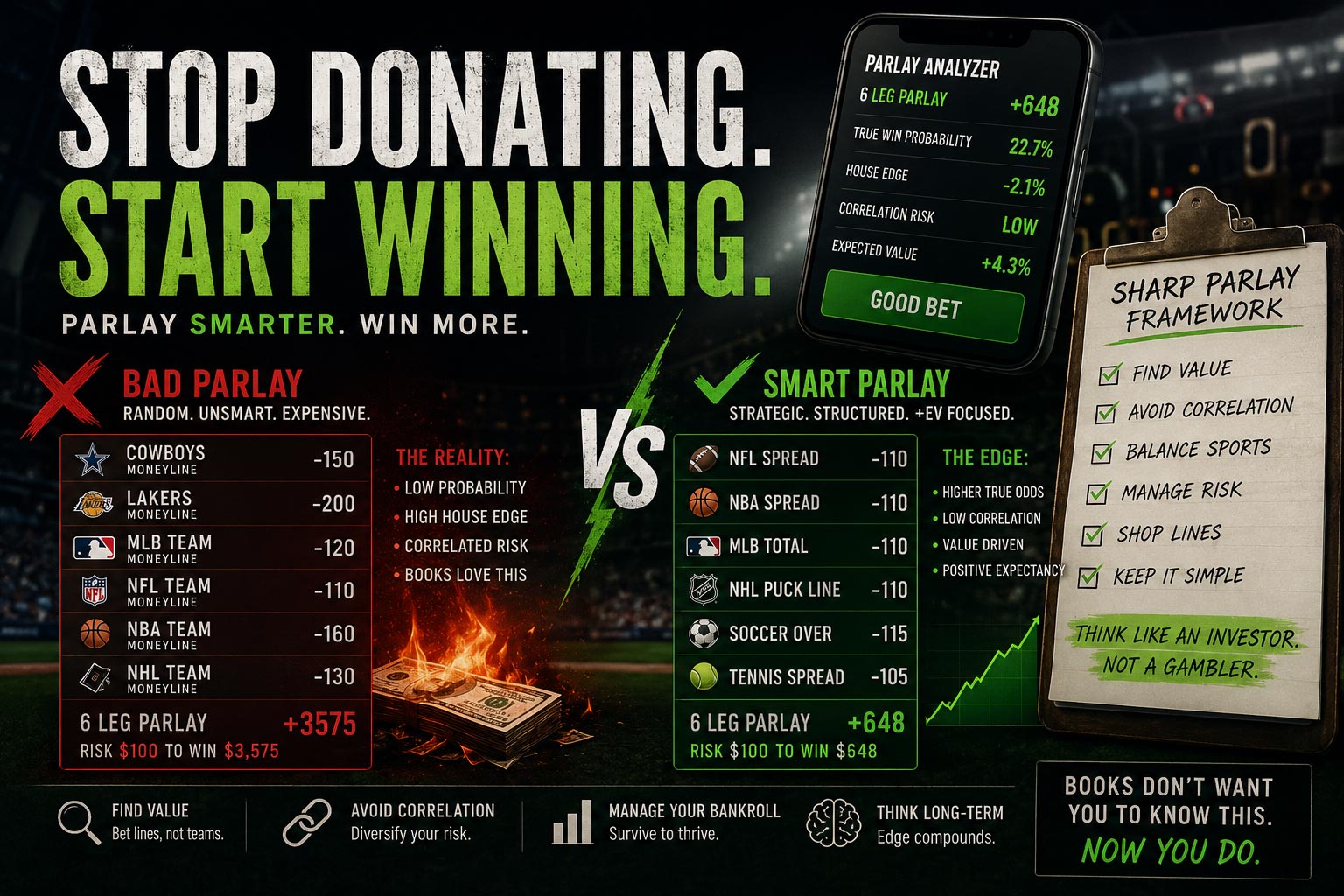
The sportsbooks are laughing at you. Every time you slam together that six-leg parlay with the Cowboys, Lakers, and whatever random MLB moneyline looked good at 2 AM, they’re literally printing money off your bankroll. The math isn’t just bad—it’s catastrophically stacked against you. But here’s the thing: parlays can work if you stop treating them like scratch-offs and start treating them like the MBA-level risk management exercises they actually are. I’m about to show you the exact framework I used to separate sharp parlay construction from degeneracy—the same discipline that separates winning like a pro from betting like a fan, and why understanding correlation and hold percentage is the difference between lighting money on fire and actually building your account.
Why Most Parlays Are a Sucker’s Bet (And How to Fix That)
Let’s talk about the house edge, because this is where 90% of bettors get absolutely cooked. Every single leg you add to a parlay compounds the sportsbook’s hold percentage—that built-in mathematical advantage they have on every bet. A standard two-leg parlay at -110 on both sides should pay out around +264 in a fair market, but most books give you +260 or worse. That’s them skimming off the top.
Now multiply that across three, four, or five legs, and you’re looking at a hold percentage that jumps from around 4.5% to sometimes 20%+ on bigger parlays. The books are essentially charging you a premium for the convenience of combining bets, and that premium grows exponentially. This is why your buddy who hits a “sick eight-legger” once a year is still down massive overall—the compounding vig is eating him alive on every ticket that loses.
The fix isn’t to stop playing parlays entirely (where’s the fun in that?). It’s to understand the expected value equation and only construct parlays where you’re either exploiting correlation, getting boosted odds through promos, or using them as calculated lottery tickets with strict bankroll limits. Think of it like portfolio theory from B-school: you wouldn’t dump your entire fund into speculative assets, so why are you putting 10% of your bankroll on a five-leg random parlay?
The Two-Leg Correlated Play: Your Actual Edge
This is where you actually make money, and it’s the strategy I abused hardest when I was running my operation. Correlated parlays exploit outcomes that aren’t truly independent—if Event A happens, Event B becomes significantly more likely. Sportsbooks have gotten sharper about limiting obvious correlations (you can’t parlay “Patrick Mahomes Over 2.5 TD passes” with “Chiefs -7” on most books anymore), but there are still massive edges hiding in plain sight.
My favorite correlated structure? Pairing a dominant team’s moneyline with their team total Over in soccer or hockey. If Manchester City is -400 against a relegation-zone team, and you think they’re winning, they’re probably not grinding out a 1-0 snoozefest—they’re likely to boat race them 3-0 or 4-1. So you pair City ML with “City team total Over 2.5 goals” and suddenly you’re getting +120 to +150 on an outcome that’s not really two independent events. The math works because the correlation isn’t fully priced into the parlay odds.
Another killer spot: NFL game script parlays. If you’re betting on a high-powered offense like the Eagles as a heavy favorite (-7.5 or more), pair it with the Under on their opponent’s team total. If Philly covers a big number, they probably controlled the game, which means the opposing offense was stuck in negative game script and didn’t hit their number. Books still treat these as independent events even though they’re clearly not. This is the closest thing to an edge you’ll find in parlay construction, and it’s how sharp players actually use these tickets instead of just mashing random legs together.
The 3-Leg to 4-Leg “Anchor” Method: Boosting Tight Lines
When you want to venture into three or four-leg territory, you need a structural approach or you’re just gambling with extra steps. The anchor method is simple: find one absolutely nuclear favorite—we’re talking -300 or heavier—that you’re willing to stake your reputation on. This becomes your foundation leg that boosts the payout of two or three other bets that are sitting around -110 to -120.
Here’s a real-world example from last NBA season: You’ve got the Celtics at home against the Pistons, and Boston is -450. That’s your anchor—it’s basically a 82% implied probability, and if that doesn’t hit, your whole ticket was probably cooked anyway. Now you add two tight spreads you actually like: maybe Nuggets -2.5 at home and a total you’ve done actual research on. Your anchor leg turns what would’ve been a +264 two-leg parlay into a +350 to +400 three-legger without adding much real risk, because that Celtics leg was hitting 9 times out of 10 anyway.
The key is discipline: your anchor can’t be some random heavy favorite you’re forcing into the ticket. It needs to be a spot where you genuinely believe the market is underestimating the probability gap—maybe it’s a rest-advantage spot, a playoff team against a tanking squad in March, or an MLB ace against a AAA-level lineup. And your other legs need to be actual researched plays, not just “these games are on TV tonight.” I’d limit this to 3-4 legs max and allocate maybe 2-3% of your bankroll per ticket. Any more legs and the compounding hold destroys your expected value no matter how good your picks are.
The 5+ Leg “Lottery” Guardrails: Entertainment with Structure
I’m not going to sit here and tell you never to play the big parlays—I’d be lying if I said I didn’t throw $20 on a seven-legger when I’m bored on a Sunday. But you need to treat these exactly like buying a lottery ticket: pure entertainment value with money you’re completely fine burning. The expected value on anything over five legs is so negative that you’re essentially paying for the dopamine rush of sweating the last leg, and that’s fine as long as you acknowledge what you’re doing.
The golden rule: never allocate more than 0.5-1% of your total bankroll to these tickets. If you’re working with a $2,000 account, that’s a $10-$20 max bet on the big parlays. The math is brutal here—a five-leg parlay at standard -110 odds has a hold percentage around 8-10%, and it gets worse from there. You’re fighting uphill against compounding vig, and even if you’re hitting 55% on individual picks (which would make you profitable long-term on straight bets), you’re still going to lose money on five-leggers over time.
That said, exploit every parlay insurance and boost promo you can find. DraftKings, FanDuel, and BetMGM in markets like New York, New Jersey, and Ontario regularly offer “parlay insurance” where you get your stake back as a free bet if exactly one leg fails. This drastically improves your expected value on 4-5 leg parlays—you’re essentially getting a free lottery ticket with a safety net. Same with odds boosts: if you’re getting a 25% boost on a same-game parlay, the books are temporarily subsidizing your expected value. These promos are the only reason to venture into bigger parlays regularly, because they’re literally giving you back some of that compounded hold percentage.
The bottom line on parlay math is pretty simple: the house edge compounds with every leg you add, and unless you’re exploiting correlation, using promos, or treating big parlays as entertainment expenses, you’re just donating to the sportsbook’s quarterly earnings. Stick to two-leg correlated plays for your actual edge, use the anchor method when you want to spice up a three or four-legger, and keep the five-plus-leg chaos to under 1% of your roll. I’ve seen way too many sharp bettors blow up their accounts chasing the big parlay score when they could’ve been grinding steady profits on smarter constructions. What’s your worst parlay beat? Drop it in the comments—misery loves company.
Keep reading: Apply this to single-game tickets with same game parlay correlation, hedge your slate using round robins, and check the house’s cut with our vig guide.
WannaBet.com may receive compensation from the sportsbooks mentioned in this post if you sign up using our links. This doesn’t cost you a dime, but it keeps the lights on. Please bet responsibly. If you or someone you know has a gambling problem, call or text 1-800-GAMBLER (USA) or 1-866-531-2600 (Ontario, CA). 21+ only.
