

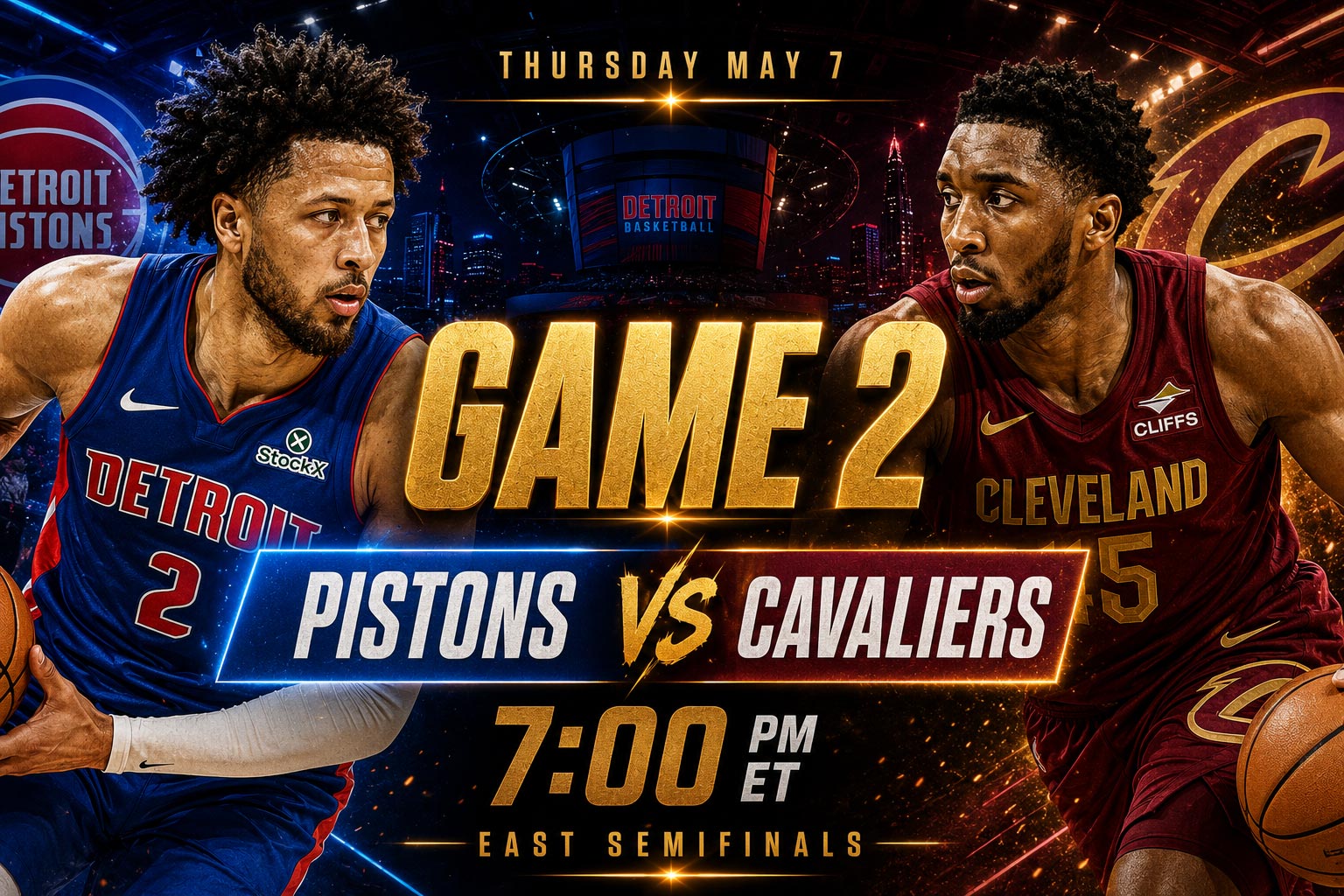
The Pistons just took Game 1 at The Palace, and now we’re at that classic crossroads where championship DNA gets tested. LeBron and the Cavs are staring down an 0-2 hole that historically turns series into formalities, while Detroit’s trying to prove their home court advantage isn’t just some statistical anomaly. This is where playoff basketball separates the contenders from the pretenders, and where smart money finds edges that casual bettors completely miss.
Pistons vs Cavs Game 2: Protect or Hold?
Detroit’s home court advantage isn’t just about crowd noise—it’s about systematic execution that the market consistently undervalues. The Pistons are 8-2 at The Palace this postseason, and that’s not luck; that’s Rasheed Wallace and Ben Wallace controlling the paint while Chauncey Billups orchestrates an offense that knows exactly where every possession ends. The expected value on Detroit protecting home court is significantly higher than the -6.5 spread suggests, especially when you factor in their defensive efficiency rating at home versus on the road.
Here’s the risk mitigation play that Vegas doesn’t want you to see: Detroit’s first-half spreads have been money all playoffs. They come out aggressive, establish defensive intensity early, and force teams into uncomfortable offensive sets before halftime adjustments can happen. The Pistons are covering first-half lines at a 70% clip at home, which is essentially a market inefficiency begging to be exploited.
The contrarian angle? Everyone’s hammering LeBron’s ability to adjust, but the kid’s 20 years old facing the best defensive system in basketball. Detroit’s defensive scheme forces him into contested mid-range jumpers while daring Larry Hughes and Eric Snow to beat them from the perimeter. That’s not a recipe for a road split—that’s a recipe for going down 0-2.
Can Cleveland Steal One Before Going Home?
Look, LeBron’s got that generational talent that makes anything possible, but talent needs supporting infrastructure to win playoff games. The Cavs’ offensive rating drops 8.3 points per 100 possessions on the road in these playoffs, and that’s before they face a Detroit defense that’s basically a MBA case study in defensive coordination. Cleveland’s path to a split requires Zydrunas Ilgauskas dominating inside and LeBron shooting over 45% from the field—both scenarios that Detroit’s game plan explicitly targets.
The market’s giving Cleveland +6.5 because everyone remembers LeBron’s Game 1 moments, but they’re forgetting the 38% shooting and six turnovers that came with them. This is classic recency bias meeting public betting patterns—casual money pours in on star power while sharp action quietly hammers Detroit’s systematic advantages. The Cavs need multiple things to break right simultaneously, and that’s not where you find betting value in a seven-game series.
Cleveland’s best shot involves forcing transition opportunities and getting to the free-throw line 30+ times, but Detroit’s half-court defense limits fast breaks and their disciplined perimeter defense doesn’t foul jump shooters. The Cavs are essentially banking on variance breaking their way, which is a terrible foundation for a road playoff win. You’re betting on chaos versus structure, and structure wins that matchup seven times out of ten.
The Plays
The Lock:
- Pistons -6.5 (Full Game): Detroit’s defensive system at home is too refined, and Cleveland doesn’t have the offensive weapons to exploit it consistently.
The Sharp Play:
- Pistons -3.5 (First Half): This is where the real edge lives—Detroit establishes dominance early before Mike Brown can make adjustments.
The Prop:
- LeBron James Under 27.5 Points: The Wallace brothers are going to make him work for every bucket, and the supporting cast can’t punish help defense consistently enough.
The Strategy:
- Consider a two-unit play on Detroit’s first half spread and a single unit on the full game. This gives you early cash potential while maintaining series positioning leverage.
- If you’re feeling spicy, parlay the Pistons first-half spread with the under on total points—Detroit’s defensive pace grinds games to a halt early.
Market Psychology & The Edge
The public’s overvaluing LeBron’s narrative potential while undervaluing Detroit’s systematic playoff execution. This is textbook market arbitrage—emotional betting versus statistical reality. Vegas knows casual money floods toward star players in must-win situations, which is exactly why the Pistons’ line isn’t higher. They’re practically begging you to take Cleveland while sharp money has already moved Detroit’s opening number.
The championship equity calculation here is simple: Teams that go up 2-0 at home win the series 94% of the time historically. Detroit knows this, Cleveland knows this, and more importantly, the market knows this but still isn’t pricing it aggressively enough. That’s your edge—exploiting the gap between what should happen statistically and what the betting public wants to happen emotionally.
Here’s the Harvard MBA framework: Detroit represents low-risk, moderate-reward positioning with exponential series value. Cleveland represents high-risk, moderate-reward positioning with diminishing returns even if they hit. From a portfolio perspective, you’re stacking units on asymmetric upside, and that’s Detroit protecting home court.
This game isn’t about LeBron’s potential—it’s about whether Cleveland’s infrastructure can support a road playoff win against elite defensive execution. Detroit’s got every systematic advantage: home court, defensive coordination, playoff experience, and a market that’s still undervaluing their dominance. The Pistons are going up 2-0, and smart money’s already positioned accordingly. What’s your play—riding with championship DNA or betting on a 20-year-old miracle worker to overcome structural disadvantages?
WannaBet.com may receive compensation from the sportsbooks mentioned in this post if you sign up using our links. This doesn’t cost you a dime, but it keeps the lights on. Please bet responsibly. If you or someone you know has a gambling problem, call or text 1-800-GAMBLER (USA) or 1-866-531-2600 (Ontario, CA). 21+ only.
