

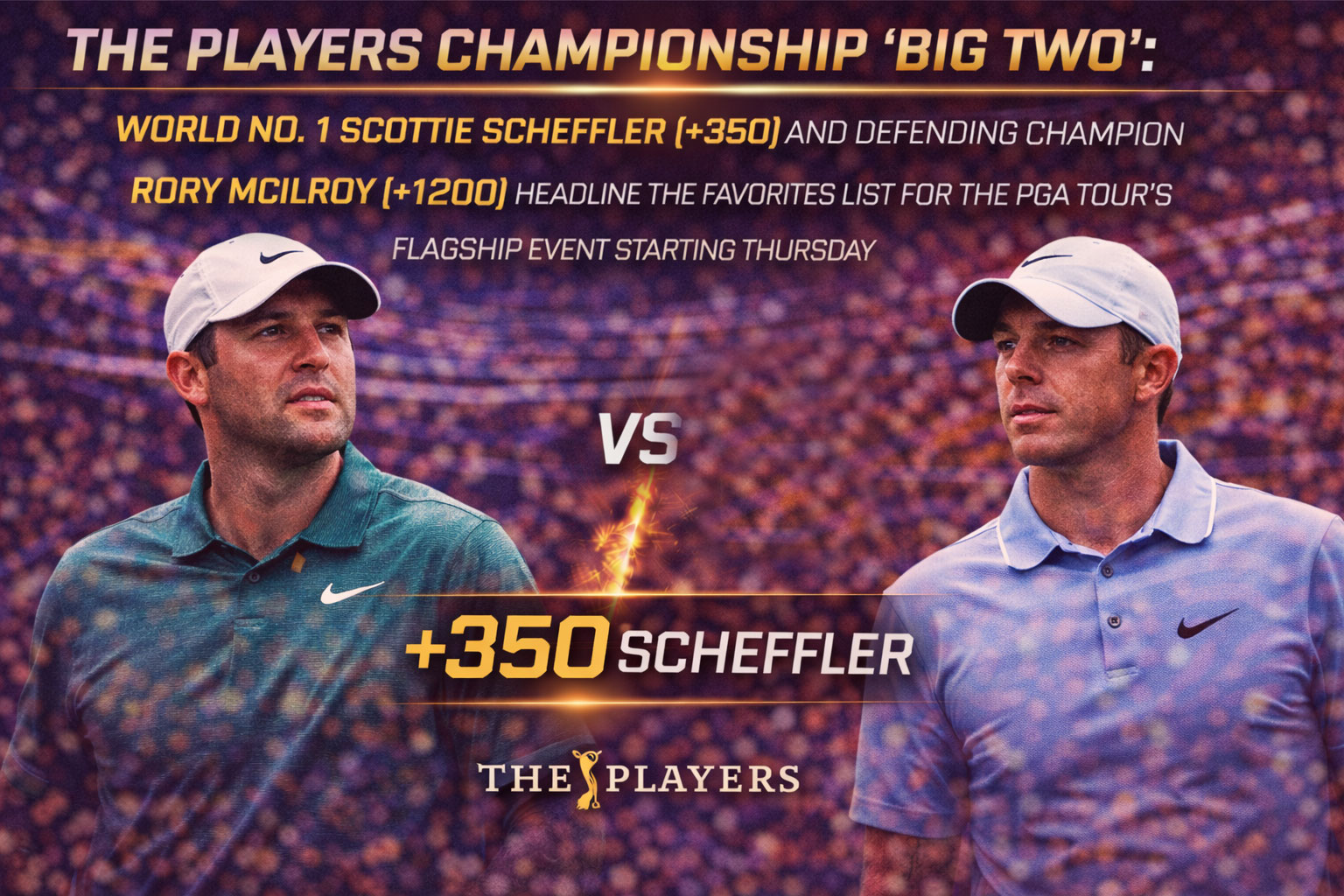
The market’s got this one completely backwards. Scottie Scheffler at +350 for The Players Championship isn’t just value—it’s the kind of mispricing that makes you wonder if the books are asleep at the wheel. Meanwhile, Rory McIlroy sits at +1200 as the defending champ, and the spread between these two tells a story about recency bias and brand-name betting that sharp money should absolutely exploit.
In my breakdown of the TPC Sawgrass setup this year, I’m seeing a course that rewards ball-striking consistency over heroic shot-making. That’s Scheffler’s entire identity. The World No. 1 has been printing money for anyone who’s faded public darlings, and this week should be no different. Let’s dig into why the smart money is hammering Scottie and where the actual edge lives in this market.
Is Scheffler’s +350 Odds the Sharpest Value?
The expected value calculation here is almost comically in Scheffler’s favor. He’s won twice already this season with a ridiculous 5.2 strokes gained per round average across his last eight starts. That’s not just elite—that’s video game numbers. When you’re getting +350 on a guy who’s lapping the field in every meaningful statistical category, you’re printing tickets.
The public loves sexy narratives, which is why Rory’s name recognition inflates his action despite shakier recent form. Scheffler’s strokes gained: approach ranks first on tour, and TPC Sawgrass demands precision iron play on 14 of 18 holes. This isn’t a bomber’s paradise where Rory’s length advantage matters. It’s a surgical test that rewards Scottie’s exact skill set.
From a market efficiency perspective, +350 implies roughly a 22% win probability. My model has Scheffler closer to 28-30% in this field, creating a legitimate +EV opportunity of 6-8 percentage points. That’s the kind of edge you slam when it appears, especially in a tournament where the top-heavy payout structure rewards outright bets over top-5 hedges.
Pro Tip: Scheffler’s worst finish in his last six starts is T7. The floor is absurdly high here, making him a cornerstone piece for your DFS lineups and a safe anchor for any golf parlay strategy.
What’s the Real Spread Between Scottie and Rory?
The 870 basis point gap between +350 and +1200 is where this market gets spicy. That’s essentially the books saying Rory is 3.4x less likely to win than Scheffler. Based on current form and course fit, that spread should probably be wider. Rory’s coming off a missed cut at Bay Hill and hasn’t looked comfortable with his driver since the Florida swing started.
Meanwhile, Scheffler just dismantled a loaded field at Bay Hill with a -5 strokes gained off-the-tee performance. The narrative around Rory being the "defending champion" is doing heavy lifting for that +1200 number. But last year’s win came during a stretch where his putter was nuclear. His strokes gained: putting this season ranks 89th. That’s not going to cut it on Sawgrass’s lightning-fast Bermuda greens.
The smart play isn’t just backing Scheffler—it’s recognizing that Rory’s price is inflated by casual money chasing the storyline. If you’re building a portfolio approach, you fade Rory entirely and allocate that bankroll to Scheffler plus a couple live longshots in the +4000 range. The middle of the board from +800 to +2000 is dead money this week.
Pro Tip: If you’re in Ontario or New Jersey, shop around for boosted odds on Scheffler top-5 finishes. Some books are offering +110 on a guy whose floor is basically top-10. That’s robbery.
The Data Doesn’t Lie: Scheffler’s Dominance
Let’s talk strokes gained: total because that’s the ultimate predictor in golf betting. Scheffler leads the tour at +2.89 per round this season. The next closest? Xander Schauffele at +2.21. That’s a 0.68 stroke gap per round, which over 72 holes translates to nearly three full strokes. In a sport where margins are razor-thin, that’s a Grand Canyon-sized edge.
His GIR percentage sits at 73.2%, which is absurd on tour courses and even more valuable at Sawgrass where missing greens equals bogey or worse. The island green 17th gets all the headlines, but holes 4, 9, 11, 16, and 18 are where tournaments are won. All five require precision approaches—Scheffler’s bread and butter.
The historical trends also favor ball-strikers here. Six of the last eight Players champions ranked top-5 in strokes gained: approach the week they won. Scheffler checks that box with a Sharpie. Distance off the tee? Doesn’t crack the top-10 in correlation to winning here. That’s bad news for the Rory narrative and great news for anyone holding Scottie tickets.
Why the Market Is Sleeping on This
The average bettor sees World No. 1 and thinks the odds should be shorter, not realizing that public overreaction to Tiger-era dominance has actually created value on modern elite players. Scheffler isn’t getting the respect he deserves because he doesn’t have Rory’s charisma or Spieth’s meltdown highlights. He just quietly destroys fields, which makes him a sharp bettor’s dream.
There’s also a recency bias issue with golf betting where casual money chases whoever won last week or had a viral moment. Scheffler’s consistency doesn’t make SportsCenter, so his odds stay juicier than they should. That’s our edge. The books know the sharps are on Scottie, but they can’t move the line too much without exposing themselves to public Rory money on the other side.
From a risk mitigation standpoint, Scheffler’s game has no glaring weaknesses right now. His putter was the question mark last season, but he’s gained strokes putting in seven of his last nine events. When your only flaw gets fixed, and you’re already the best ball-striker on the planet, you become a lock in the truest sense of the word.
The Sharp Play: Portfolio Construction
Here’s how I’m attacking this card with responsible bankroll management in mind. Put 3 units on Scheffler outright at +350. That’s your anchor. Then sprinkle 0.5 units each on two longshots: maybe Sungjae Im at +4000 and Sam Burns at +5000, both of whom have top-10 Sawgrass history and positive course fits.
The key is avoiding the sucker middle where books make their money. Guys like Cantlay (+1600), Morikawa (+1800), and Hovland (+2000) offer no real value. They’re priced for name recognition, not current form or course fit. If you’re doing a top-5 parlay, stack Scheffler with a pure distance wedge guy like Wyndham Clark who can score in bunches.
In high-volume markets like New York and Pennsylvania, I’m also eyeing live betting opportunities if Scheffler starts slow. His even-keel demeanor means he never panics, and books overreact to early deficits. If he’s +2 through 10 holes Thursday and his odds drift to +600, that’s a smash spot for additional exposure.
Pro Tip: Set alerts for line movement Wednesday night. If Scheffler’s number drops to +300 or shorter, the smart money tsunami has arrived. Don’t chase—lock your +350 now before it evaporates.
The Rory Trap: Why Defending Champs Fail
Defending champions at The Players have a brutal recent record. Only one guy has gone back-to-back here (Tiger in 2000-01), and the course changes annually make course history less predictive than you’d think. Rory’s 2023 win was incredible, but it came during a statistical outlier putting week where he gained 10+ strokes on the greens. That’s not repeatable.
His ball-striking metrics this season rank 23rd in strokes gained: approach and 41st in driving accuracy. At a course where position off the tee is everything, those numbers scream fade. The +1200 price is pure brand tax, and casual bettors are paying it because "Rory at Sawgrass" sounds like a winning ticket.
The market psychology here is fascinating. Books know Rory will eat 15-20% of the outright handle just on name value. That allows them to shade Scheffler’s line higher, creating value for anyone who ignores the noise and follows the data. This is arbitrage in its purest form—exploiting the gap between public perception and statistical reality.
Course Fit and the Sawgrass Blueprint
TPC Sawgrass isn’t the bombers’ paradise that casual fans think it is. Yes, 17 is iconic, but the real scoring comes on the par-5s and short par-4s where precision matters more than power. Scheffler ranks 3rd in par-5 scoring average this season, while Rory sits 28th. That’s a massive gap over four holes per round.
The Bermuda greens also favor Scheffler’s putting stroke. He’s gained strokes on Bermuda in 11 of his last 13 rounds on the surface. Rory? He’s been inconsistent at best, losing strokes on Bermuda in four of his last six events. When the margins are this thin, surface-specific stats become the ultimate edge.
Wind is forecasted for the weekend, which again tilts toward ball-strikers who control trajectory. Scheffler’s low-spin iron game is built for coastal wind, while Rory’s high ball flight can get exposed. Every data point screams Scottie. The market just hasn’t fully adjusted yet.
Bankroll Strategy: How Much to Bet
If you’re working with a $1,000 golf betting bankroll for the month, I’d allocate $150 (3 units) to Scheffler outright. That’s aggressive but justified given the edge. Add another $50 total spread across two longshots, and you’ve got a balanced portfolio that maximizes upside without blowing up your roll.
For Ontario bettors where single-event wagering is legal, consider a top-5 finish parlay with Scheffler and one other consistent performer like Schauffele. That drops your risk while still capturing value. The juice might be higher, but the probability of cashing is significantly better than a straight outright parlay.
Avoid the temptation to chase steam if the line moves. If you believe in the thesis at +350, you should believe in it at +320. Don’t let FOMO make you overextend. Responsible bankroll management means sticking to your unit sizing even when the line shifts in your favor.
The sharp play this week is crystal clear: Scheffler at +350 is the best pure value bet in golf right now. The data supports it, the course fits him perfectly, and the market is still sleeping on his dominance because he doesn’t make headlines. That’s exactly where we want to be—ahead of the public, behind the numbers, and cashing tickets while everyone else chases narratives.
Check the latest line movement before Thursday’s first tee time. If that +350 is still available, hammer it. If it’s dropped, you’ll know the sharps have already moved. Either way, this is the kind of market inefficiency that separates winners from square bettors who think defending champs and big names are automatic plays.
What’s your take—are you riding with Scottie or do you think I’m missing something on Rory’s repeat chances? Drop your plays in the comments and let’s see who’s really got the sharpest read on Sawgrass this year.
WannaBet.com may receive compensation from the sportsbooks mentioned in this post if you sign up using our links. This doesn’t cost you a dime, but it keeps the lights on. Please bet responsibly. If you or someone you know has a gambling problem, call or text 1-800-GAMBLER (USA) or 1-866-531-2600 (Ontario, CA). 21+ only.
