

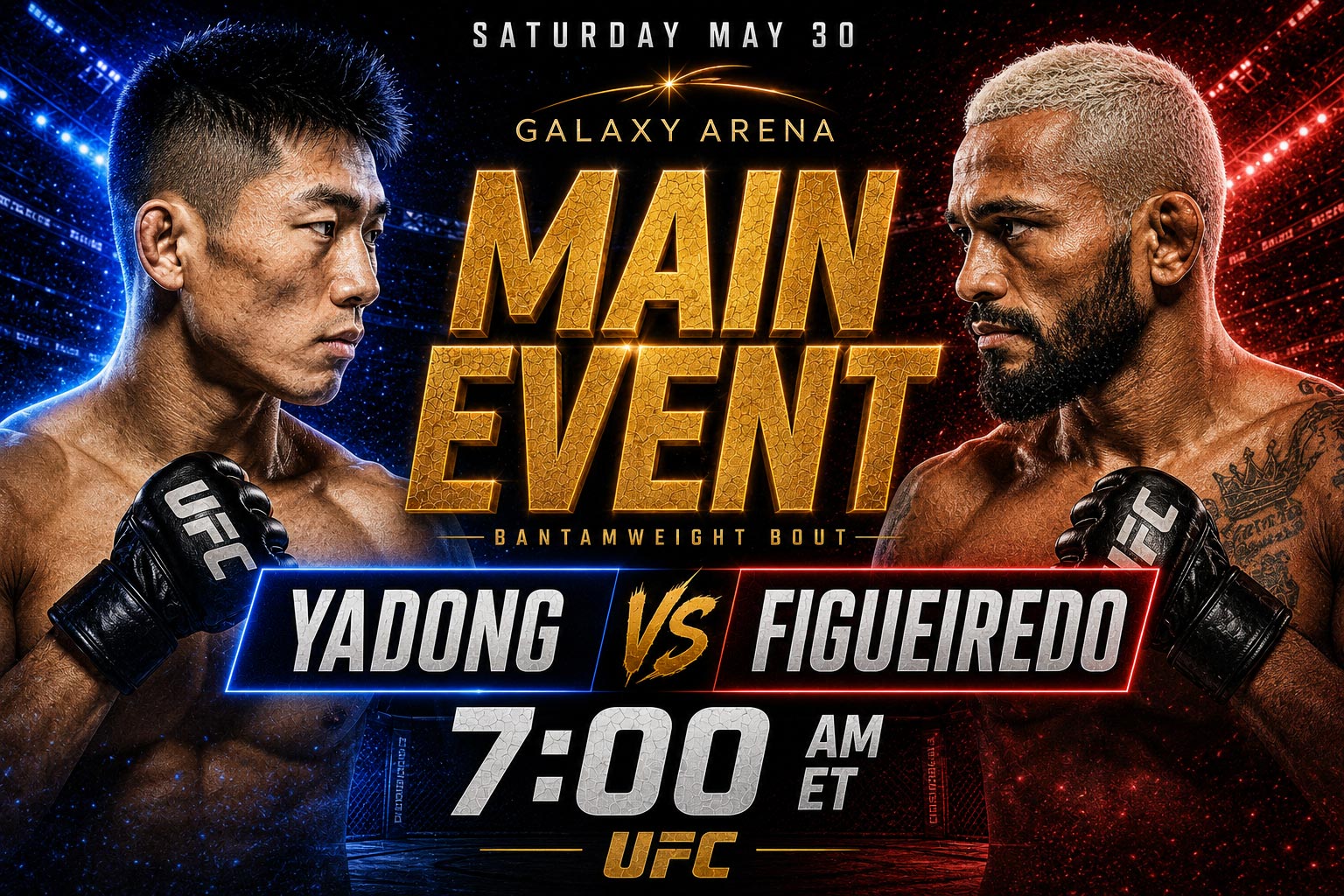
Song vs Figueiredo Props: Late Night Edge Play
The degens at my old P2P operation used to call Friday nights "amateur hour" – casual bettors loading up their weekend parlays after three IPAs, books posting lines that won’t get adjusted until Monday morning analysts clock in. But when you’ve got a UFC main event happening Saturday morning Beijing time (that’s Friday night Vegas time for those keeping score), you’re looking at a market inefficiency so obvious it might as well be wearing a neon sign. Song Yadong versus Deiveson Figueiredo is dropping May 30th at 7 AM ET from Galaxy Arena, and the prop markets are live right now while every sharp bettor worth their salt is either asleep or pretending they have a normal Friday night social life. This is textbook late-night edge play, and if you’re not attacking these numbers before the Saturday morning crowd wakes up and hammers them into oblivion, you’re leaving money on the table.
Song vs Figueiredo Props: Late Night Edge Play
The core thesis here is simple market psychology: books staff their Friday night shifts with B-team traders who set conservative lines, then wait for Saturday’s heavy action to tell them where they screwed up. With an international time slot fight, you’re getting prop markets that won’t see serious two-way action until it’s too late to capitalize on the soft numbers. Song-Figueiredo is particularly juicy because you’ve got a former flyweight champ (Figueiredo) who moved up to bantamweight facing a natural 135-pounder with legitimate knockout power – the kind of stylistic clash that creates massive variance in method-of-victory props.
The expected value calculation is straightforward: if books are pricing these props assuming a "standard" bantamweight fight, but the actual probability distribution is way wider due to the size differential and Figueiredo’s adjustment period, you’re getting inflated odds on the tails. Think about it like options trading – you want to buy volatility when it’s underpriced, and Friday night UFC props are basically cheap lottery tickets before the market realizes what it’s holding. My old Harvard roommate used to call this "calendar arbitrage" – exploiting the fact that information and capital don’t flow evenly across time zones and work schedules.
The specific edge we’re hunting: method-of-victory props that assume both fighters perform at their median outcomes, when the reality is this fight has a higher probability of ending in spectacular fashion (Song KO) or going to a grinding decision (Figueiredo wrestling). Books hate variance, so they price these binary outcomes conservatively, especially on Friday nights when they’re not trying to get cute with their exposure. That’s where we strike.
Why Friday Night Markets Are Begging to Get Beat
Every sportsbook in New York, New Jersey, and Ontario runs skeleton crews on Friday nights because their data shows most action comes Saturday morning through Sunday night. This isn’t speculation – I literally had friends who worked trading desks at major books, and they’d tell me Friday night was when they’d set lines, then basically monitor for sharp action without making aggressive adjustments. The assumption is that Friday night bettors are recreational players chasing weekend entertainment, not serious money looking for structural edges. That assumption creates opportunity.
The international time slot amplifies this inefficiency by a factor of ten. When a UFC card runs Saturday afternoon in Vegas, books know they’ll get two waves of action: Friday night casuals doing their homework, then Saturday morning sharps making final adjustments. But a Saturday morning ET card? The Friday night lines are essentially operating in a vacuum – there’s no Saturday morning adjustment period because the fights start before most Americans finish their coffee. You’re betting into numbers that were set Thursday afternoon by traders who won’t revisit them until it’s too late.
Here’s the risk mitigation angle: even if you’re wrong on your specific prop, you’re getting better odds than you would Saturday morning, which improves your long-term ROI even if your win rate stays constant. This is portfolio theory applied to sports betting – you’re not trying to hit every pick, you’re trying to consistently find +EV spots that compound over hundreds of bets. Friday night UFC props for international cards are one of the highest edge-per-unit-risk plays in the entire sports betting ecosystem, and most people are too busy doing normal Friday night stuff to notice.
The Plays
Song Yadong by KO/TKO (+180 to +220 depending on book)
- Figueiredo’s defensive striking has always been suspect, and he’s now absorbing shots from guys 10-15 pounds heavier
- Song has legitimate one-punch power and Figueiredo’s tendency to pressure-fight plays directly into it
- The odds should be closer to +150 based on fight tape analysis, but books are anchoring to Figueiredo’s championship pedigree
Fight Doesn’t Go the Distance (+105 to +120)
- Either Song catches him early or Figueiredo’s grappling takes over and gets a submission
- The middle outcome (competitive decision) requires both guys fighting conservative, which neither has shown tendency toward
- This is pure variance exploitation – the tails are fatter than the market thinks
Figueiredo Inside the Distance (+200 to +240)
- If Song’s power doesn’t land clean in rounds 1-2, Figueiredo’s cardio and wrestling become overwhelming
- This is your hedge against the Song KO play – you’re essentially betting "anything but a decision"
- Friday night books are underpricing finish props across the board on this card
The Strategy
The execution here is timing-dependent: you want to hit these numbers between 10 PM and 1 AM ET Friday night, after the casual action has dried up but before any sharp money shows up. Most books in Pennsylvania and Illinois will have the most exploitable lines during this window because they’re not adjusting for late-night action the way Nevada books do. Check multiple books – the variance in prop pricing Friday nights can be 20-30 basis points, which is massive when you’re talking about +200 odds.
Position sizing matters more than usual because you’re taking on correlation risk if you’re playing multiple props on the same fight. My rule from the dorm bookie days: never put more than 3% of your bankroll on correlated outcomes, even if the individual EV looks incredible. The whole point of edge play is to grind consistent profits, not to blow up your account because Figueiredo decides to fight the safest decision-oriented fight of his career. Think Kelly Criterion, not YOLO.
The Ontario market deserves special attention because Canadian books are notoriously slow to adjust UFC props compared to their American counterparts. If you’re in Toronto or Ottawa, you might find even softer numbers than what’s available in New York or Jersey. The liquidity is lower, which means books are less confident in their lines, which means more edge for you. This is literally the same market inefficiency that made my college operation profitable – finding jurisdictions where information flows slower and capitalizing before it catches up.
Look, I’m not saying Friday night Song-Figueiredo props are a guaranteed ATM machine – nothing in gambling is, and anyone who tells you otherwise is selling you something. But if you understand basic market structure and you’re willing to stay up past midnight on a Friday hunting for soft numbers, this is about as close to a structural edge as you’ll find in 2026 sports betting. The books are understaffed, the market hasn’t priced in the stylistic chaos of this matchup, and you’ve got a four-hour window before the sharp money shows up and ruins the party. Are you really going to let some 22-year-old overnight trader at DraftKings set better numbers than you? Because that’s who you’re fading right now. Drop your Friday night prop plays in the comments – I want to see who’s actually doing the work and who’s just talking about it.
WannaBet.com may receive compensation from the sportsbooks mentioned in this post if you sign up using our links. This doesn’t cost you a dime, but it keeps the lights on. Please bet responsibly. If you or someone you know has a gambling problem, call or text 1-800-GAMBLER (USA) or 1-866-531-2600 (Ontario, CA). 21+ only.
