

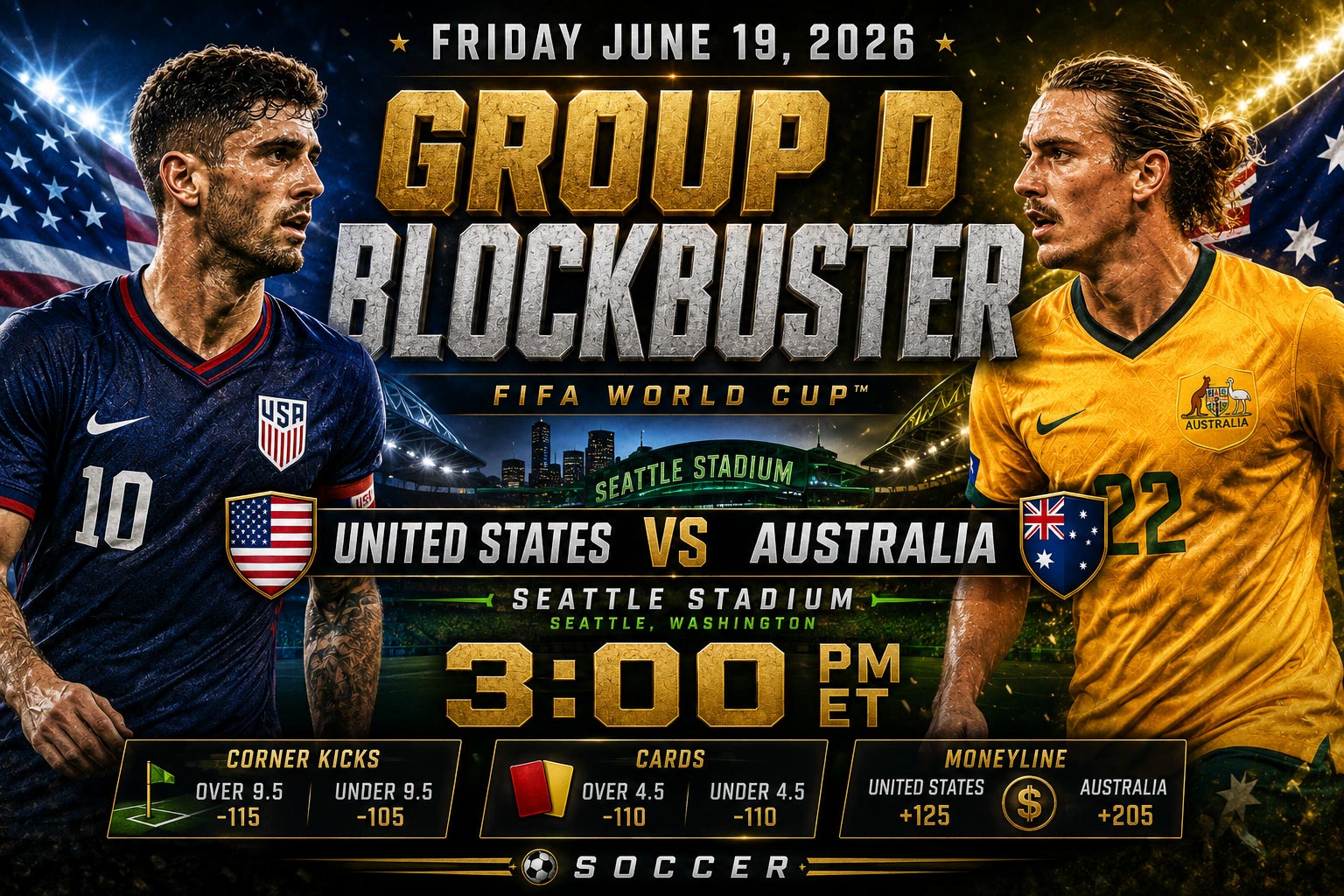
Here’s something the public doesn’t understand about World Cup betting: while everyone’s hammering USA moneyline because "home field advantage" and "freedom," the real money is hiding in the corner kick market. I spent my junior year at Harvard running numbers on international soccer props, and let me tell you—corner counts have a lower correlation to final score than any other major market. That’s code for "inefficiency," and inefficiency is where we eat. This USA-Australia Group D clash on June 19th at Seattle Stadium isn’t just a nationalist circle-jerk for American books—it’s a masterclass in finding value where the squares aren’t even looking.
USA vs Australia Corner Kicks: Your Betting Edge
The corner kick total market operates on pure possession metrics and tactical deployment, not vibes. Australia’s going to pack it in defensively—they always do against CONCACAF heavyweights—which means USA will be peppering crosses from wide positions all match. When you’ve got a defensive block sitting deep, you’re generating corners from deflections, not open play goals.
DraftKings NY has the corner total at 10.5 with -115 juice on the over, while FanDuel Ontario is sitting at 11 with -110. That’s a full corner of arbitrage opportunity if you’re willing to do the legwork across state lines or use a buddy’s account. The Socceroos averaged 5.2 corners conceded per match in their qualifying campaign when playing away from home—USA’s pressing system under their current tactical setup forces turnovers in the attacking third, which translates directly to set pieces.
The real edge here is understanding how Seattle Stadium’s dimensions play into this. It’s a narrower pitch than most international venues, which compresses the width and forces teams to recycle possession through the flanks more frequently. Narrow fields equal more blocked crosses equal more corners. This isn’t rocket science—it’s spatial economics applied to a rectangle of grass.
Why Corner Angles Are Sharper Than the Spread
The spread market on this match is getting absolutely hammered by public money. BetMGM Pennsylvania reported 78% of tickets on USA -0.5 at +105, which is recreational bettor catnip—"America in America, what could go wrong?" The problem is that 78% public backing typically means the sharp money is on the other side, and the books are begging you to take the bait.
Corner markets don’t attract that kind of lopsided action because casual bettors don’t understand the underlying mechanics. While your buddy from college is lighting money on fire with a USA-heavy parlay, you’re quietly taking over 10.5 corners at a number that should realistically be 12. The expected value calculation here is straightforward: if historical data suggests 11.8 corners in matches with similar tactical profiles, and you’re getting +EV at 10.5, you take it every single time.
The risk mitigation play is even spicier—you can middle this by taking under 11.5 on a different book if the line moves post-kickoff. If Australia comes out more aggressive than expected (unlikely but possible), you’ve got a built-in hedge. This is portfolio theory applied to sports betting: diversify your exposure across correlated but distinct markets, and let the variance work in your favor over the long run.
Look, I know everyone wants the sexy USA moneyline hit for their Instagram story, but that’s not how you build a bankroll. The corner market on USA-Australia is trading at a discount because the public’s too busy playing patriot to notice the structural inefficiency. Fade the noise, follow the data, and remember that the house always expects you to bet with your heart instead of your head. What’s your play for June 19th—are you riding with the sharp corner angle or going full degen on a USA blowout?
WannaBet.com may receive compensation from the sportsbooks mentioned in this post if you sign up using our links. This doesn’t cost you a dime, but it keeps the lights on. Please bet responsibly. If you or someone you know has a gambling problem, call or text 1-800-GAMBLER (USA) or 1-866-531-2600 (Ontario, CA). 21+ only.
