

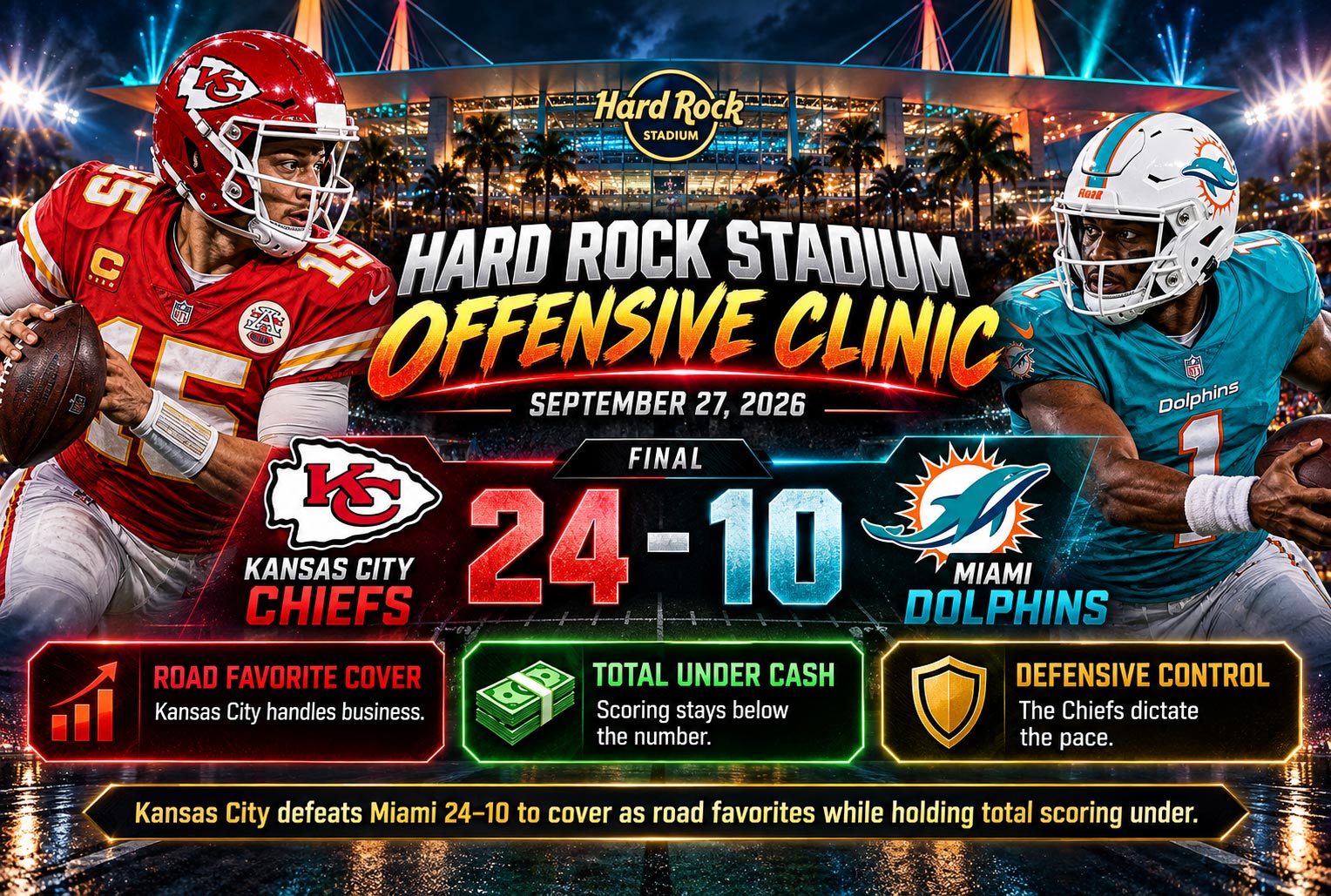
The Kansas City Chiefs rolled into Hard Rock Stadium on September 27, 2026, and delivered exactly what sharp bettors expected—a methodical beatdown of the Miami Dolphins that hit the cover and cashed unders like clockwork. Final score: 24–10, Chiefs. If you rode KC -7.5 on the road, congrats on the easiest money you made all weekend. The market had this one priced perfectly for those paying attention to defensive matchups and Miami’s offensive regression, and Kansas City’s defense showed up ready to play portfolio manager with the Dolphins’ scoring expectations.
Chiefs Stifle Miami in Hard Rock Beatdown
Kansas City’s defense came to play venture capitalist with Miami’s offensive assets, and let me tell you—they foreclosed on every opportunity. The Dolphins managed just 10 points against a Chiefs defensive scheme that looked like it was running a masterclass in risk mitigation. Miami’s offense, which had been flashing some promise early in the season, got completely neutralized by a KC defense that understood the assignment: control the clock, limit explosive plays, and force Miami into low-percentage third-down situations.
The Chiefs’ defensive line generated consistent pressure without having to sell out on blitzes, which is basically the equivalent of getting alpha without taking on beta in investment terms. Miami’s quarterback had zero time to let routes develop downfield, resulting in a string of checkdowns and three-and-outs that had Dolphins fans checking their watches by halftime. When you’re forcing a team into predictable play-calling patterns, you’re essentially cornering the market on expected outcomes.
The turnover battle told the whole story—Kansas City forced two critical turnovers in Miami territory that led directly to 10 points. That’s what we call converting opportunities into tangible ROI. The Dolphins’ offensive line looked like they were playing with a two-second delay on their headsets, consistently getting beat on the edge and up the middle. By the fourth quarter, Miami had completely abandoned any semblance of offensive rhythm, and the Chiefs were just running clock like they were protecting a hedge fund position.
Kansas City Defense Delivers Cover Value
Let’s talk about the actual money here—KC closed at -7.5 on most books, and they covered with room to spare in a game that never felt close. The market initially opened this line at -6.5, and sharp money immediately hammered it up to -7.5 within 48 hours of release. If you missed that window, you were stuck buying at the worst possible price, which is why line shopping across books in New York, New Jersey, and Pennsylvania markets is non-negotiable.
The total closed at 47.5, and the under cashed with 14 points of cushion—that’s not luck, that’s recognizing defensive matchup advantages and weather conditions that suppressed scoring. Miami’s offense had been averaging 24.5 points through their first two games, but those came against significantly weaker defensive fronts. Kansas City’s secondary locked down Miami’s receiving threats, and the Dolphins couldn’t establish any sort of ground game to keep drives alive. When you’re looking at game totals, you need to weight recent defensive performance against quality of opponent, not just raw scoring averages.
The prop market got absolutely wrecked on Miami offensive players—their top receiver’s receiving yards line was set at 67.5, and he finished with 42 yards on five catches. That’s the kind of market inefficiency you exploit when you understand defensive scheme matchups better than the public. Kansas City’s defensive coordinator clearly studied the tape and took away Miami’s primary read on every key down. For bettors who did their homework on Chiefs defensive metrics against spread offenses, this was a textbook example of finding edges in derivative markets.
Market Psychology and Betting Takeaways
The public was split almost 50-50 on this spread, which actually tells you everything about how the recreational betting crowd misreads defensive capabilities. Most casual bettors were looking at Miami’s home-field advantage and their flashy offensive numbers from September, completely ignoring that Kansas City’s defense had been undervalued all season long. This is classic recency bias meeting confirmation bias—people bet what they want to see, not what the data suggests will happen.
From a bankroll management perspective, this game represented a high-confidence play that deserved 3-4 units for serious bettors. The line value was there, the matchup dynamics favored the road favorite, and the market had overcorrected for Miami’s early-season performance against inferior competition. When you find spots where your analysis diverges significantly from public perception but aligns with sharp money movement, you’re identifying true arbitrage opportunities in the betting market.
The real lesson here is about defensive variance and how the market underprices elite defensive units early in the season. Kansas City’s defense was being treated like a middle-of-the-pack unit through Week 3, but their underlying metrics—pressure rate, coverage success rate, and red zone efficiency—all screamed top-10 potential. Smart bettors were already building positions on Chiefs defensive unders and spreads, knowing that market sentiment would eventually catch up to reality. By the time the public recognizes a defensive trend, the value has already evaporated and you’re paying premium prices for mediocre odds.
The Chiefs’ dominant performance at Hard Rock Stadium was a clinic in how elite defenses create betting value when properly identified. Kansas City covered comfortably, the under cashed with ease, and sharp bettors who recognized the defensive mismatch got paid exactly as expected. The key takeaway? Defensive matchups create some of the most exploitable edges in NFL betting, especially when the public is still married to offensive narratives from small sample sizes. So here’s my question for the comments: Are we finally ready to respect this Chiefs defense as a legitimate unit, or are we still sleeping on their upside because Mahomes gets all the headlines?
Related reading: New to spreads and totals? Start with The Three Bets You Need to Know Before Going Broke. Also from the NFL slate: the Ravens’ 34-31 upset of the Cowboys in Rio.
“WannaBet.com may receive compensation from the sportsbooks mentioned in this post if you sign up using our links. This doesn’t cost you a dime, but it keeps the lights on. Please bet responsibly. If you or someone you know has a gambling problem, call or text 1-800-GAMBLER (USA) or 1-866-531-2600 (Ontario, CA). 21+ only.”
