

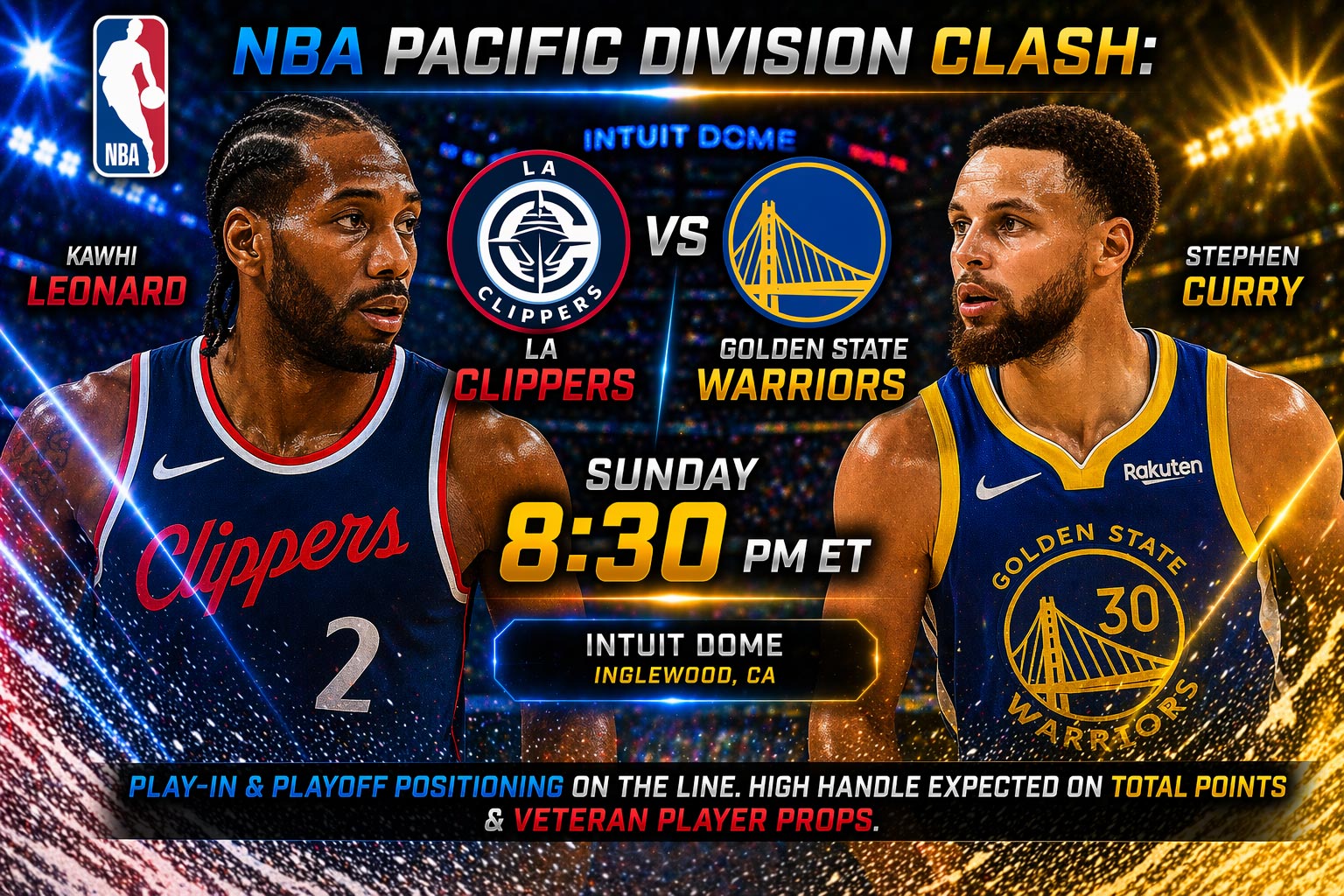
Look, I get it. Sunday night NBA in March isn’t exactly the Super Bowl, but that’s precisely why sharp money gets made on games like Clippers-Warriors. While the public’s busy hammering Lakers futures and crying about their DraftKings parlays, there’s legitimate value sitting right in front of us at the Intuit Dome. This isn’t some random Tuesday tank-fest—both teams are scrapping for playoff positioning, which means rotation patterns are predictable and the effort level isn’t in question.
The total for this game opened around 225.5 and has already seen movement, which tells me the market is still trying to figure out what it wants to be. Books are getting two-way action, retail bettors are doing their usual “overs because Steph Curry” thing, and meanwhile, there’s an actual edge hiding in the noise. Let’s break down why this number is softer than a venture capitalist’s handshake.
Why the Market’s Sleeping on This Over/Under Play
The first thing you need to understand is that totals are all about pace and efficiency, not just “good offense vs bad defense” narratives that ESPN shoves down your throat. Golden State ranks 4th in pace this season, pushing tempo even when they probably shouldn’t, while the Clippers under Ty Lue have been more deliberate—sitting around 15th in pace. When these two styles collide, the public automatically assumes we’re getting a track meet because “Warriors = points,” but the reality is more nuanced than your average bettor’s analysis.
Here’s where it gets interesting: the Clippers have been running a tighter rotation since the trade deadline, leaning heavily on their core guys in meaningful games. Kawhi and PG (when healthy) eating up 35+ minutes means fewer garbage-time possessions with third-stringers jacking threes. The Warriors, meanwhile, have been inconsistent with their bench production—some nights Kuminga looks like a future All-Star, other nights he’s putting up cardio numbers. This variance matters more for totals than spreads.
The sharp play here isn’t just blindly smashing one side—it’s understanding when points get scored. Both teams are top-10 in half-court efficiency, which sounds like over fuel, but half-court basketball inherently means fewer possessions per 48 minutes. If this game settles into a playoff-style grind with both teams actually playing defense (wild concept, I know), we’re looking at a number that could easily slide under. The market’s pricing in Golden State’s reputation without accounting for their recent defensive improvements.
The Matchup Matrix: Where Value Actually Lives
Let’s talk personnel for a second because this isn’t just abstract theory—actual humans play these games. The Clippers have been elite at defending the three-point line this season, holding opponents to 35.2% from deep, which is top-5 in the league. Golden State’s entire offensive identity revolves around the three-ball, attempting the 2nd-most threes per game. When an elite three-point shooting team meets an elite three-point defense, something’s gotta give, and historically, defense wins that battle more often than Vegas prices in.
On the flip side, Golden State’s interior defense has been suspect all year, ranking 23rd in opponent field goal percentage in the paint. Normally, this would be a green light for Kawhi and PG to attack the rim, but here’s the catch—both guys have been managing minutes and are more selective about when they turn on “playoff mode.” In a regular season game with playoff implications but not immediate urgency, we might see a more measured approach rather than a 130-point explosion. This is classic expected value calculation: high probability of moderate scoring beats low probability of fireworks.
The injury report also matters here, and I’m not just talking about the obvious stuff. Role players like Bones Hyland or GP2 can swing totals by 3-4 points just based on whether they’re chucking or playing actual basketball. Check the injury reports closer to tip-off, because if either team is down a key rotation piece, that affects both pace and efficiency. The books adjust slower than you’d think, especially on Sunday afternoon when the trading desks are running on skeleton crews.
The Play: How I’m Actually Betting This
The Strategy:
- Wait until 90 minutes before tip for the sharpest line
- Monitor the injury reports religiously—this isn’t set-and-forget
- Consider live betting the total at halftime if the first quarter is chaotic
The Logic:
I’m leaning under, but not because I think this will be a 195-point snoozefest. The number feels inflated by about 3-4 points based on Golden State’s brand value and recency bias from their high-scoring games against trash defenses. The Clippers are a legitimate playoff-caliber defense, and this game matters enough that both teams will actually try on that end of the floor. When effort meets execution in the halfcourt, unders cash more than the public realizes.
The Risk Assessment:
The biggest threat to this thesis is a blowout. If either team gets up 20+ in the third quarter, we’re getting garbage-time three-point contests that artificially inflate the total. That’s why I’m also eyeing the team totals—Clippers under 113.5 might offer cleaner exposure without the variance of Golden State potentially going nuclear. Diversification isn’t just for your 401(k), folks.
Here’s my actual move: I’m putting 1.5 units on the under at anything 226 or higher, and if we get 227+, I’m bumping it to 2 units. The expected value is there, the market psychology supports it, and frankly, I trust Ty Lue’s defensive schemes more than I trust Steve Kerr’s rotations in March. Is this a mortal lock? No, because those don’t exist. But it’s a +EV play with a defendable thesis, which is literally all we’re looking for.
At the end of the day, beating the book isn’t about picking winners—it’s about finding prices that don’t reflect reality. The public sees Warriors-Clippers and thinks “points,” but the actual game environment suggests something different. Whether you tail this or fade it, at least you’re thinking about why the number is what it is, not just what your gut tells you after three beers. Drop your actual plays in the comments—are you riding with the under or do you think I’m completely cooked on this one?
WannaBet.com may receive compensation from the sportsbooks mentioned in this post if you sign up using our links. This doesn’t cost you a dime, but it keeps the lights on. Please bet responsibly. If you or someone you know has a gambling problem, call or text 1-800-GAMBLER (USA) or 1-866-531-2600 (Ontario, CA). 21+ only.
