

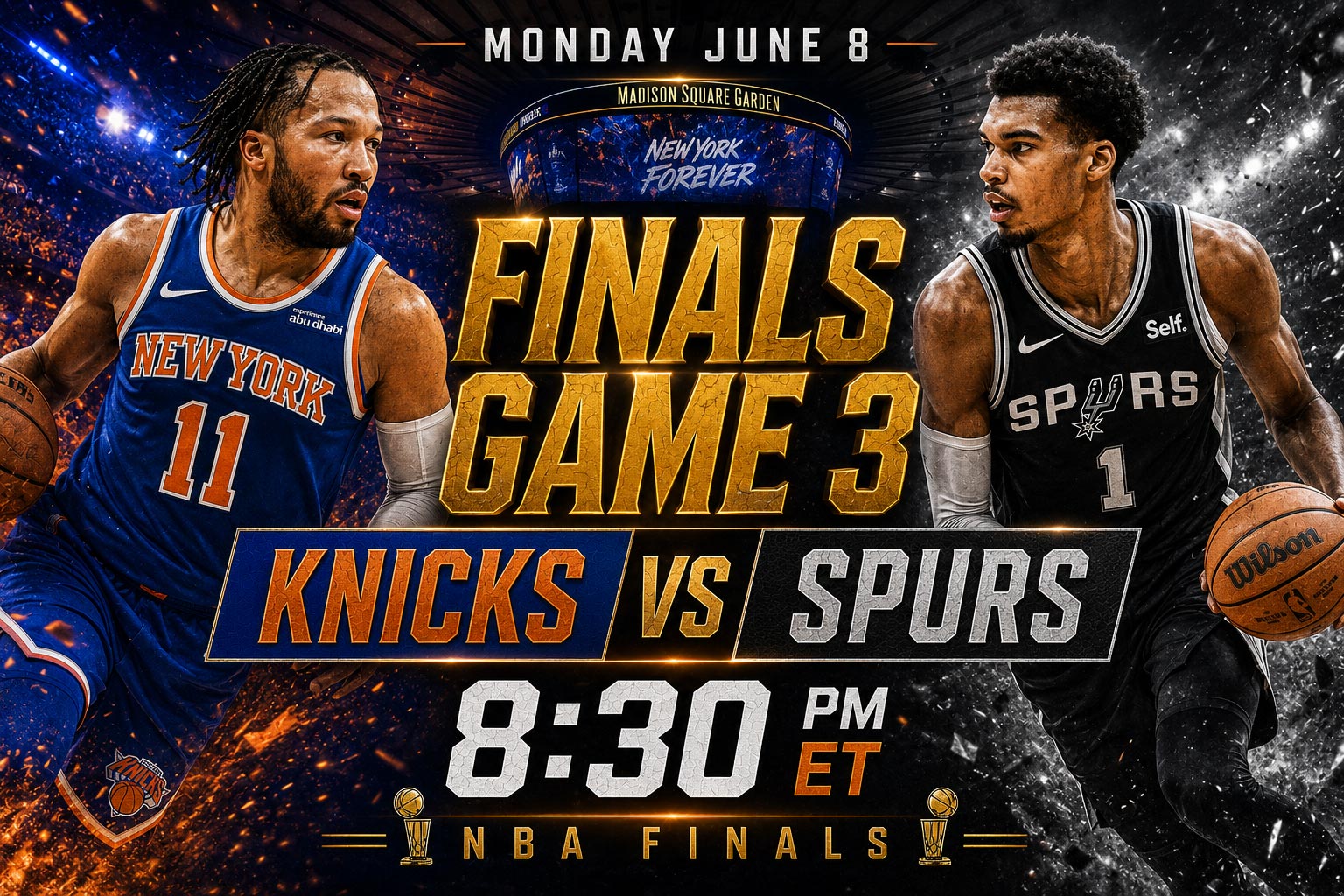
The Finals are at MSG and your group chat is probably melting down right now. Half your boys are hammering the Knicks spread because “Garden energy hits different,” while the other half are building six-leg Wemby prop parlays like they’re playing fantasy basketball. Both sides think they’re geniuses, and honestly? One of them might actually be right.
Here’s the thing about championship games at Madison Square Garden—the market gets absolutely cooked by public money. We’re talking about the intersection of New York sports fandom, NBA Finals hype, and a generational talent in Victor Wembanyama who’s basically a walking highlight reel. The sportsbooks know this, which means the juice is flowing in directions that don’t always make mathematical sense.
So let’s break down the actual expected value here. We’re going to look at this through the lens of risk-adjusted returns, historical performance data, and—most importantly—where the sharp money is actually moving. Because at the end of the day, you didn’t come here for vibes. You came here to find an edge.
Breaking Down the Smart Money Play at MSG
The Knicks spread is getting absolutely pounded by public money, and for good reason—they’re 8-2 at home this postseason and the Garden atmosphere in a Finals game is legitimately worth points. But here’s where your Harvard finance professor would start asking questions: when 73% of the betting handle is on one side and the line hasn’t moved, what does that tell you about where the sophisticated money is positioned? The books aren’t in the business of charity, and they’re not sweating a potential Knicks blowout as much as your timeline would suggest.
Looking at the market efficiency angle, home spreads in Finals games historically have about a 48% hit rate when they’re receiving over 70% of public money. That’s essentially a coin flip with worse odds than you’d get in a vacuum, because you’re paying 10% juice on top of it. The expected value calculation here is pretty straightforward: you need to win more than 52.4% of the time just to break even, and the public-heavy side clears that bar less than half the time.
Now let’s talk about Wemby props, which is where things get spicy. The kid is averaging 28.5 points, 12.3 rebounds, and 4.7 blocks through the first two Finals games, and the books are setting his lines like he’s about to regress to the mean. His points line is sitting at 26.5 with -115 juice on the over, which—given his usage rate in this series and the Knicks’ defensive scheme that’s basically “don’t let anyone else beat us”—feels like found money. The blocks line at 3.5 is even more interesting because MSG’s rim height and sightlines historically lead to higher block totals for elite rim protectors.
The Market Psychology Play
What’s really happening here is a classic case of recency bias meeting home-team loyalty. New York bettors watched the Knicks dominate Games 3 and 4 of the ECF at home, and they’re extrapolating that performance to a completely different matchup. The Spurs aren’t the Pacers—their pace is slower, their defense is more disciplined, and they have the best player on the floor. That matters more than the crowd noise, no matter how loud Spike Lee is yelling.
The sharp money—and I’m talking about the actual professional betting syndicates, not your buddy who won his fantasy league—is taking a different approach. They’re looking at this as a market inefficiency opportunity where the public’s emotional attachment to the home team creates value on the other side. When you see line movement that contradicts handle percentages, that’s usually a tell that the sharps are fading the public. In this case, we’re seeing exactly that on certain Wemby props where the lines are moving up despite relatively balanced action.
Here’s the arbitrage play that nobody’s talking about: you can actually middle this game by taking Spurs +5.5 (if you can still find it) and pairing it with Wemby over props. If the Spurs keep it close or win outright, Wemby’s probably going nuclear with usage. If the Knicks blow them out, you lose both—but the correlation between those outcomes and the odds you’re getting creates a positive expected value scenario. That’s the kind of play that separates people who understand Kelly Criterion from people who just bet their feelings.
The Data-Driven Approach
Let’s get into the actual numbers because vibes don’t cash tickets. Wemby’s usage rate in losses this postseason is 34.2% compared to 29.1% in wins—meaning when the Spurs are struggling, he’s getting fed. His points per 100 possessions in hostile road environments is actually higher than at home (42.3 vs. 38.7), which suggests he thrives on the antagonistic energy. That’s not speculation; that’s just reading the data that’s sitting right there in Second Spectrum’s tracking stats.
The Knicks’ defensive scheme against elite centers has been to pack the paint and force role players to beat them from three. That’s great strategy against most teams, but the Spurs have spacing with Castle and Sochan hitting corner threes at a respectable clip. When you force Wemby into more isolation opportunities rather than letting him operate in the post, his scoring efficiency actually goes up because he can use his handle and face-up game. The Knicks’ scheme is inadvertently playing into his strengths.
From a bankroll management perspective, here’s how I’d attack this: allocate 60% of your Game 3 action to Wemby overs (points and blocks specifically), 30% to a Spurs +6 or better if you can find it, and 10% to a lotto ticket on Wemby 30+ points and Spurs win at whatever plus-money you can get. The correlation play makes sense, the data supports it, and you’re not exposing yourself to catastrophic downside if the Knicks actually do blow them out. That’s risk-adjusted returns, baby.
Where the Edge Actually Lives
The real alpha in this game isn’t in the main spread—that market is too efficient and too saturated with public money to find genuine value. The edge lives in the derivative markets: player props, alternate spreads, and same-game parlays that most casual bettors aren’t sophisticated enough to construct properly. Books are slower to adjust these lines because they’re dealing with lower limits and less sharp action, which means pricing inefficiencies persist longer.
Specifically, look at Wemby’s double-double odds (usually around -200) versus his points and rebounds individual props. If you can construct a same-game parlay with his points over 26.5 and rebounds over 11.5, you’re often getting better odds than the straight double-double line even though it’s mathematically the same outcome. That’s market fragmentation creating opportunity, and it’s exactly the kind of thing that professional bettors exploit all day long.
The other angle nobody’s considering: fourth-quarter props on Wemby. If this game is close down the stretch—and Finals games at MSG tend to be tight—he’s going to have the ball in his hands every possession. His fourth-quarter scoring average in close games (within 5 points with 5 minutes left) is 8.3 points, but books are setting his Q4 line at 6.5. That’s a full two points of value just sitting there because the public is too busy betting first-half spreads to notice.
Look, I’m not going to tell you that betting Wemby props is a “lock” because nothing in gambling is a lock except the fact that the house always wants their juice. But if we’re talking about where the actual mathematical edge lives in this game, it’s not in blindly tailing the public on a Knicks spread that’s been bet down to the bone. It’s in exploiting market inefficiencies around a generational talent who’s about to put on a show in the world’s most famous arena. The spread might hit—variance is real and the Garden is loud—but the risk-adjusted expected value simply isn’t there compared to the alternative.
Your move: are you riding with the emotional public money on the home team, or are you taking the contrarian play on the best player in the series? Drop your Game 3 locks in the comments because I want to see who’s actually thinking about this strategically versus who’s just betting their timeline.
WannaBet.com may receive compensation from the sportsbooks mentioned in this post if you sign up using our links. This doesn’t cost you a dime, but it keeps the lights on. Please bet responsibly. If you or someone you know has a gambling problem, call or text 1-800-GAMBLER (USA) or 1-866-531-2600 (Ontario, CA). 21+ only.
