

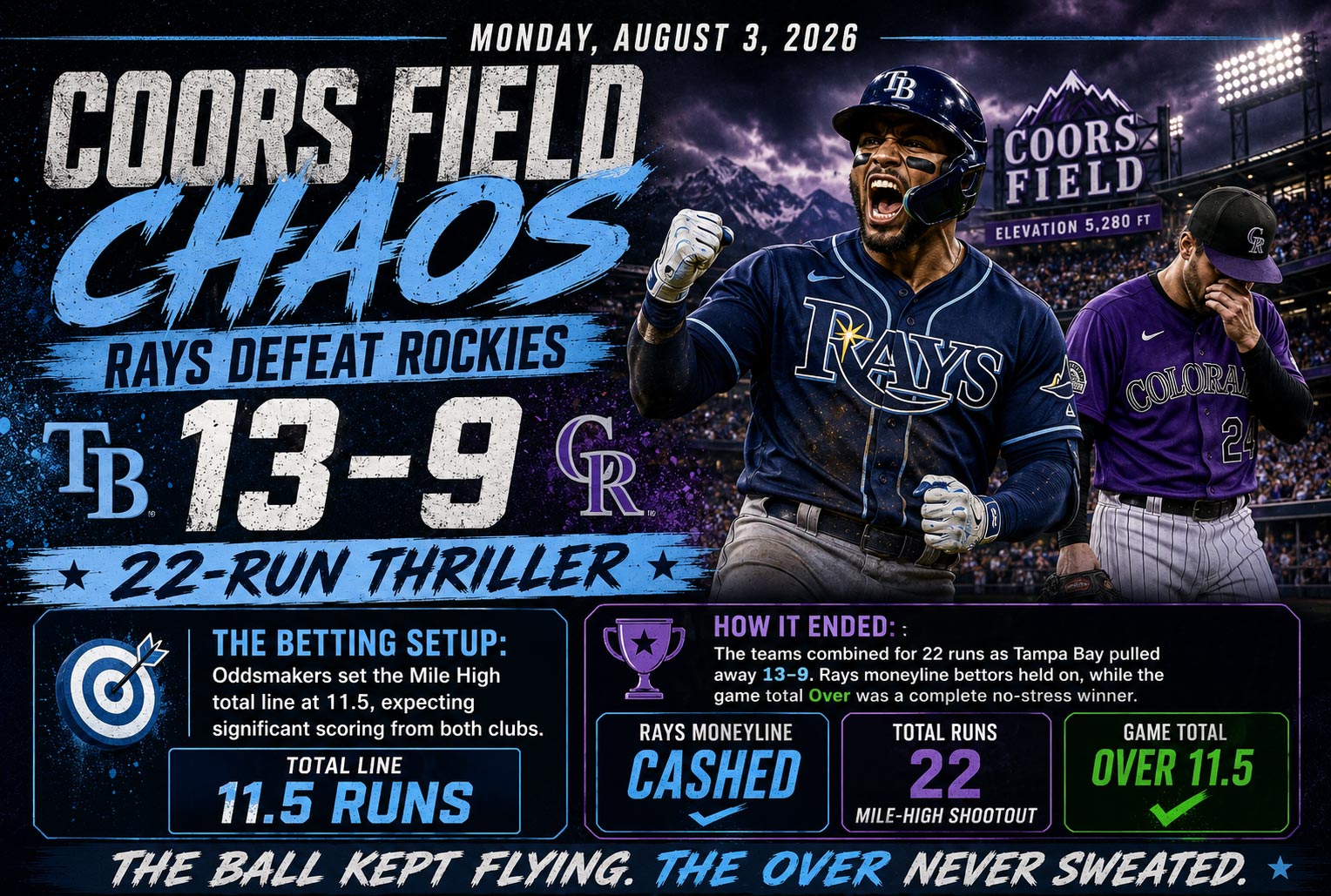
The Rays just beat the Rockies 13-9 at Coors Field on Monday night, and if you didn’t hammer the Over at 11.5, you’re doing this whole sports betting thing wrong. This wasn’t some miracle backdoor cover or a ninth-inning push that made your Apple Watch blow up—this was a textbook exploitation of market inefficiency that sharp bettors have been printing money on for years. Twenty-two combined runs in Denver isn’t newsworthy anymore; it’s basically the expected outcome, and yet books keep setting these totals like they’re pricing a sea-level stadium.
Coors Field Over Hits Again in 22-Run Slugfest
The numbers from Monday’s game tell a story that should surprise exactly nobody who’s been paying attention. Tampa Bay came into Denver and put up 13 runs on the Rockies, who managed a respectable 9 of their own, cruising past that 11.5 total before most East Coast bettors even checked the final score. The Rays moneyline crew got to sweat a little bit—because what’s baseball betting without some unnecessary cardiac events—but the Over bettors were counting their money by the seventh inning stretch.
Here’s what actually happened: both offenses did exactly what they’re supposed to do at 5,280 feet above sea level. The physics don’t lie—baseballs travel roughly 5-10% farther in Denver’s thin air, breaking balls don’t break as sharply, and pitchers who look like Cy Young candidates anywhere else suddenly resemble batting practice fodder. The Rays racked up 15 hits, the Rockies added 12 more, and everyone who understood basic atmospheric science cashed their tickets.
The game flow was never in doubt for Over bettors. By the fourth inning, we already had 11 runs on the board, and both bullpens looked like they were auditioning for a “how not to pitch” instructional video. This wasn’t a grind-it-out pitcher’s duel that randomly exploded late—this was Coors Field doing Coors Field things from the first pitch, exactly as the market should have anticipated.
Why Mile High Totals Are Still Free Money
Let’s talk about market psychology for a second, because this is where the edge lives. Oddsmakers set this total at 11.5, which honestly feels like they’re either trolling us or they’ve never actually watched a baseball game played in Denver. The historical data is screaming at you: Coors Field averages roughly 1.5-2 more runs per game than a typical MLB stadium, and yet books consistently set totals that don’t fully account for this altitude advantage.
The beautiful thing about Coors Over bets is that you’re not gambling—you’re arbitraging atmospheric physics against public betting patterns. Casual bettors still think 11.5 sounds “high” because they’re anchoring to what totals look like at Yankee Stadium or Fenway, but that’s apples-to-oranges analysis. You’re essentially getting paid to understand that air density affects ball flight, which is something you learned in high school physics class but apparently forgot when you started betting baseball.
Here’s the risk mitigation framework: when you’re betting Coors Overs, you’re building in natural variance protection. Even if one team gets shut down early, you’ve got two offenses swinging in conditions that favor hitters, plus bullpens that are gassed from playing every other day. The expected value calculation is almost comically tilted in your favor, especially in matchups where neither starting pitcher has elite stuff.
The Smart Money Approach
So what’s the actual strategy here beyond “Coors Field = bet Over”? First, you need to check the pitching matchups and weather conditions—wind blowing out is your best friend, while rare humid days can slightly suppress scoring. Monday’s game featured two mid-rotation starters and perfect hitting conditions, which should have made this Over bet feel like stealing candy from a baby.
Second, don’t get cute trying to middle or hedge these plays. The market might adjust the total upward to 12 or 12.5 for some games, and you’ll see bettors trying to get clever by taking the Under at the higher number. That’s how you end up on the wrong side of a 22-run explosion, looking like you outsmarted yourself. When the fundamentals point one direction this strongly, you ride the wave and collect your money.
The bankroll management piece matters too—just because Coors Overs hit at a profitable rate doesn’t mean you should be dumping your entire roll on every Rockies home game. Standard unit sizing applies here (2-3% of your bankroll max), but you can absolutely treat these as core portfolio plays rather than speculative longshots. Think of it as buying blue-chip stocks that happen to pay dividends in the form of runs scored at altitude.
The Coors Field Over isn’t some secret anymore, but apparently it doesn’t matter—books keep setting these totals low enough to beat, and bettors keep cashing tickets. If you’re in New York, New Jersey, or Ontario and you’re not building Coors Overs into your MLB betting strategy, you’re leaving money on the table that could be funding your next Vegas trip. What’s your go-to Coors Field betting strategy—straight Overs, first-five-innings, or are you one of those psychopaths betting Unders out of principle?
WannaBet.com may receive compensation from the sportsbooks mentioned in this post if you sign up using our links. This doesn’t cost you a dime, but it keeps the lights on. Please bet responsibly. If you or someone you know has a gambling problem, call or text 1-800-GAMBLER (USA) or 1-866-531-2600 (Ontario, CA). 21+ only.
