

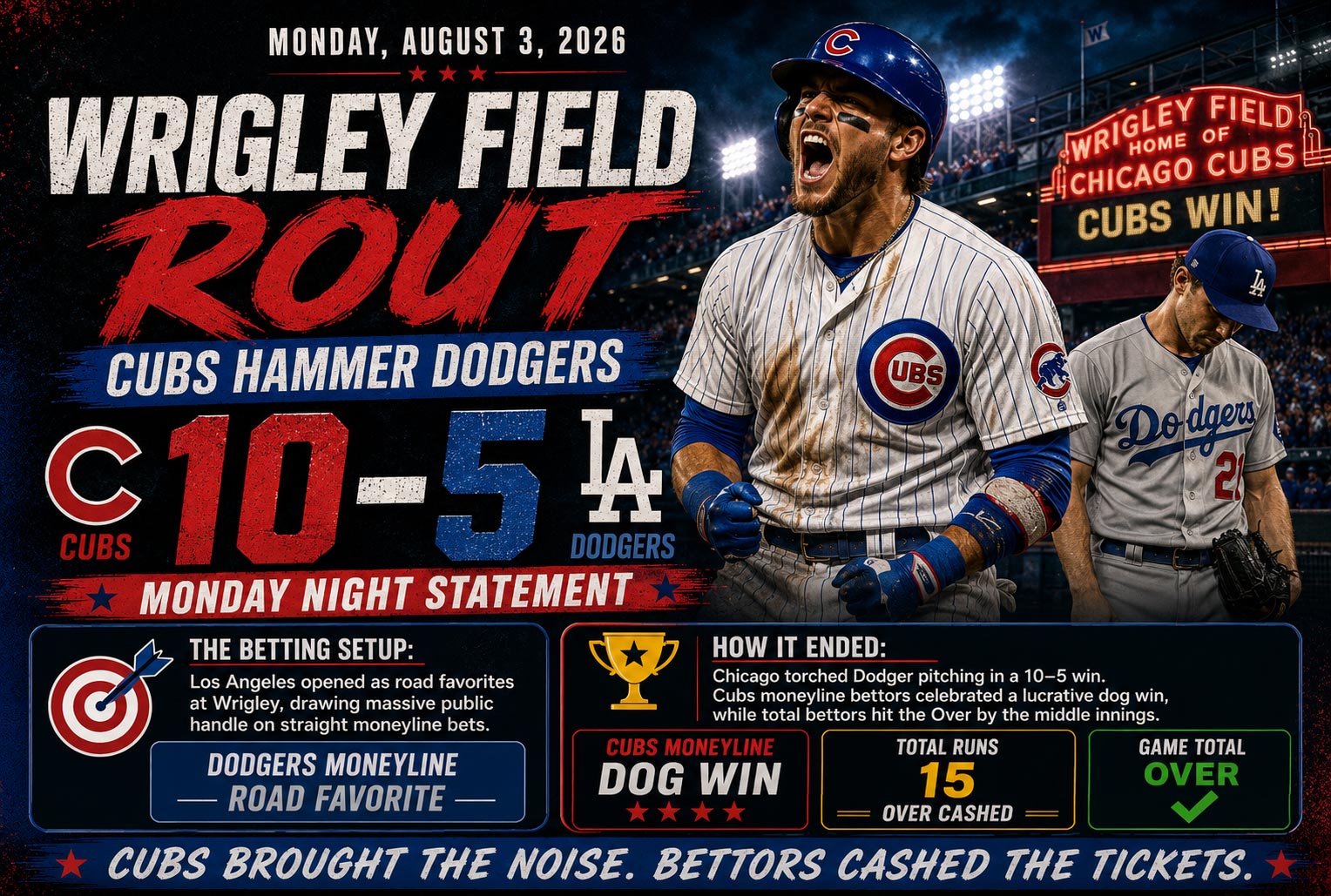
The public got absolutely cooked at Wrigley on Monday night, and honestly? It was beautiful to watch. The Dodgers rolled into Chicago as road favorites—because apparently everyone forgot that baseball is chaos wrapped in a nine-inning package—and proceeded to get their teeth kicked in by a Cubs squad that had zero business being underdogs. Final score: Cubs 10, Dodgers 5, and somewhere in Vegas, a sharp bettor just paid off his student loans. This wasn’t just a win; it was a masterclass in market inefficiency and why fading public money is basically printing cash when you know where to look.
Cubs Upset Dodgers: Dogs Bark Loud at Wrigley
The betting public loves two things: big-market teams and recency bias. So when the Dodgers opened as -145 favorites at Wrigley Field on August 3rd, 2026, the squares lined up like it was iPhone release day. Never mind that the Cubs had been scrappy at home all season or that LA’s bullpen had been leaking runs like a frat house roof. The public saw "Dodgers" and hammered that moneyline harder than a Goldman intern crushes Red Bulls during earnings season.
Chicago had other plans. By the third inning, the Cubs were up 5-1, and by the fifth, Dodger pitching looked like they were serving up batting practice meatballs at a Little League fundraiser. The final 10-5 scoreline doesn’t even tell the full story—this was a systematic dismantling that had sharp bettors popping champagne before the seventh-inning stretch. Cubs moneyline bettors at +125 were looking at a 25% ROI on a Monday night, which in gambling terms is basically insider trading (but legal).
The real winners? Anyone who recognized the value proposition here. When you’ve got a home team catching plus-money against a road favorite that’s been overvalued by public perception, that’s not gambling—that’s arbitrage with better odds. The sharps knew what the public didn’t: betting markets aren’t efficient when 80% of the handle comes from casual fans who think the Dodgers logo is a license to print money. Spoiler alert: it’s not.
How Sharp Bettors Cashed on Chicago’s Blowout
Let’s talk about how the smart money operated here, because this is where the MBA pays for itself. Sharp bettors don’t just bet on teams they "like"—they identify market inefficiencies and exploit them with surgical precision. When books opened the Dodgers at -145, the sharp action immediately hit Cubs +125, but the public money was so heavy on LA that the line barely budged. That’s your first red flag that you’re on the right side: when the line doesn’t move despite sharp money coming in, the books know they’re about to take public cash to the cleaners.
The over/under opened at 8.5 runs, and if you had even a passing knowledge of these two bullpens, you were smashing that Over button like it owed you money. By the middle innings, with the score already 7-3, Over bettors were basically doing victory laps around their living rooms. This is textbook expected value calculation: when two teams with questionable pitching depth meet at a hitter-friendly park on a warm August night, the math isn’t complicated. The public split was roughly 50-50 on the total, but the sharp money was 70% on the Over—and they were right, as usual.
Here’s the kicker that separates the pros from the amateurs: sharp bettors weren’t just hitting the Cubs moneyline. They were playing Cubs first five innings, Cubs run line at +1.5 (basically free money), and live betting the Over as Dodger pitching imploded. Risk mitigation through diversified positions, baby. While the public was married to their Dodgers -145 tickets, watching them burn in real-time, the sharps had five different ways to win. That’s not luck—that’s portfolio theory applied to sports betting, and it’s why some people vacation in Cabo while others complain about bad beats in Reddit threads.
Monday night at Wrigley was a reminder that the betting market isn’t some perfectly efficient machine—it’s driven by human psychology, recency bias, and the fact that most people bet with their hearts instead of their spreadsheets. The Cubs didn’t just beat the Dodgers; they exposed every casual bettor who thought road favorites were automatic money and every square who ignored the fundamentals. If you’re still betting based on team logos instead of market value and situational edges, you’re not gambling—you’re donating. So here’s my question for the comments: did anyone actually have the stones to hammer Cubs +125, or were you all too scared to fade the public? Because that’s where the real money lives.
WannaBet.com may receive compensation from the sportsbooks mentioned in this post if you sign up using our links. This doesn’t cost you a dime, but it keeps the lights on. Please bet responsibly. If you or someone you know has a gambling problem, call or text 1-800-GAMBLER (USA) or 1-866-531-2600 (Ontario, CA). 21+ only.
