

Here’s the uncomfortable truth nobody wants to admit: your bankroll management sucks. I’ve watched trust fund kids blow through five figures in a weekend and bartenders turn $200 into a sustainable side hustle, and the difference has nothing to do with luck. It’s all about unit sizing, and if you’re not treating your betting account like a business balance sheet, you’re essentially lighting money on fire while wondering why you can’t afford rent.
Why Most Bettors Torch Their Bankroll in 3 Weeks
The average bettor operates with the risk management skills of a drunk guy at a blackjack table. They deposit $500, immediately bet $100 on a "sure thing," and then chase losses by doubling down on the next game. It’s not gambling at that point—it’s financial self-harm with extra steps.
Here’s what actually happens: you hit a cold streak (and you will, because variance is real), lose three bets in a row, and suddenly you’re down 60% of your bankroll. Now you’re in panic mode, making emotional decisions and betting on sports you don’t even watch. I’ve seen guys bet Korean baseball at 4 AM because they convinced themselves they could "feel" the momentum shift.
The math is brutal but simple: if you’re betting 20% of your bankroll per play, you only need to lose five times to be completely wiped out. Even at a 55% win rate (which would make you sharper than most pros), the standard deviation will eventually serve you a losing streak that ends your season. This isn’t pessimism—it’s probability theory, and probability doesn’t care about your parlay hitting last weekend.
The 1-2% Rule That Actually Keeps You Solvent
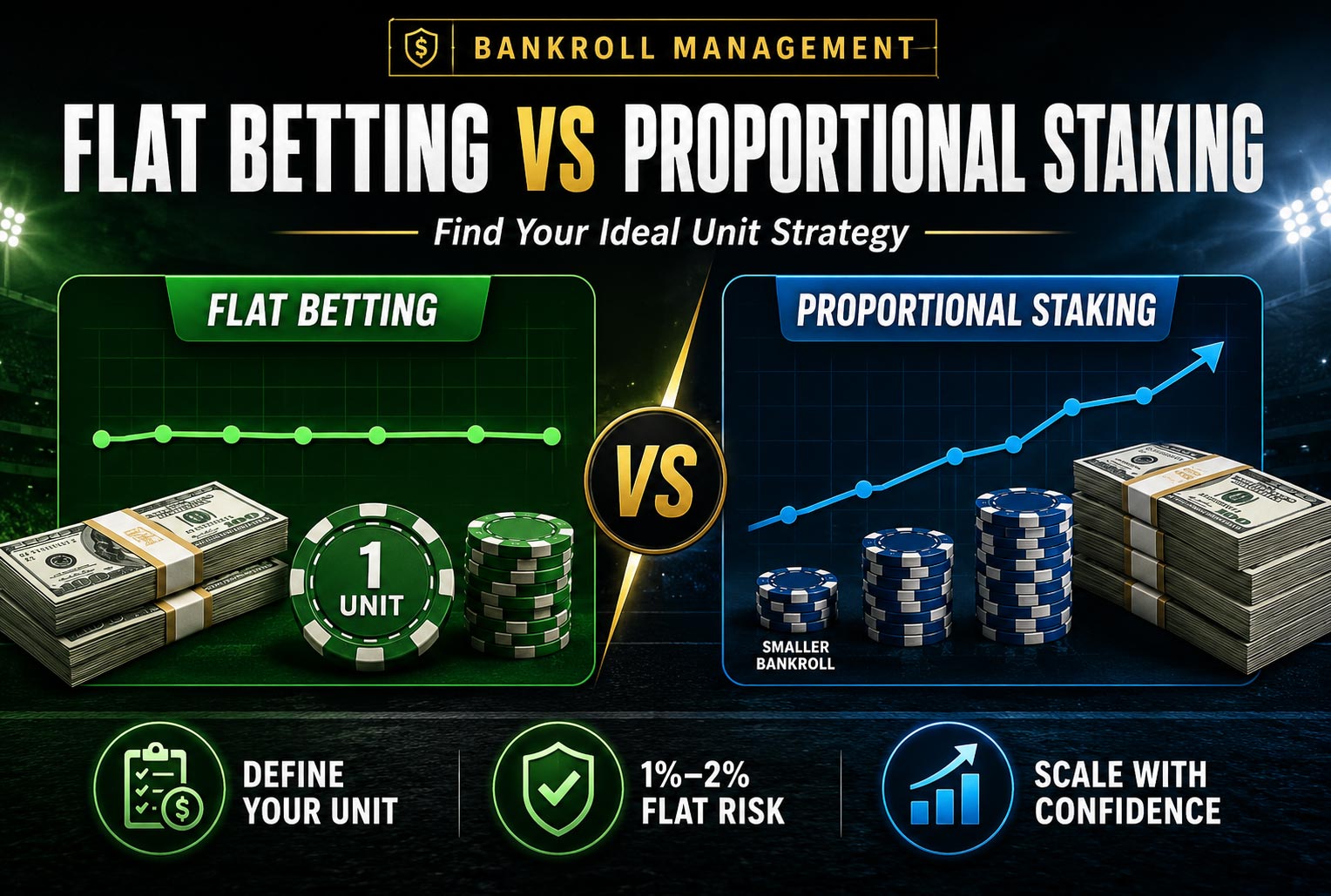
The 1-2% rule is unglamorous, boring, and the only reason I’m not driving for Uber right now. When I was running my operation at Harvard, this was the non-negotiable foundation: never risk more than 1-2% of your total bankroll on a single play. If you’ve got $1,000, your standard unit is $10-$20. That’s it. No exceptions for "locks."
Flat betting means every play gets the same unit regardless of how confident you feel. It’s the conservative approach that protects you from your own hubris—because let’s be honest, that "mortal lock" Ravens -3 feels just as certain as the Jaguars +14 you’re also eyeing. The beauty of flat betting is simplicity: you can’t outsmart yourself, and you build a clean data set to actually evaluate your performance over time.
Proportional staking is for when you’ve developed actual edge identification skills and can objectively differentiate between a 53% play and a 58% play. This means scaling your units based on perceived advantage—maybe 1% on standard plays and 2-3% on high-conviction bets where you’ve identified a genuine market inefficiency. But here’s the catch: most bettors wildly overestimate their edge and end up turning proportional staking into reckless gambling with extra steps.
The real secret? Start with flat betting until you’ve logged at least 250 tracked bets with positive ROI. Then—and only then—consider proportional staking. Think of it like options trading: you don’t touch Kelly Criterion optimization until you’ve proven you can consistently identify mispriced lines. Your confidence level means absolutely nothing without a statistical track record to back it up.
For most bettors in New York, Ontario, or anywhere else, the 1% flat betting model is the optimal strategy. It keeps you solvent through inevitable cold streaks, prevents emotional decision-making, and gives you enough runway to actually develop skills. The guys making serious money in this space aren’t betting 10% on NFL Sundays—they’re grinding small edges over thousands of plays with disciplined bankroll management.
Bottom line: if you’re betting more than 2% per play, you’re not gambling with an edge—you’re gambling with your rent money and calling it strategy. The math doesn’t lie, and neither does your empty sportsbook account three weeks from now.
Bankroll management isn’t sexy, but neither is explaining to your roommate why you can’t cover utilities this month. The 1-2% rule won’t make you rich overnight, but it will keep you in the game long enough to actually develop an edge and build something sustainable. Treat your bankroll like a business asset, not a poker chip, and you might actually still be betting six months from now instead of posting "I’m done with this rigged sport" tweets.
What’s your unit size, and be honest—are you actually sticking to it or do you conveniently bump it up when you "really like" a play?
Keep reading: A staking plan only works if you stick to it — learn how to stop chasing losses during a cold streak, and see why parlay math demands strict unit discipline.
"WannaBet.com may receive compensation from the sportsbooks mentioned in this post if you sign up using our links. This doesn’t cost you a dime, but it keeps the lights on. Please bet responsibly. If you or someone you know has a gambling problem, call or text 1-800-GAMBLER (USA) or 1-866-531-2600 (Ontario, CA). 21+ only."

One comment on "How to Size Your Bets Without Going Broke Fast"