

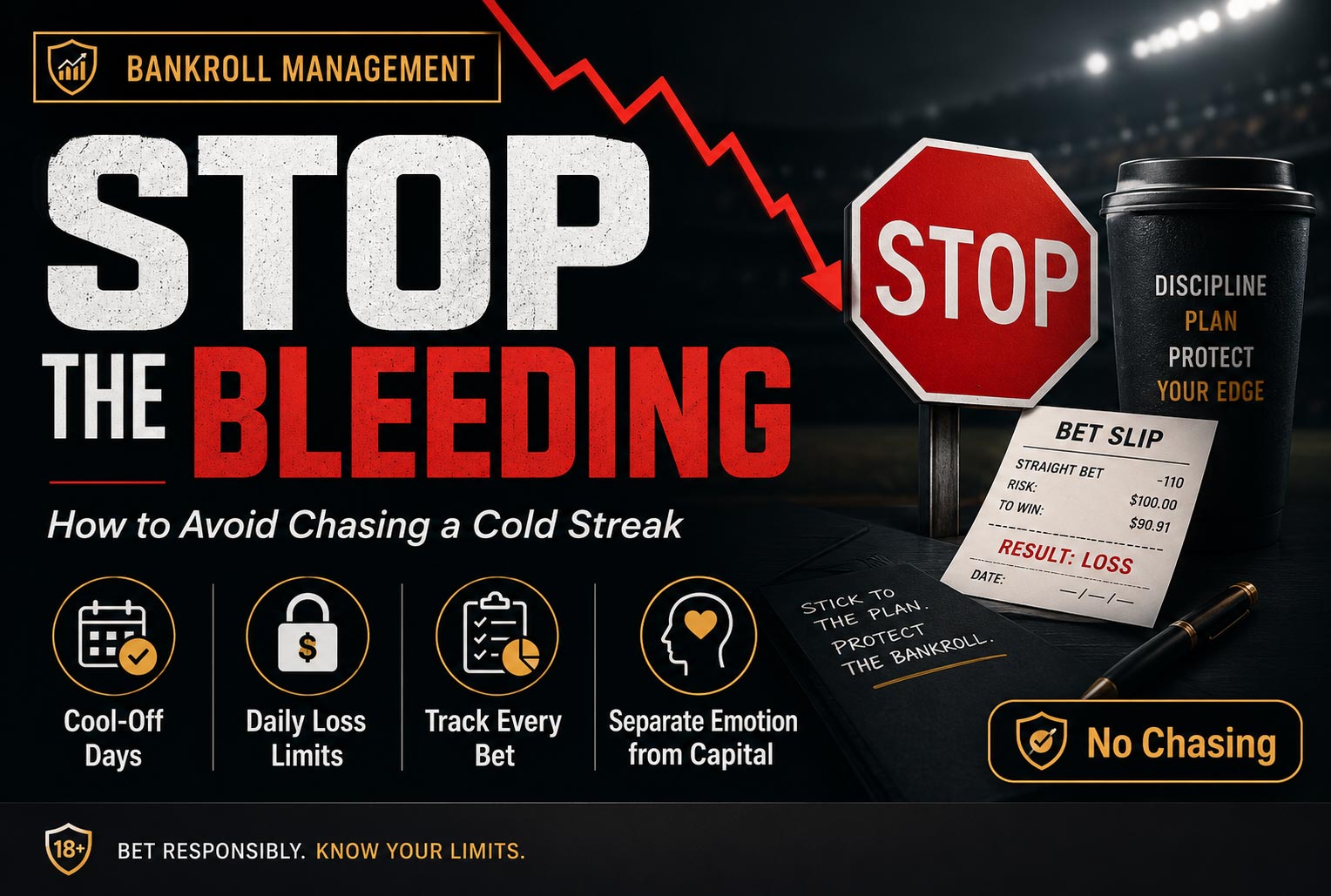
The difference between a sharp and a degenerate isn’t talent—it’s discipline. I’ve watched guys with encyclopedic sports knowledge blow their entire bankroll on a Tuesday night because they couldn’t stomach being down for the week. Here’s the brutal truth: chasing losses is the fastest way to go from "investor" to "that guy asking his roommate for Venmo loans." This isn’t about willpower or being "tougher"—it’s about implementing actual systems that prevent your lizard brain from torching your capital when variance goes against you.
Why Your "Just One More Bet" Strategy Is Broke
The math on chasing is catastrophically bad, but your brain doesn’t process it that way in the moment. When you’re down $500 and you tell yourself you’ll just bet $750 on the Lakers to "get even," you’re not making a strategic decision—you’re having an emotional reaction that bypasses every rational framework you’d normally use. The house edge doesn’t care about your feelings, and the sportsbooks have entire teams of behavioral psychologists designing their apps to exploit exactly this impulse.
Every "one more bet" compounds your expected loss while simultaneously increasing your risk exposure. If you’re betting -110 lines, you need to win 52.4% just to break even over time—and that’s when you’re making calculated plays with proper unit sizing. When you start doubling and tripling your normal stake to chase, you’re essentially taking a blowtorch to your edge. I’ve seen guys go 7-3 on the week and still end up down because those three losses were revenge bets at 5x their normal unit size.
The psychological trap is that wins feel like vindication and losses feel like injustice that needs correcting. Neither is true. Variance is built into the model—if you can’t handle being down 10 units without spiraling, you’re playing with money you can’t afford to lose. The sportsbooks in New York alone processed $20 billion in handle last year, and they’re not staying in business because people make rational decisions when they’re tilting.
The Cold Streak Kill Switch You Actually Need
Enforced cool-off periods aren’t admitting defeat—they’re implementing risk mitigation protocols. Set a hard rule: if you hit your daily loss limit (which should be 3-5% of your bankroll MAX), you’re done for 24-48 hours minimum. Not "I’ll just check the lines," not "I’ll tail someone else’s pick"—completely off the apps. FanDuel and DraftKings both have built-in time-out features in their responsible gaming settings, and if you’re serious about this, you need to pre-commit to using them before the cold streak starts.
Daily loss limits only work if they’re non-negotiable and tracked obsessively. Create a simple spreadsheet: date, bet type, stake, result, running total. When you see "-$200, -$150, -$300" staring back at you in black and white, it hits different than the abstract number in your app that you keep refreshing. I make every guy I advise send me their tracking sheet weekly—not because I care about their results, but because the act of logging forces accountability. You can’t lie to a spreadsheet.
The nuclear option is setting deposit limits directly with the books, and honestly, if you’ve chased more than twice, you should consider it. In Ontario, the regulated market requires books to honor these limits across platforms within 24 hours. Set your weekly deposit at whatever your bankroll allocation is, and when it’s gone, it’s gone. This isn’t fun to implement when you’re running hot, but future-you (the one who’s down bad at 2am on a Wednesday) will thank you for building these guardrails when you were thinking clearly.
The hardest part isn’t the system—it’s the ego hit of admitting you need one. Every sharp I know who’s lasted more than two years has some version of this framework. The ones who flamed out convinced themselves they were different, that they could white-knuckle through the variance, that "just this once" wouldn’t matter. They were wrong, and their bankrolls paid for the lesson. Your move: set the limits today, before the next cold streak makes the decision for you.
What’s your kill switch? Drop your strategy in the comments, or tell me why you think you don’t need one (I’ll wait).
Chasing losses isn’t a character flaw—it’s a predictable psychological response that happens to everyone who gambles long enough. The difference between staying in the game and going bust is whether you build systems that protect you from yourself before you need them. Set your loss limits, enforce your cool-off periods, and track every single bet like your bankroll depends on it—because it does. The house always has an edge, but emotional decision-making hands them a sledgehammer.
Keep reading: Put real guardrails in place with a proper unit strategy, and get the mindset right by learning to stop betting like a fan.
WannaBet.com may receive compensation from the sportsbooks mentioned in this post if you sign up using our links. This doesn’t cost you a dime, but it keeps the lights on. Please bet responsibly. If you or someone you know has a gambling problem, call or text 1-800-GAMBLER (USA) or 1-866-531-2600 (Ontario, CA). 21+ only.

One comment on "How to Stop Chasing Losses Like a Degenerate"