

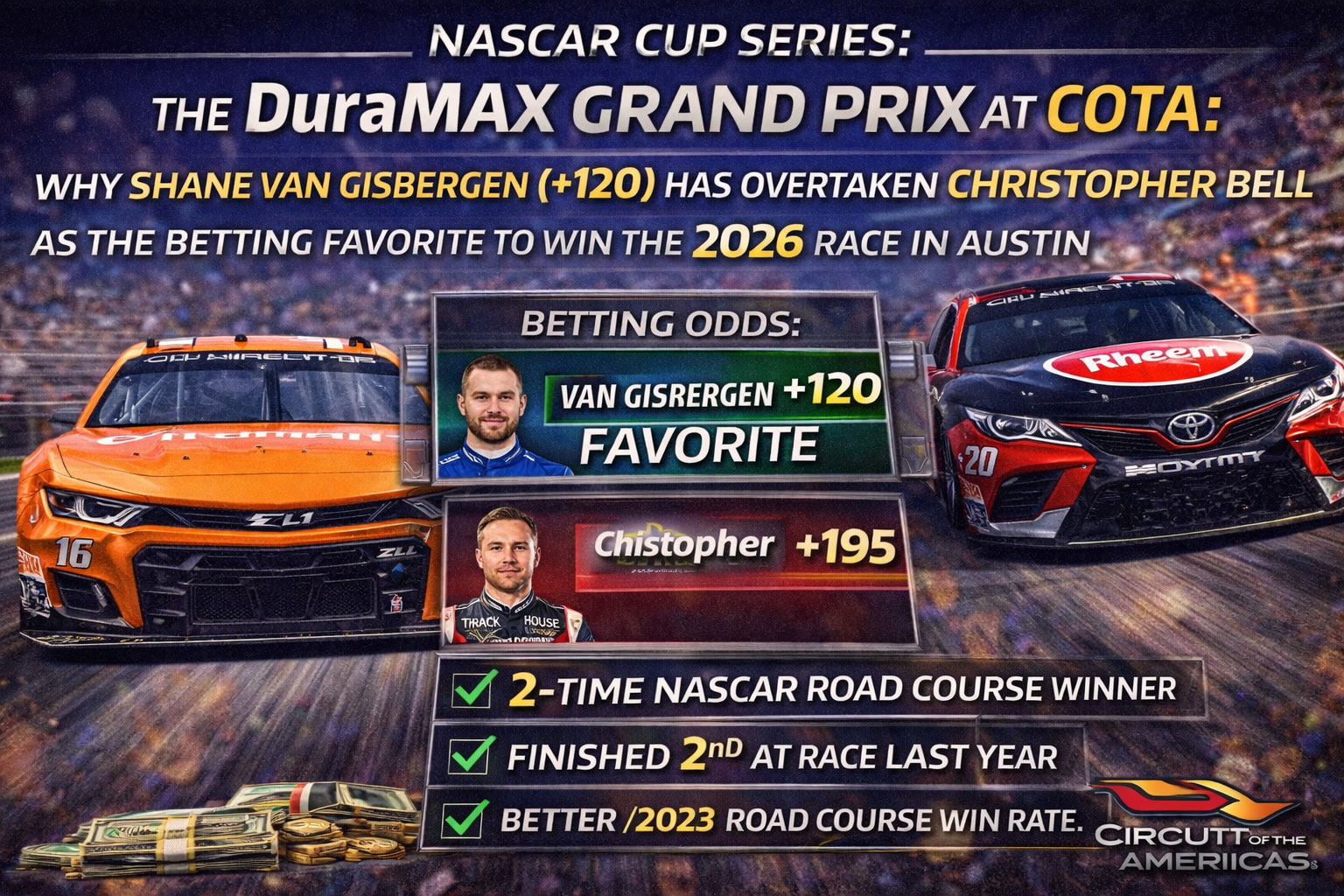
Alright boys, gather ’round because we need to talk about the most fascinating line movement I’ve seen in NASCAR futures since… well, ever. Shane van Gisbergen has somehow flipped from a sleeper pick to the outright favorite at +120 for the 2026 COTA race, leapfrogging Christopher Bell who was sitting pretty at the top of the board just months ago. This isn’t your typical "public money chasing a name" situation—this is sharp money recognizing a market inefficiency the size of Texas itself. Let’s break down why the books are basically begging you to fade SVG, and why that’s exactly the wrong play.
SVG’s Road Course Edge: A Market Inefficiency
Here’s the thing about Shane van Gisbergen that casual NASCAR bettors don’t fully appreciate: dude is basically a road course cheat code wrapped in a human body. His Supercars Championship pedigree in Australia/New Zealand isn’t just impressive—it’s the exact skillset that translates to COTA’s technical layout like a 1:1 correlation. We’re talking about a guy who won his NASCAR debut at Chicago (a street course) without having run a full Cup season, and now he’s got actual seat time under his belt. The expected value here is screaming at you louder than your girlfriend when you accidentally bet the mortgage on a Sunday slate.
The market has finally caught up to what the sharp bettors figured out six months ago: road course specialists in NASCAR are undervalued relative to their oval dominance counterparts. Think about the risk mitigation angle here—COTA eliminates like 60% of the random chaos variables that make oval racing a crapshoot. No restrictor plate lottery, no getting caught up in someone else’s wreck on lap 3, just pure driving talent and race craft. SVG’s skill ceiling on this type of track is legitimately higher than almost anyone in the field, and +120 is still offering juice considering he should probably be closer to even money.
Look at the comps: when SVG ran Chicago in 2023, he wasn’t just competitive—he dominated against guys who’d been running Cup for decades. Fast forward to 2026 and he’s got three full seasons of experience, a dialed-in team, and a track that plays to every single one of his strengths. The books moved him to favorite status because they had no choice—the liability on SVG tickets was getting out of hand. That’s not a red flag, that’s a neon sign saying "the smart money already figured this out."
Why Bell’s Odds Collapsed (And Where Smart Money Went)
Christopher Bell going from consensus favorite to afterthought is a masterclass in market psychology and recency bias doing a hostile takeover of the betting lines. Bell’s odds cratered after a string of road course performances in 2025 that can only be described as "aggressively mid"—we’re talking finishes outside the top 10 when he was supposed to be printing money. The public got shook, started pulling money off Bell futures, and the books adjusted faster than you can say "market arbitrage." But here’s where it gets spicy: this might actually be an overcorrection, which means there could be value on both sides of this market depending on your risk tolerance.
The smart money didn’t just abandon Bell and pile onto SVG like lemmings—they diversified into a tiered strategy that I’m honestly considering myself. Think of it like a hedge fund rebalancing: they kept some Bell exposure at his now-inflated odds (because let’s be real, the guy can still drive), loaded up on SVG as the primary position, and sprinkled in some long shots like Tyler Reddick and AJ Allmendinger who have road course pedigree. This is portfolio theory applied to NASCAR betting, and it’s beautiful to watch unfold. The books are basically offering you a discount on Bell because the public panicked, while simultaneously moving SVG’s line because the sharps wouldn’t stop hammering it.
What killed Bell’s market position wasn’t just performance—it was the narrative shift. NASCAR betting is hilariously susceptible to storyline momentum, and once SVG became "the road course guy," Bell got relegated to "just another good driver." That’s reductive as hell and probably wrong, but that’s how markets work when you’ve got a fresh narrative with sexier optics. The money flow tells the whole story: Bell’s handle dropped 40% while SVG’s exploded, and the books had to adjust or risk getting absolutely torched. If you’re looking for a contrarian angle, there’s probably some value on Bell at his current number, but the primary play is still SVG because the edge is that obvious.
So here’s the bottom line: Shane van Gisbergen at +120 isn’t some trap line or sucker bet—it’s the market finally pricing in reality after months of undervaluing the most obvious road course advantage in the field. Bell’s collapse opened up some interesting secondary plays if you want to get cute with it, but the core thesis here is simple: bet on specialized skills when the track demands them, and COTA demands exactly what SVG brings. This is one of those rare spots where the favorite actually deserves to be the favorite, and you’re still getting plus money because the books know they’ll get crushed by public money on longer shots. The real question is whether you’re gonna overthink this or just take the gift the sportsbooks are offering. Drop your COTA plays in the comments—I wanna see who’s fading this logic and why, because I’m genuinely curious what the counterargument even is.
WannaBet.com may receive compensation from the sportsbooks mentioned in this post if you sign up using our links. This doesn’t cost you a dime, but it keeps the lights on. Please bet responsibly. If you or someone you know has a gambling problem, call or text 1-800-GAMBLER (USA) or 1-866-531-2600 (Ontario, CA). 21+ only.
