

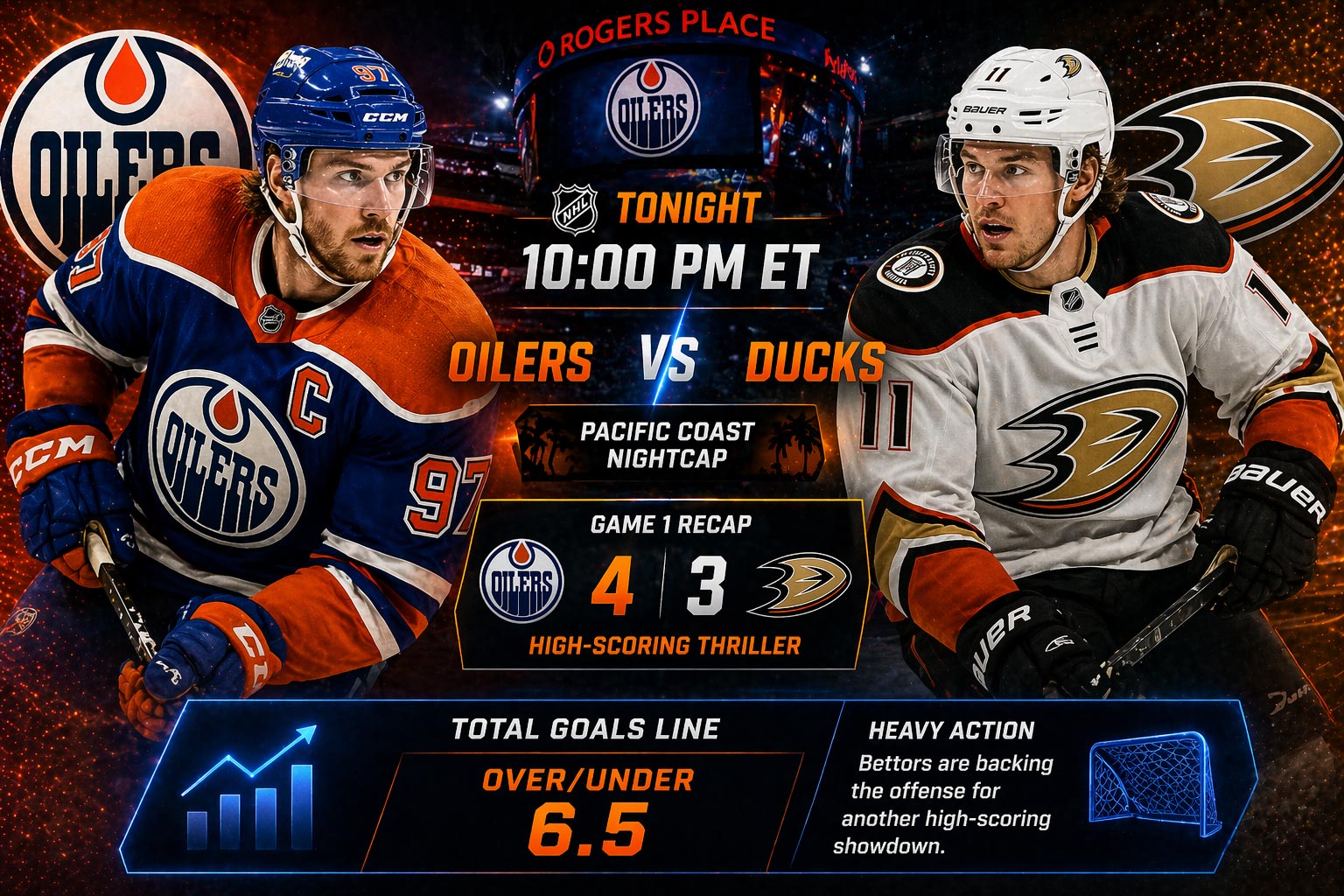
The Oilers and Ducks just gave us a 4-3 barnburner that had over bettors cashing tickets and asking for seconds. Now the market’s reacting exactly how you’d expect—the total’s climbing, the public’s piling on, and everyone’s convinced we’re getting another track meet at Rogers Place. But here’s where it gets interesting: sometimes the sharpest play is the most obvious one. When two teams show you who they are in Game 1, and the oddsmakers still can’t price them correctly because they’re anchored to season-long defensive metrics that clearly don’t apply to this matchup, that’s not a trap—that’s an invitation. Tonight at 10 PM ET, we’re running it back, and I’m about to explain why the over isn’t just a good bet, it’s a market inefficiency begging to be exploited.
Oilers-Ducks Over Hits Different After Game 1
Game 1 wasn’t some fluke shootout that happened because both goalies forgot their equipment at home. This was structural, predictable offense from two teams whose playing styles complement each other like peanut butter and jelly—if peanut butter was Connor McDavid and jelly was complete defensive breakdowns. The Oilers averaged 3.4 goals per game this season, and the Ducks, despite their rebuild narrative, have been leaking goals like a frat house basement. When you put those two variables in the same equation, seven total goals isn’t an outlier—it’s the expected value.
The eye test from Game 1 confirmed what the advanced stats have been screaming all season. Edmonton’s power play looked like a video game cheat code, going 2-for-4 while the Ducks’ penalty kill looked like they were actively trying to lose a bet. Meanwhile, Anaheim showed enough offensive spark to keep pace early, which is crucial for over bettors—you need both teams contributing, not a 6-0 blowout where everyone stops trying in the third period. The pace of play was electric, transition opportunities were abundant, and both goaltenders looked decidedly human.
Here’s the market psychology angle that everyone’s missing: sportsbooks are going to shade this total higher because they know the public saw that 4-3 final and immediately thought "over." But they’re not shading it enough because they’re still respecting Edmonton’s home defensive numbers from earlier in the season. That’s anchoring bias in action, and it creates a gap between the actual probability of outcomes and the implied probability from the betting line. That gap is where we make our money.
Why Smart Money’s Hammering the Total Tonight
Let’s talk about the revenge narrative for a second, because it actually matters here. The Ducks aren’t coming back to Edmonton thinking "let’s tighten up defensively and grind out a 2-1 win"—they’re a young, hungry team that just proved they can hang offensively with one of the league’s best attacks. That confidence is dangerous for under bettors. Teams don’t magically transform their identity between games, especially when Game 1 reinforced their offensive capabilities. Anaheim’s going to come out firing again because that’s literally their only path to victory.
From an expected value perspective, the matchup fundamentals haven’t changed overnight. McDavid and Draisaitl are still going to get their looks—they’re generational talents playing against a Ducks defense that ranks bottom-third in high-danger chances allowed. The special teams disparity remains massive, and in a league where power plays can swing totals by 2-3 goals per game, that’s not some minor detail. We’re not betting on chaos here; we’re betting on repeatable processes that favor goal scoring. The Law of Large Numbers suggests that one game is a small sample, but when that one game aligns perfectly with season-long trends, it’s confirmatory evidence, not noise.
The sharps understand something the public doesn’t: betting the over after a high-scoring game isn’t "chasing"—it’s pattern recognition. If anything, the books are giving us better value tonight because they’re worried about public over-loading and trying to balance their liability. But when the market moves and you’re getting a slightly better number than you deserve based on the actual matchup dynamics, that’s not a red flag—that’s a green light. The smart money isn’t getting cute here; they’re doubling down on what works.
The Plays:
- Over 6.5 goals (if available) is the primary target—anything 7 or lower is still playable
- Edmonton team total over 3.5 as a hedge position if you want single-team exposure
- First period over 1.5 for the degens who can’t wait until 1 AM ET for their sweat
The Strategy:
- Don’t overthink this—sometimes the obvious play is obvious for a reason
- If you’re in New York, New Jersey, or Ontario, shop lines across DraftKings, FanDuel, and BetMGM for the best total
- Consider splitting your unit across the full game over and a first period derivative to manage variance
Look, I know what you’re thinking: "This feels too easy, there’s gotta be a catch." But that’s recency bias talking—you’ve been burned by public traps before, so now you’re gun-shy when a legitimate edge presents itself. The catch isn’t that the over is a trap; the catch is that most bettors will talk themselves out of it because they’re too smart for their own good. Sometimes in betting, like in business, the best opportunities are the ones hiding in plain sight while everyone else is searching for complexity that doesn’t exist. The Oilers and Ducks just showed us their cards in Game 1, and the dealer’s asking if we want to run it back at basically the same price. I’m not leaving this table. Drop your Game 1 bad beats in the comments—did anyone actually have the under last night, or are we all riding this wave together?
WannaBet.com may receive compensation from the sportsbooks mentioned in this post if you sign up using our links. This doesn’t cost you a dime, but it keeps the lights on. Please bet responsibly. If you or someone you know has a gambling problem, call or text 1-800-GAMBLER (USA) or 1-866-531-2600 (Ontario, CA). 21+ only.
