

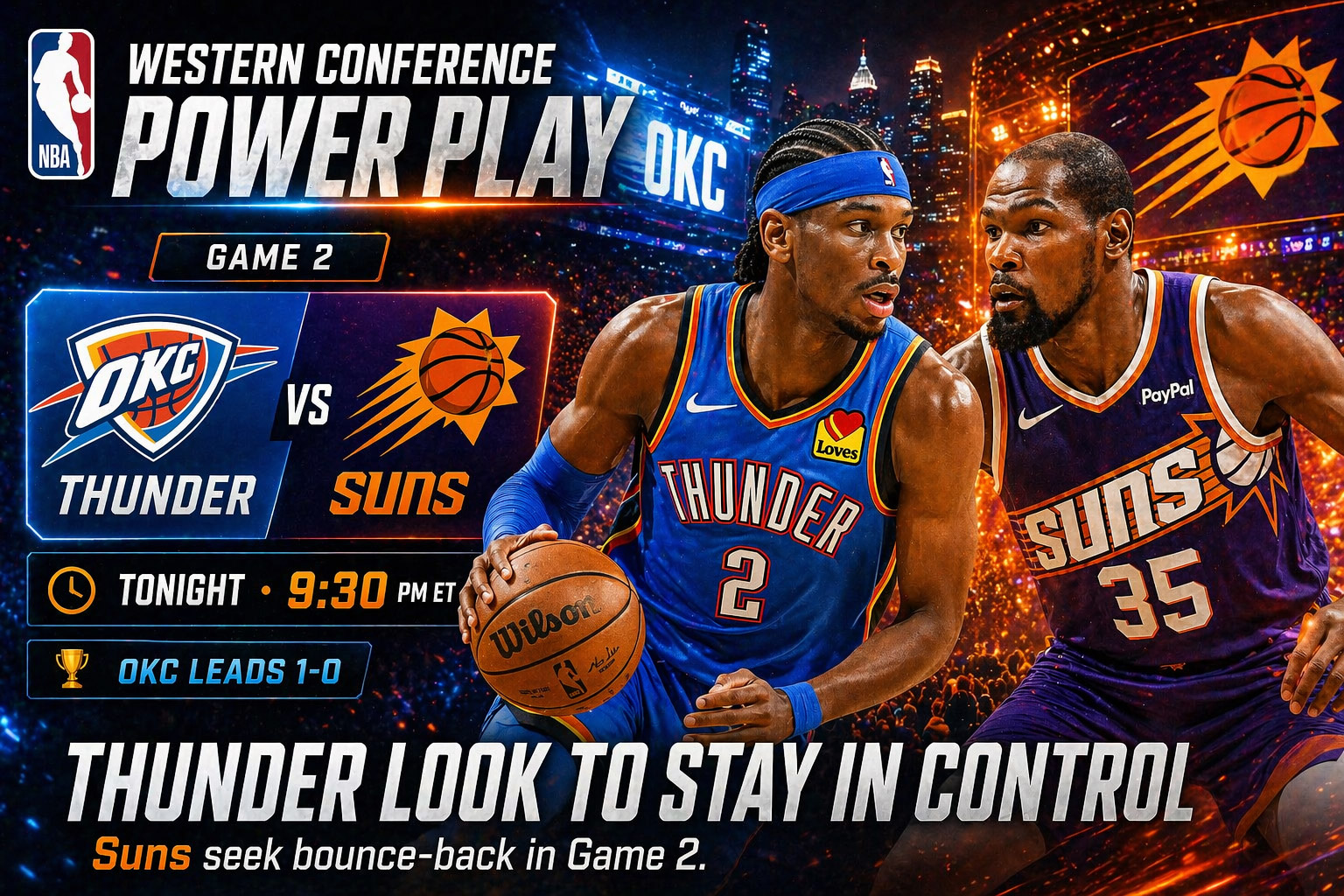
The public sees a 35-point blowout and thinks "fluke." The sharp money sees systematic advantage and thinks "exploit the overreaction." After OKC dismantled Phoenix in Game 1, the market’s doing exactly what we expected – overcorrecting on the Suns’ "playoff experience" and Kevin Durant’s legacy while completely missing why the Thunder are structurally built to dominate this matchup. Let me break down why doubling down on OKC in Game 2 isn’t just contrarian for the sake of it – it’s basic expected value math that Vegas is practically begging you to take.
Thunder’s Efficiency Edge: Why Game 1 Wasn’t a Fluke
The Thunder didn’t just beat Phoenix by 35 – they exposed a fundamental mismatch in pace and defensive versatility that doesn’t magically fix itself in 48 hours. OKC forced 18 turnovers while committing just 8, and that’s not some random variance spike when you’re running the league’s second-best defensive rating with wings who can switch 1-through-4. Shai Gilgeous-Alexander is operating in a completely different offensive ecosystem than Durant and Booker, one built on systematic advantages rather than individual shot-making, and that gap compounds over a seven-game series.
Here’s the market arbitrage everyone’s missing: Phoenix’s half-court offense runs at a glacial 95.3 possessions per game, while OKC thrives at 99.8. When you force an old, methodical team to play faster, their defensive rotations break down – we saw it with Jusuf Nurkić getting torched in transition and we’ll see it again tonight. The Suns’ roster construction is fundamentally flawed for playing from behind, and once OKC gets that 12-15 point cushion (which they will), Phoenix has to abandon their identity entirely.
The efficiency metrics paint an even uglier picture for Suns backers. OKC’s offensive rating of 118.7 in Game 1 wasn’t some outlier shooting performance – they generated those looks through ball movement (28 assists) and attacking mismatches that still exist. Meanwhile, Phoenix’s 83.7 offensive rating was the predictable result of what happens when you can’t get into your sets and you’re relying on two 35-year-old scorers to create everything. That’s not variance, that’s structural disadvantage.
The Market’s Overreacting to Phoenix’s Roster
Every talking head on ESPN is running the same tired narrative: "Championship DNA," "Kevin Durant in the playoffs," "They’ll adjust." Cool story – where’s the actual evidence this roster can execute those adjustments? The Suns are trotting out the same starting five that got exploited in Game 1, and unless Nurkić suddenly developed lateral quickness overnight, Chet Holmgren is going to eat again. The market’s pricing in some mythical "veteran response" that ignores the fact that OKC’s youngest rotation players are their best defenders.
Here’s where the MBA brain kicks in: this is textbook recency bias working in reverse. The public sees one blowout and assumes regression to the mean, but they’re anchoring to an outdated prior about what Phoenix "should" be rather than what the tape shows they actually are. Vegas knows the casual money will flood toward the Suns at +7.5 or whatever inflated number they’re offering, so the line stays artificially high despite sharp action hammering OKC. That’s free money for anyone paying attention to the actual matchup data.
The roster construction argument gets even worse when you dig into the bench units. Phoenix’s second unit got outscored by 22 points in Game 1, and their answer is… the same guys? Meanwhile, OKC can throw out lineups with Jalen Williams and Cason Wallace that maintain defensive intensity without any dropoff. When you’re getting consistent two-way production from your 6th through 9th men and your opponent is running a seven-man rotation with 35-year-old legs, the late-game execution gap becomes a chasm. That’s not disrespecting KD’s legacy – it’s acknowledging that basketball is still a team sport with roster depth requirements.
Look, I’m not saying Phoenix can’t steal a game in this series – variance exists and Durant can still get nuclear for 40 points on any given night. But betting on outlier performances instead of systematic advantages is how recreational bettors go broke. The Thunder have the efficiency edge, the matchup advantage, and a home crowd that’s going to make communication impossible for Phoenix’s already-shaky defensive rotations. The market’s giving you a gift by overvaluing "playoff experience" and undervaluing the structural mismatch that just produced a 35-point annihilation. Take OKC and thank Vegas for the free money later. What’s your take – am I missing something on Phoenix’s adjustment capability, or is this the easiest fade of the playoffs?
WannaBet.com may receive compensation from the sportsbooks mentioned in this post if you sign up using our links. This doesn’t cost you a dime, but it keeps the lights on. Please bet responsibly. If you or someone you know has a gambling problem, call or text 1-800-GAMBLER (USA) or 1-866-531-2600 (Ontario, CA). 21+ only.
