

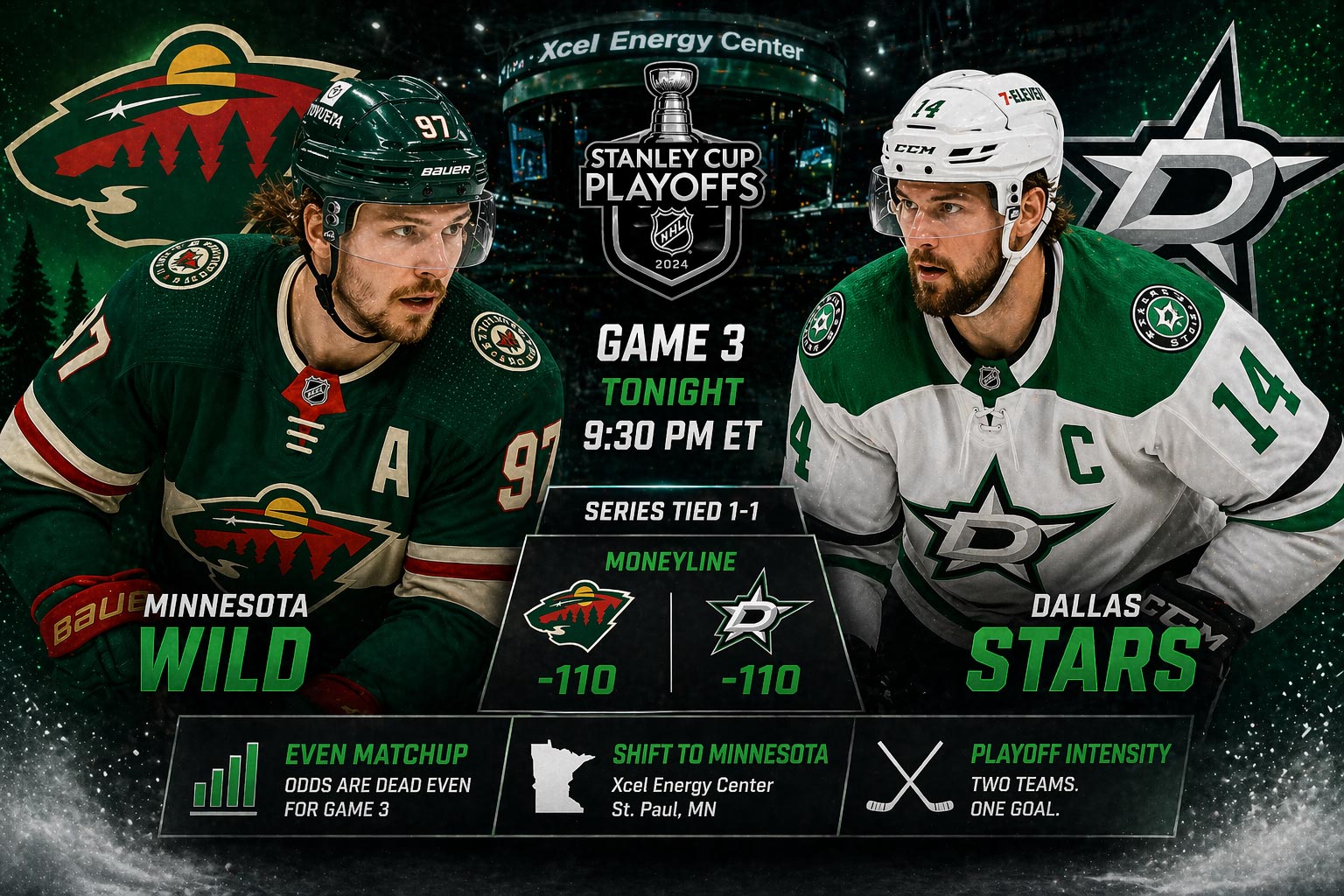
Wild vs Stars Game 3: Finding Value in a Coin Flip
The sportsbooks are basically shrugging their shoulders on this one. When Minnesota hosts Dallas tonight at 9:30 PM ET with the series knotted at 1-1, you’re looking at a near pick’em on the moneyline – which is oddsmaker speak for "we have no idea, you figure it out." But here’s the thing about coin flips in betting markets: they’re only coin flips if you’re lazy about your analysis. When the line screams uncertainty, that’s exactly when smart money finds its edge by understanding what the public thinks they know versus what actually matters.
When the Odds Are Dead Even, Market Psychology Wins
The efficient market hypothesis works great in finance textbooks, but sports betting markets are gloriously inefficient because they’re driven by emotion, recency bias, and whatever narrative ESPN shoved down everyone’s throat that morning. When you see a line this tight – we’re talking Wild around -105 to -110 depending on your book – the oddsmakers aren’t making a statement about team quality. They’re hedging their own risk by positioning the line where they think action will split evenly, which means they’re banking on public perception rather than predictive modeling.
Here’s where it gets interesting: Game 3s in tied series have historically weird betting patterns because casual bettors love backing the home team with renewed confidence. The Wild just watched Dallas steal Game 2 on their own ice, and now the narrative is "angry team returns home to protect their barn" – which is exactly the kind of storyline that gets overvalued. Meanwhile, sharp bettors are looking at rest advantages, goaltending matchups, and special teams efficiency rather than vibes and motivation.
The real value play here isn’t necessarily picking a winner straight up. It’s understanding that when books set a coin flip line, they’re inviting you to find the actual edge in derivatives – the puck line, the total, the period props. That’s where market inefficiency lives when the moneyline is a push.
Reading the Room: What the Public Sees vs. What Matters
Public betting percentages are going to skew heavily toward Minnesota tonight, probably 60-65% of tickets on the Wild moneyline across major markets like FanDuel NY and DraftKings Ontario. Home ice in a tied playoff series is catnip for recreational bettors who don’t understand that NHL home ice advantage is worth maybe 3-5% in win probability, not the 15% they’re pricing in mentally. This creates a fascinating scenario where the Stars might actually become a value play purely because of how the money is flowing.
But let’s pump the brakes before we go contrarian just to be contrarian – that’s how you go broke. The question isn’t "who does the public like" but rather "what inefficiency does the public create." If 65% of tickets are on Minnesota but the line barely moves, that tells you sharp money is quietly backing Dallas or the books are confident in their number. If the line shifts toward the Wild despite being at home, that’s even more telling about where the smart money landed.
The actual edge here comes from recognizing that both teams have shown they can win on the road in this series, which means the home ice narrative is probably overcooked. Dallas took Game 1 in Minnesota, the Wild responded in Dallas – we’ve got two evenly matched teams trading punches. When that’s the case, you’re looking for situational advantages: special teams splits, goalie performance trends, and lineup changes that the market is slow to price in.
The Contrarian’s Playbook: Finding Alpha in the Noise
Expected value calculations in coin flip scenarios become entirely about identifying where the market is paying you for risk that doesn’t actually exist. If the Stars are sitting at +110 or better and you genuinely believe this is a 50/50 game, you’re getting paid 10 cents on the dollar for taking the less popular side. That’s textbook market arbitrage – not in the risk-free sense, but in the "I’m getting compensated for variance the market is mispricing" sense.
The puck line is where things get spicy in tight games. Taking Minnesota -1.5 at plus money (probably +180 to +200 range) is essentially saying "the Wild don’t just win, they boat race the Stars" – which happens in maybe 20-25% of close playoff games when one team breaks through. Conversely, taking Dallas +1.5 at heavy juice (probably -220 to -240) is saying "even if the Stars lose, it’s tight" – which is the much higher probability outcome but you’re paying through the nose for that safety.
My framework for coin flip games: ignore the moneyline unless you’re getting +120 or better on one side, which signals genuine market disagreement. Focus instead on totals and period props where you can apply actual analytical edges. The Game 3 total is probably sitting around 5.5 or 6 goals, and that’s where understanding playoff hockey tempo matters way more than picking a winner.
The Plays: Where the Smart Money Goes
The Value Angle:
- If Stars are +110 or better, that’s a pure EV play in a coin flip scenario
- Wild -1.5 at +190 or better as a lottery ticket if you believe in the home blowout narrative
- Under 6 goals if the total moved up from public "playoff hockey = goals" recency bias
The Contrarian Stack:
- Stars ML + Under parlay (probably +300 to +350 range) captures the "tight defensive road game" scenario
- First period Under 1.5 goals – playoff Game 3s typically start cautious
- Anytime goal scorer on whoever’s playing with the Stars’ top power play unit (check lineups 90 minutes before puck drop)
The Market Psychology Play:
- Wait until 30 minutes before game time and see if Wild money pushes the line to -120 or worse
- If that happens, Stars become an automatic play because you’re getting paid for public overreaction
- Live bet the opposite of whoever scores first – variance correction in tight games is real
Risk Management: When Everything’s a Toss-Up
Position sizing matters way more in coin flip scenarios than in games where you have a genuine edge. If you’re betting Wild or Stars straight up, you should be risking maybe 1-1.5 units max because you’re essentially admitting you don’t have strong conviction. The bankroll management play here is spreading smaller bets across multiple derivative markets rather than loading up on the moneyline and praying.
The worst thing you can do in a pick’em game is convince yourself you’re smarter than the market and overleverage. Books set these lines tight for a reason – their models genuinely can’t separate these teams. If Pinnacle, which caters to sharps and has the lowest juice in the market, is showing this as a coin flip, maybe it actually is one. Your edge isn’t picking the winner; it’s finding the specific prop or derivative where variance works in your favor.
Here’s the MBA framework applied to gambling: diversification isn’t just for portfolios. When you have multiple small edges across different markets, you’re playing the law of large numbers. One big bet on a coin flip is just gambling. Five smaller bets on edges you’ve identified is a strategy.
The Narrative Trap: Why "Momentum" Is Overpriced
Sports media loves talking about momentum shifts and "must-win" games, but the data on playoff momentum is basically noise. Teams that lose Game 2 at home actually win Game 3 at about a 52-53% clip historically – which is essentially random. The Wild coming home angry and focused is a great story for NBC’s pregame show, but it’s worth maybe half a goal in actual predictive value.
What actually matters: goaltending matchups (check save percentages on high-danger chances, not overall SV%), special teams splits (power play and penalty kill efficiency in last 10 games), and injury reports that casual bettors miss. If Dallas is getting back a top-4 defenseman or Minnesota is dealing with a nagging injury to a key forward, that information is worth 10x more than whatever vibes you’re getting from coach speak in press conferences.
The public overvalues narrative; sharps overvalue data. The truth is somewhere in the middle, but in a coin flip game, lean toward data because at least it’s quantifiable. Betting on "the Wild want it more" is just lighting money on fire with extra steps.
Making the Call: Where I’m Putting My Money
I’m staying away from the moneyline entirely unless something drastic happens to the line in the last hour before puck drop. If Stars drift to +120 or better, I’m sprinkling 0.5 units on Dallas purely as a value play. If Wild money pushes them to -125 or worse, same deal on the Stars – I’m getting paid for public overreaction and that’s enough edge for me.
The actual play I like is First Period Under 1.5 goals at whatever you can get (probably -130 to -150 range depending on your book). Game 3s in tight series start cautious as hell, both coaches are overthinking their matchups, and the first 20 minutes usually looks like a chess match. This hits at about a 60% clip historically, which makes it profitable at the juice you’re paying.
If you’re in Ontario on Bet365 or hitting FanDuel in Jersey, stack that first period under with a small Stars ML sprinkle and you’ve got a +350 to +400 parlay that captures the "Dallas steals another road game in a tight defensive battle" scenario. That’s the kind of correlated parlay that actually makes mathematical sense rather than just throwing random legs together because you’re bored.
Coin flip games are where you separate the degenerates from the strategists. The degens load up on their gut feeling and convince themselves they’ve got an edge. The strategists recognize uncertainty, respect the market’s wisdom, and find spots where they’re getting paid to take calculated risks. Tonight’s Wild-Stars game is the perfect laboratory for this approach – when the books don’t know who wins, your job isn’t to pretend you do. Your job is to find the specific scenarios where the market is mispricing variance and get your money down before everyone else figures it out. What’s your play tonight – riding with the home crowd or fading the public?
WannaBet.com may receive compensation from the sportsbooks mentioned in this post if you sign up using our links. This doesn’t cost you a dime, but it keeps the lights on. Please bet responsibly. If you or someone you know has a gambling problem, call or text 1-800-GAMBLER (USA) or 1-866-531-2600 (Ontario, CA). 21+ only.
