

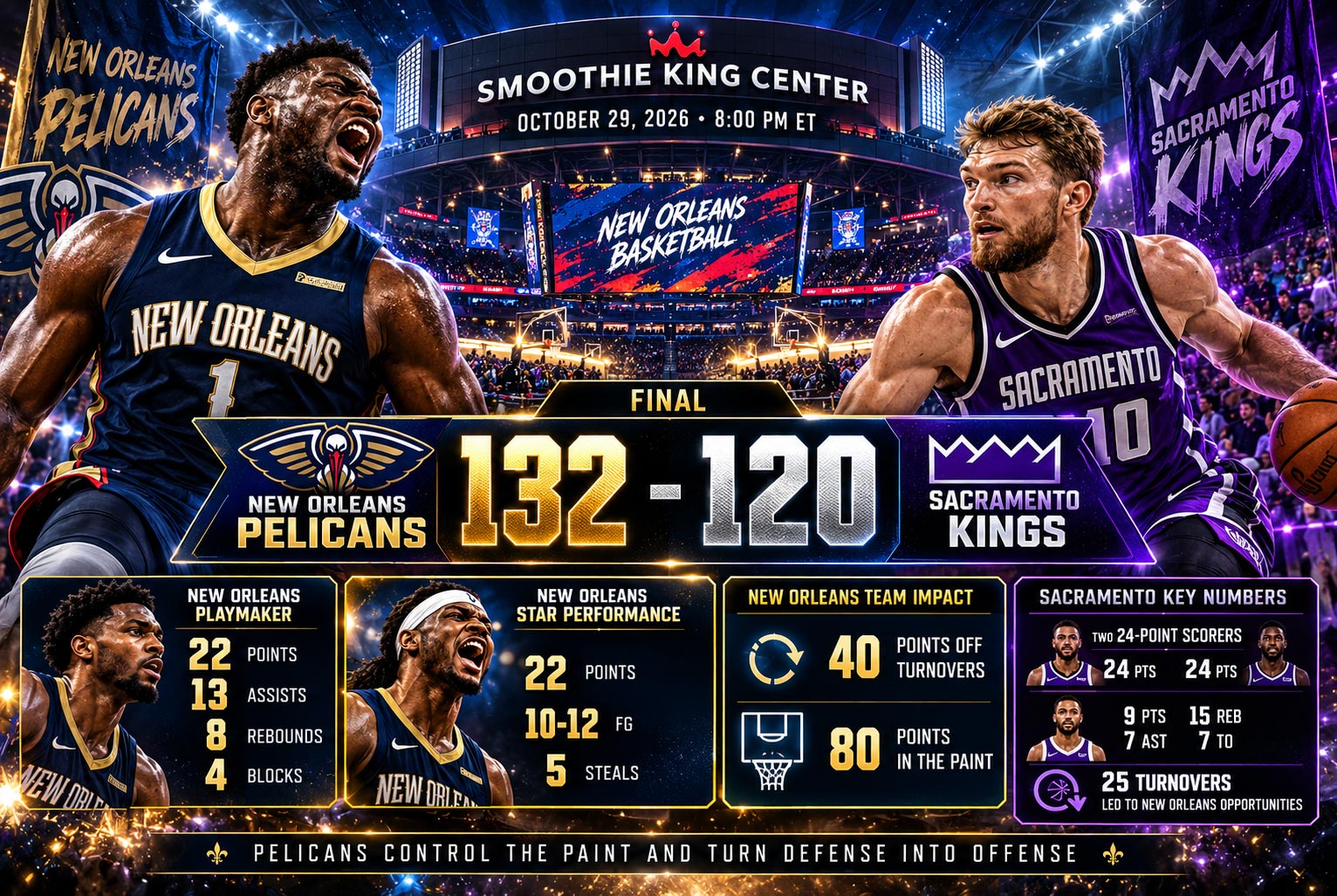
Four blocks. From a guard. Running point. In a 132-120 game where his team dropped 80 in the paint. If you had Jeremiah Fears’ stat line on a bingo card Thursday night, you were either clairvoyant or lying to your friends.
Here’s the headline for anyone scrolling: the Pelicans beat the Kings 132-120 at the Smoothie King Center on October 29, 2026, and the game was decided by turnovers, not shot-making. Sacramento coughed it up 25 times. New Orleans turned that into 40 points. That’s not a basketball game, that’s a wealth transfer.
Below: why this was readable before tip, what the box score tells us about where the live market was slow, and which numbers I’m going to be hammering the next time these two are on the board in New York, Ontario, or wherever your app lives.
Jeremiah Fears Cooks Kings in Pelicans’ 132-120 Win
Let’s start with the obvious: 22 points, 13 assists, 8 rebounds, and 4 blocks is a line that makes prop sheets look like they were written by an intern. Fears didn’t just fill the box score, he dictated the shape of the game — pace up, paint touches, kick-outs, repeat. When your lead guard is generating that much rim pressure, every other prop on the slate inflates with him.
The assist number is the one that mattered most for ticket holders. Thirteen dimes on a night where the team hit 80 points in the paint isn’t a coincidence — it’s the direct output of a downhill guard playing against a defense that kept losing containment. If you were sitting on an over for his assists, you probably had it cashed by the early fourth and were already shopping for a same-game parlay leg to re-risk.
And the four blocks? Pure lottery ticket. Nobody prices guard blocks seriously, which is exactly why that market is a soft spot — the implied probability on a guard hitting 2+ rejections is usually priced like it’s impossible instead of merely unlikely. That’s not a core play, that’s a dart with real expected value when the matchup is this chaotic.
The Fears Line — What Actually Happened
| Category | Jeremiah Fears |
|---|---|
| Points | 22 |
| Assists | 13 |
| Rebounds | 8 |
| Blocks | 4 |
Zion Williamson’s night deserves its own paragraph, and not for the scoring. 22 points on 10-of-12 shooting is a 83.3% clip from the field, which is less “efficient scoring game” and more “layup line with defenders present.” When he’s finishing at that rate, the Pelicans’ paint number becomes the most predictable stat on the floor.
But the five steals are the real tell. Zion generating that kind of live-ball defensive volume is the engine behind the transition points — he wasn’t just finishing possessions, he was creating them out of thin air. Steals into dunks is the most profitable sequence in basketball and the most underpriced in live markets.
Add Trey Murphy III with 19 and Herbert Jones with 16, and you’ve got four guys at 16 or more, with Bennedict Mathurin adding 10. That’s the distribution profile that makes team totals easier to read than individual props — the ceiling is high but the volume is spread, which punishes the guy who stacked three Pelicans overs and needed all of them to pop.
The Plays I’d Have Been On:
- Pelicans team total over — paint-heavy offense vs. a turnover-prone opponent is the cleanest version of this bet
- Fears assists over — volume creator on a night with 80 paint points
- Zion shooting efficiency angles — 10-of-12 doesn’t happen without a structural matchup edge
- Live first-half over — once the turnover rate showed up, the market was slow to adjust
The 25-Turnover Disaster That Printed Pelicans Tickets
Twenty-five turnovers. Let me put that in terms a finance guy understands: that’s burning more than a fifth of your possessions on unforced operational failure. You can shoot the lights out and still lose if you’re handing the other team 25 free trips — and Sacramento found out the hard way.
New Orleans scored 40 points off those giveaways. Final margin was 12. Do the arithmetic and you’ll notice the turnover differential wasn’t a factor, it was the factor. Every other variable in this game — shooting splits, rebounding, bench production — was noise relative to that one line item.
What makes it worse for Kings backers is how those turnovers converted. 80 points in the paint means the Pelicans weren’t settling for transition threes and hoping — they were getting to the rim, which is the highest-expected-value shot in the sport. Live-ball turnovers into rim attempts is a compounding machine, and it compounded all night.
The Turnover Math
| Metric | New Orleans | Sacramento |
|---|---|---|
| Final Score | 132 | 120 |
| Turnovers Committed | — | 25 |
| Points Off Turnovers | 40 | — |
| Points in the Paint | 80 | — |
Sacramento’s individual performances tell you this wasn’t a shot-making problem. Precious Achiuwa and De’Andre Hunter each dropped 24, which is a perfectly respectable two-man scoring punch. On most nights, 24-and-24 from your top two buckets keeps you in the game — or wins it.
The issue was Domantas Sabonis finishing with 9 points, 15 rebounds, 7 assists, and 7 turnovers. The rebounding and playmaking were there, but seven giveaways from your offensive hub is a structural failure, not a bad night. When the guy initiating from the elbow is the one leaking possessions, everything downstream breaks.
For bettors, that’s the lesson: Sabonis rebound props stayed healthy, his assist props held up, but the team result was never in doubt once the turnovers started piling up. Correlate your legs to the right variable — the individual stats were fine, the team-level outcome was cooked.
The Strategy Going Forward:
- Fade teams with turnover-prone offensive hubs against aggressive defensive guards — Zion’s 5 steals weren’t random
- Points-in-the-paint props are the most stable market when one team has a clear interior advantage
- Live betting is where the edge lives — the turnover rate was visible early, and the number was slow to react
- Don’t over-stack same-game parlays when four players are sharing the scoring load; correlation cuts both ways
- Sharp money reads process, public money reads names — the box score said “Achiuwa and Hunter had it going.” The result said “25 turnovers.”
So where does this leave us? The Pelicans just showed a profile that’s extremely bettable going forward: a lead guard who generates rim pressure, a finisher converting at 10-of-12, and a defense turning live-ball steals into instant offense. That’s a repeatable formula, not a hot night.
For Sacramento, the fix isn’t shooting — 24 from Achiuwa and 24 from Hunter is enough offense to win plenty of games. It’s the 25 turnovers, and specifically the 7 from a guy who touches the ball on nearly every possession. Until that number comes down, I’m looking at their opponent’s team total every single time they’re on the board.
Hot take: Jeremiah Fears’ assist line is going to be chronically underpriced for at least another month, because the market hasn’t caught up to how much paint volume this offense generates. Books price reputation, not usage — and that gap is where you get paid.
Your turn: Are you buying Fears as a season-long prop goldmine, or was this a turnover-inflated outlier that regresses the second he plays a team that can hold onto the basketball? Drop it in the comments.
“WannaBet.com may receive compensation from the sportsbooks mentioned in this post if you sign up using our links. This doesn’t cost you a dime, but it keeps the lights on. Please bet responsibly. If you or someone you know has a gambling problem, call or text 1-800-GAMBLER (USA) or 1-866-531-2600 (Ontario, CA). 21+ only.”
