

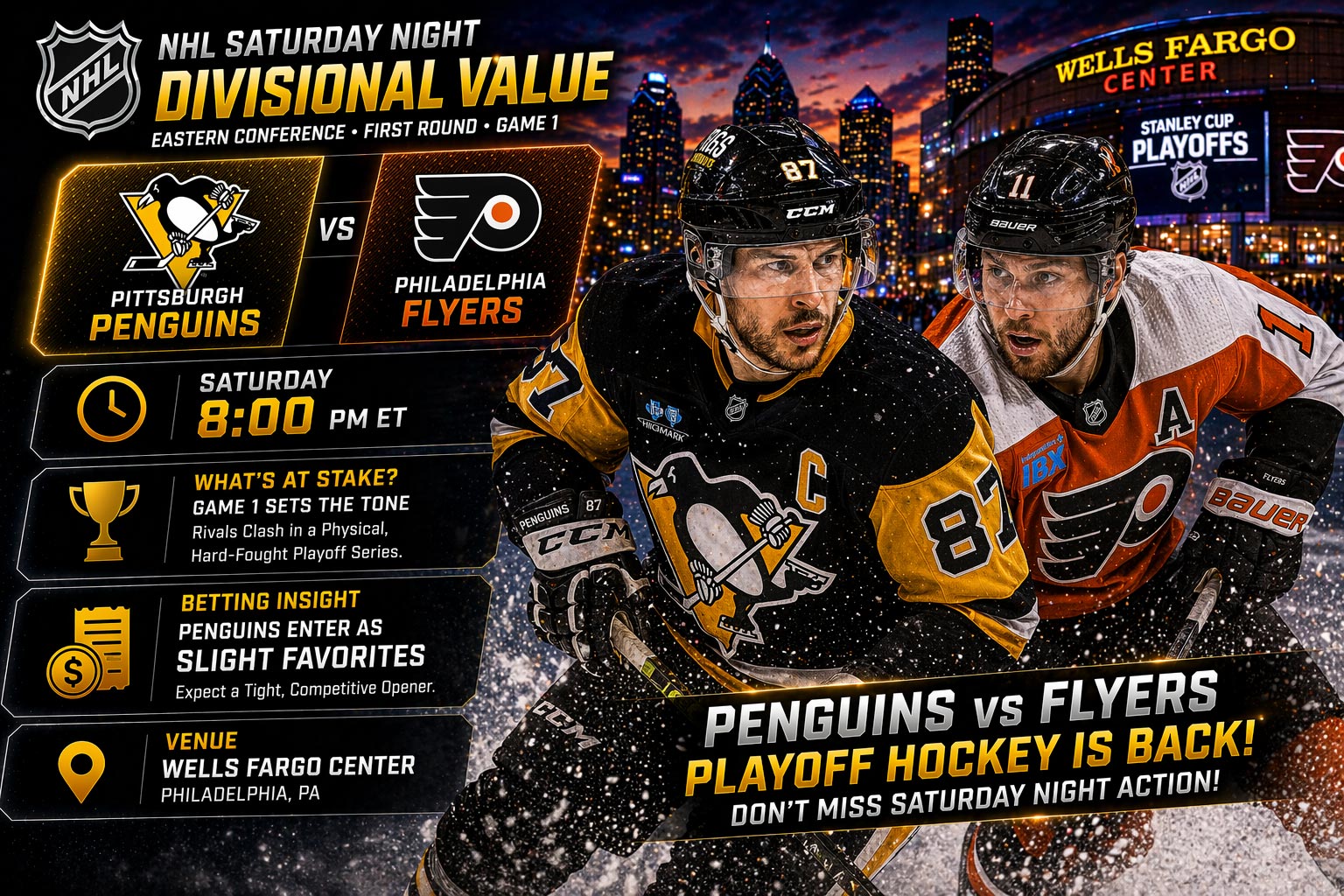
Here’s the thing about markets that think they’re efficient—they usually aren’t. Saturday night at 8 PM ET, we’ve got Game 1 of this first-round series, and while the books have Pittsburgh as slight favorites, the real value play isn’t where you think it is. Let’s talk about why your average bettor in Pennsylvania is about to light money on fire, and how we’re gonna fade them all the way to the bank.
Pens vs Flyers Game 1: Finding Value in a Rivalry
The Pennsylvania sports betting market is about to do what it always does with this matchup—overreact emotionally and create exploitable inefficiencies. You’ve got Philly degenerates hammering their boys because “it’s the playoffs baby,” while Pittsburgh fans are still living in 2017 thinking Crosby’s gonna waltz to another Cup. Neither side is thinking about this rationally, which is exactly where we want to be positioned.
Here’s the market psychology play: rivalry games create recency bias on steroids. Everyone remembers that 7-6 barnburner from three years ago or that line brawl from last season, so the public pounds the over and gets cute with “both teams to score in every period” props. Meanwhile, sharp money knows that Game 1s in playoff hockey are typically defensive chess matches where coaches tighten up systems and nobody wants to be the guy who costs their team the opener.
The books know this too, which is why they’re baiting you with juicy-looking totals. But the real edge here isn’t just fading the public—it’s understanding that Pittsburgh’s slight favorite status is actually undervaluing them given their playoff experience differential. We’re not just betting on talent; we’re betting on organizational muscle memory, and that’s where the Penguins have a massive asymmetric advantage.
Why the Market’s Sleeping on This Matchup
Let’s run the expected value calculation here like we’re doing a DCF model in finance class. The Flyers are getting hyped because they squeaked into the playoffs and have “nothing to lose” energy, but that narrative is worth exactly zero dollars when you’re facing a team that’s been to the finals three times in the last decade. The market is pricing in variance when it should be pricing in variance reduction—playoff hockey rewards systems over chaos, and guess which team has the better system?
The public money is going to flood Philly because of three factors: home-state bias (Pennsylvania bettors love their Flyers), underdog appeal, and the classic “rivalry game anything can happen” logic that sounds smart at the bar but falls apart under scrutiny. This creates what I call “emotional liquidity”—a fancy way of saying there’s dumb money sloshing around waiting to be extracted. When FanDuel and DraftKings see heavy action on one side from retail bettors, they adjust lines to balance their books, not to reflect true probability.
Here’s where it gets spicy: the sharp money in New Jersey and New York markets isn’t touching Philly at current prices. Check your line movement throughout the week—if you see the Penguins line tightening despite public money flowing to the Flyers, that’s your signal that the pros are taking Pittsburgh and laying the juice. That’s not coincidence; that’s information arbitrage, and we’re piggybacking on it like MBAs riding VC money to a Series B.
The Plays
Primary Position:
- Penguins ML (-145) — Risk mitigation through superior playoff infrastructure. We’re paying premium for quality, like buying VOO instead of meme stocks.
Value Hunting:
- Under 6 goals — Game 1 playoff hockey is tighter than a VC’s wallet during a recession. Both teams playing not to lose.
Degenerate Special:
- Penguins to win & Under 6.5 (+180) — Same game parlay that actually makes mathematical sense. Playoff series openers reward defensive discipline.
Props to Watch:
- Sidney Crosby Over 0.5 Points — The man shows up when it matters. Playoff Crosby is a different asset class entirely.
The Strategy
Bankroll allocation here follows the Kelly Criterion, not your emotions. If you’re betting more than 3-5% of your roll on this game because “bro it’s a rivalry,” you’re doing it wrong. The edge exists, but it’s not massive enough to justify going full degen mode. Think of this as a high-probability, medium-reward play—we’re looking for consistent 5-10% ROI, not lottery tickets.
The timing component matters too. If you’re in Pennsylvania, New Jersey, or New York, watch the line movement on Saturday afternoon. Public money typically floods in 2-4 hours before puck drop when casual bettors get off work and start scrolling their books. If the Penguins line moves from -145 to -135, you’ve got clear evidence of sharp money getting backed off by square action—that’s when you hammer it.
Risk management means having an exit strategy. If you’re live betting this game and the Flyers score first, don’t panic and hedge like an idiot. Playoff teams that score first win about 65% of the time, but that still leaves 35% equity in your position. The key is knowing your breakeven points before you place the bet, not after your heart rate spikes in the second period.
The beautiful thing about rivalry games is that everyone thinks they have an edge because they “know” these teams. But knowing that Philly fans are passionate and Pittsburgh has won Cups doesn’t give you an edge—it gives you trivia night material. The real edge comes from understanding market psychology, recognizing when public sentiment creates pricing inefficiencies, and having the discipline to bet the math instead of the narrative. Saturday night is going to separate the guys who bet like they’re texting in the group chat from the guys who actually understand expected value. So what’s it gonna be—you riding with the sharp money or dying with the squares? Drop your spiciest takes in the comments, and let’s see who actually understands playoff hockey value.
WannaBet.com may receive compensation from the sportsbooks mentioned in this post if you sign up using our links. This doesn’t cost you a dime, but it keeps the lights on. Please bet responsibly. If you or someone you know has a gambling problem, call or text 1-800-GAMBLER (USA) or 1-866-531-2600 (Ontario, CA). 21+ only.
