

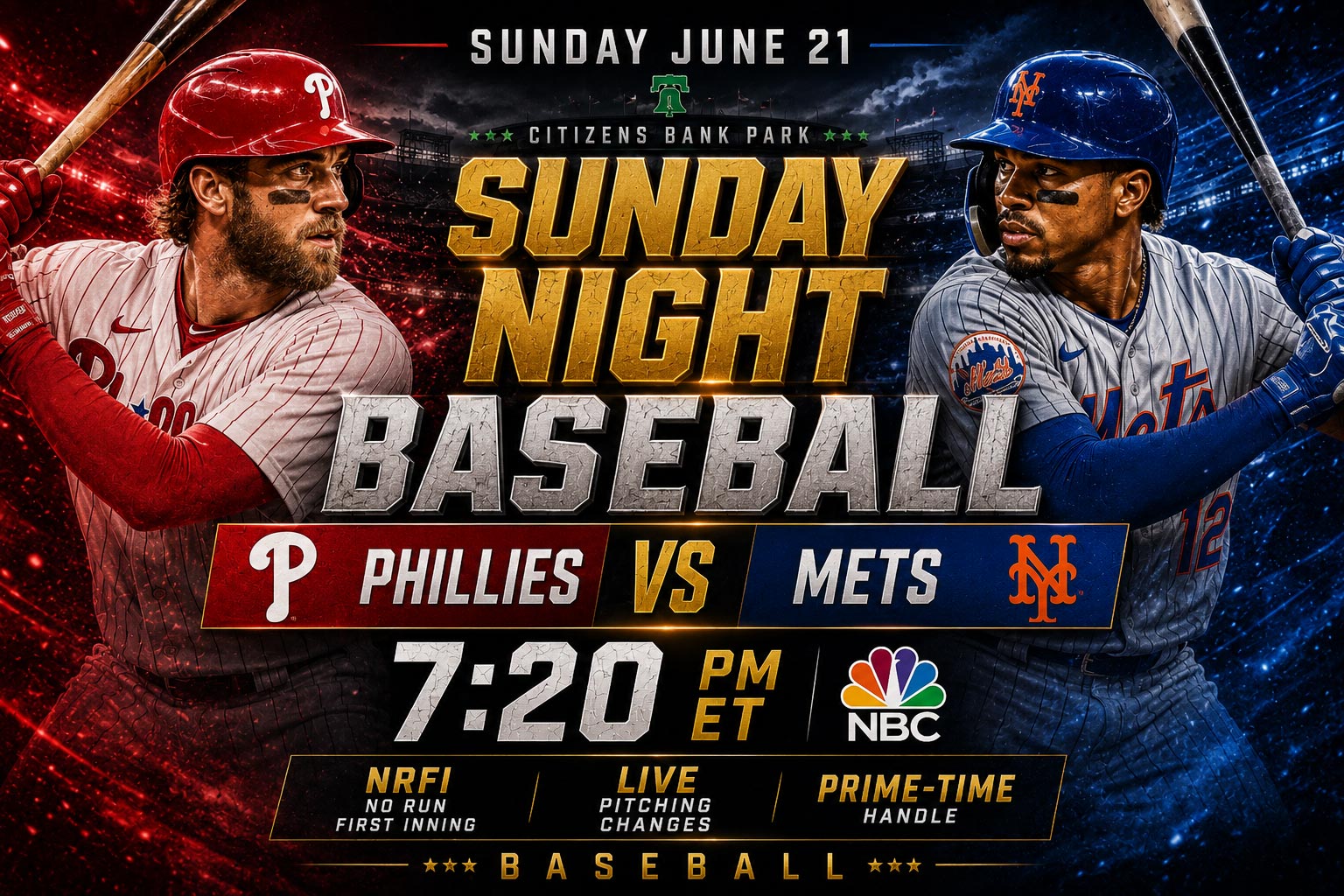
Sunday Night Baseball under the lights at Citizens Bank Park—sounds like a dream betting environment, right? The Phillies and Mets squaring off with the entire country watching, massive handles pouring in on NRFI props, and the sharp bettors licking their chops. But here’s the thing: when the public thinks they’ve found an edge on a nationally televised game, they’re usually walking straight into a trap. This isn’t your typical Tuesday afternoon divisional matchup where you can exploit sleepy oddsmakers—this is NBC primetime, and the books have been sharpening their pencils all week for this exact moment.
===
Phillies vs Mets NRFI: Why Sunday’s a Trap
The NRFI market has exploded over the past two seasons, and for good reason—it’s a clean, digestible prop that doesn’t require you to sweat nine innings. You get your answer in 15 minutes, crack a beer, and move on to the next play. But when you’ve got a standalone Sunday night broadcast with zero competition for eyeballs, the betting volume creates a market efficiency problem that actually works against the casual bettor. The books know exactly what’s coming: public money hammering the NRFI because "elite pitchers under the lights = no runs," right?
Wrong. Citizens Bank Park is a notorious launching pad, especially when the summer heat settles in and the ball starts flying. We’re talking about a venue that consistently ranks in the top five for home runs allowed, and June weather patterns in Philly create conditions where exit velocity spikes by 2-3 mph compared to April/May. The public sees two quality starters on the mound and immediately assumes that translates to a scoreless first inning, completely ignoring the ballpark context and how lineups perform specifically in that opening frame.
Here’s where the trap gets beautiful from the book’s perspective: they can shade the NRFI line knowing the public will still pound it regardless. You’re not getting -110 on this thing—you’re probably looking at -125 or worse because they know the handle is coming. That’s not an edge; that’s paying a premium to bet into a coin flip in a hitter-friendly environment. The expected value just isn’t there when you’re laying that kind of juice on a prop that’s essentially 50/50 in this specific context.
The Public’s Loading Up on the Wrong Side
The market psychology here is textbook behavioral economics meeting sports betting degeneracy. Sunday Night Baseball creates what I call "recency bias on steroids"—bettors remember the last nationally televised pitching duel and assume this game will follow the same script. They’re not thinking about sample size, park factors, or how these specific lineups match up against the probable starters in the first inning. They’re thinking "prime time = quality = under," and the books are more than happy to take that action.
Let me break down the actual edge here using some game theory: the sharps aren’t touching NRFI at -125 in a bandbox like Citizens Bank Park. They’re either passing entirely or looking at YRFI (Yes Run First Inning) if they can get plus-money, because the variance works in their favor when you account for the ballpark and the pressure of a national broadcast. First-inning jitters are real, command issues get amplified, and one hanging slider to a top-of-the-order bat turns your "lock" into a loser before you’ve finished your first hot dog. The public doesn’t price in volatility; the sharps live on it.
What’s particularly brutal about this trap is that the books have live betting ammunition ready to deploy. If the NRFI does hit (which it might!), they’ll immediately offer juiced same-game parlays and second-inning props to keep the public engaged and giving back their winnings. It’s a brilliant risk mitigation strategy: even if they lose the NRFI handle, they recoup it through subsequent in-game markets where the house edge is even more pronounced. You’re not just betting against the Phillies and Mets—you’re betting against a sophisticated revenue optimization model.
Look, I’m not saying the NRFI is guaranteed to lose on Sunday night—baseball is weird, and sometimes the chalk hits. But when you’re laying -125 or worse on a prop in a hitter’s park during a nationally televised game where the public is all over one side, you’re not finding an edge—you’re providing liquidity for the sharps to fade. The real play here is either passing entirely and enjoying the game, or getting creative with alternate markets where the public isn’t creating artificial line movement. Save your bankroll for spots where you actually have an information advantage, not where you’re fighting against market efficiency and ballpark physics. What’s your move on Sunday—are you fading the public or staying disciplined and sitting this one out?
WannaBet.com may receive compensation from the sportsbooks mentioned in this post if you sign up using our links. This doesn’t cost you a dime, but it keeps the lights on. Please bet responsibly. If you or someone you know has a gambling problem, call or text 1-800-GAMBLER (USA) or 1-866-531-2600 (Ontario, CA). 21+ only.
