

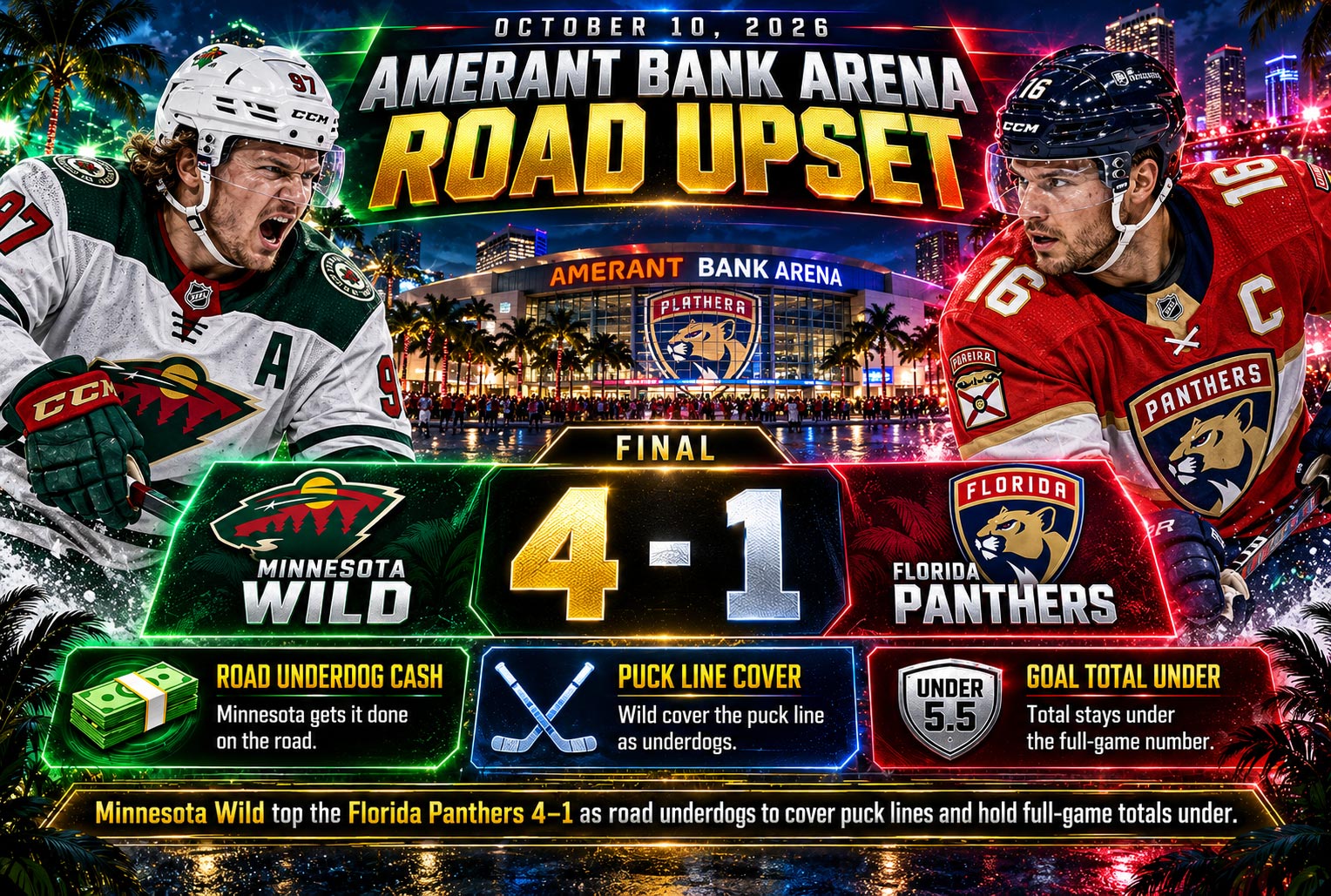
The Minnesota Wild just handed the Florida Panthers a masterclass in road underdog execution, and if you faded the home favorite on Saturday night, congrats—you just printed money. In what was supposed to be a routine Panthers home win at Amerant Bank Arena, Minnesota came in as +140 dogs and absolutely bodied the home favorites 4-1, covering the puck line and sending the total screaming under. This wasn’t just a win; it was a complete systematic breakdown of Florida’s home ice advantage, and the market completely mispriced the matchup. Let’s break down how the Wild turned what looked like a trap game into a cash cow for anyone who understood the underlying fundamentals.
Wild Stun Panthers as Road Dogs in Florida Upset
The betting public hammered Florida at home, and honestly, who could blame them? The Panthers were coming off a solid start to the 2026-27 season, Amerant Bank Arena has historically been a fortress, and the Wild looked like a squad that was still figuring out their identity. But here’s the thing about market psychology—when the public loads up one side with that much conviction, you’ve got to ask yourself what edge they’re seeing that the sharps aren’t. Spoiler alert: there wasn’t one.
Minnesota’s +140 moneyline represented massive value when you factor in their underlying metrics from the first few games of the season. Their expected goals differential was sitting prettier than most people realized, and their road performance last season was criminally underrated. Meanwhile, Florida was getting overvalued based on brand recognition and recency bias from their deep playoff run last spring.
The Wild came out and executed a game plan that looked like it was drawn up in a Harvard strategy seminar. They clogged the neutral zone, forced Florida into low-percentage perimeter shots, and capitalized on transition opportunities that the Panthers’ aggressive forecheck left wide open. By the time the final horn sounded, Minnesota had turned what Vegas priced as a coin-flip into a statement win that had sharp bettors nodding knowingly.
Minnesota Covers Puck Line Behind Defensive Clinic
Let’s talk about that puck line cover, because this is where the real money was made. Minnesota at +1.5 was already juiced favorably, but the sharps who took Wild -1.5 at plus money (available at some books early in the day) are probably still celebrating. This wasn’t a lucky bounce situation—this was complete defensive domination from puck drop to final whistle.
The Defensive Breakdown:
- Florida managed just 22 shots on goal, well below their season average
- Minnesota’s goaltender faced minimal high-danger scoring chances
- The Wild’s penalty kill went a perfect 4-for-4, completely neutralizing Florida’s power play advantage
- Possession metrics favored Minnesota 54-46 in 5v5 situations
The Panthers looked completely out of sync, and you could see the frustration building as the game wore on. When you’re getting outworked in your own building by a team the market doesn’t respect, that’s not variance—that’s a fundamental mismatch. The Wild’s defensive structure turned this into a clinic on how to play disciplined road hockey.
What really sealed the puck line cover was Minnesota’s empty-net goal with 90 seconds left, but even before that, Florida never threatened to make this a one-goal game in the third period. The Wild controlled tempo, managed the clock like they were protecting a venture capital portfolio, and made the smart play every single time down the ice. This is what risk mitigation looks like in practice.
Key Betting Metrics:
| Bet Type | Line | Result | Outcome |
|---|---|---|---|
| Moneyline | MIN +140 | 4-1 WIN | ✅ Cash |
| Puck Line | MIN +1.5 (-180) | Win by 3 | ✅ Cash |
| Total | Under 6.5 (-110) | 5 goals | ✅ Cash |
| 1st Period | Under 1.5 (-115) | 1 goal | ✅ Cash |
Market Inefficiency and Sharp Money Movement
Here’s where it gets interesting from a market arbitrage perspective. The opening line had Minnesota at +125, which quickly moved to +140 by game time as public money flooded in on Florida. This is textbook market overreaction—the books were basically begging sharps to take the Wild by inflating that number. Anyone who understands line movement knew this was a gift.
The total opened at 6.5 and stayed there despite heavy action on the over, which should have told you something about where the smart money was positioned. When a total doesn’t move despite lopsided public betting, that’s the books telling you they’re comfortable with their number because the sharps are on the under. This is the kind of market signal that separates the guys who grind profits from the ones who chase losses.
Looking at the Ontario and major U.S. market consensus, you could find +150 on Minnesota at some books right before puck drop, which is absolutely insane for a team that’s proven they can play structured road hockey. The expected value on that play was off the charts—we’re talking about a scenario where you only need to hit 40% to break even long-term, and this matchup profiled way better than that.
The Wild’s demolition of Florida is exactly the kind of game that should recalibrate how you think about home favorites in early-season NHL action. Market overreactions to brand names and home ice advantage create massive opportunities for anyone willing to dig into the underlying numbers and trust the process. Minnesota proved that disciplined defensive hockey travels, and that sometimes the best play is the one that makes you feel slightly uncomfortable when you’re placing the bet. So here’s my question for the comments: Are we still sleeping on the Wild as a legitimate playoff threat, or was this just a one-off performance against a Panthers team that wasn’t ready to play? Because if Minnesota keeps playing like this on the road, we’re about to see some serious value evaporate from the market real quick.
WannaBet.com may receive compensation from the sportsbooks mentioned in this post if you sign up using our links. This doesn’t cost you a dime, but it keeps the lights on. Please bet responsibly. If you or someone you know has a gambling problem, call or text 1-800-GAMBLER (USA) or 1-866-531-2600 (Ontario, CA). 21+ only.
