

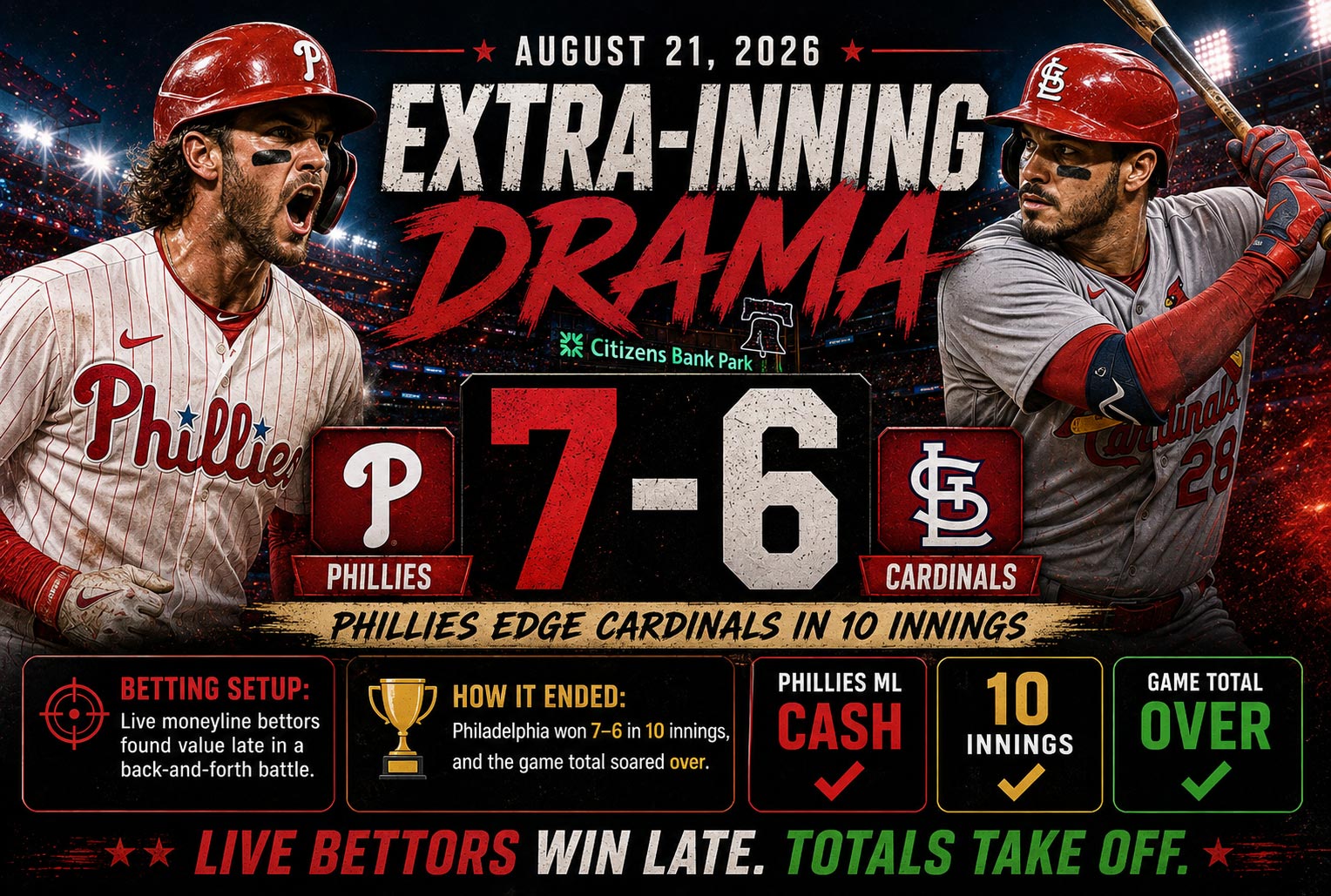
Chaos is the best business model in sports betting. The public panics, the books scramble to adjust, and sharp money sneaks in through the cracks. That’s exactly what went down at Citizens Bank Park on August 21, 2026, when the Phillies and Cardinals turned a regulation baseball game into a 10-inning circus that paid off everyone smart enough to stay awake. Philadelphia walked it off 7-6 in extras, delivering a masterclass in live betting opportunity and total destruction. If you weren’t on your phone hedging positions by the 8th inning, you left money on the table.
Phillies Walk Off Cards in 10th: Live ML Gold
The setup was textbook late-game variance. Cardinals led 5-3 heading into the bottom of the 9th, and the pregame Phillies moneyline (+115) looked dead in the water. That’s when the live ML market turned into a gold mine—Phillies ballooned to +340 on most books with two outs in the 9th. Then Kyle Schwarber happened. Two-run bomb to tie it, and suddenly that +340 ticket was sweating extra innings instead of getting shredded.
The 10th inning was pure expected value realization. Cardinals scratched across one in the top half to go up 6-5, pushing their live ML back down to -180. But here’s where market psychology gets exploited: the public hammers the team in the lead, inflating the juice on the losing side. Phillies were sitting at +145 in the bottom of the 10th, which is insane value for a home team one swing away from winning. Bryce Harper delivered the walk-off double, and anyone who bought low on Philly cashed two separate live ML positions if they played it right.
This game was a textbook lesson in volatility arbitrage. The emotional rollercoaster created multiple entry points where implied probability lagged behind actual game state. Sharp bettors don’t bet on outcomes—they bet on mispriced markets. When the public overreacts to momentum shifts, you fade the panic. That’s how you turn a random August game into a bankroll builder.
The Live Betting Breakdown
Key Line Movements:
- Phillies Pregame ML: +115
- Phillies Live ML (Bottom 9th, down 5-3, 2 outs): +340
- Phillies Live ML (Bottom 10th, down 6-5): +145
- Cardinals Live ML (Top 10th, up 6-5): -180
The risk mitigation play here was hedging if you caught Phillies at +340. Once they tied it in the 9th, you could’ve locked profit by taking Cardinals -180 in extras, guaranteeing a positive return regardless of outcome. But the real degenerates—myself included—doubled down on Philly at +145 in the 10th. Higher variance, higher upside. That’s the game within the game.
The market inefficiency was glaring because books overweight recency bias. Cardinals score in the top of the 10th, and algorithms assume momentum continuation. But baseball doesn’t work like that—especially not with Harper and Castellanos due up. The fundamentals (home field, top of lineup, high-leverage relievers exhausted) suggested Phillies had way better than 40% win probability. That gap between market line and actual probability? That’s your edge.
Extra-Inning Chaos Delivers for Sharp Bettors
The total was the other bloodbath. Game opened at 8.5 runs, closed at 9, and the final score of 7-6 (13 total runs) obliterated the Over. But here’s what casual bettors miss: the smart money was on the live Over once extras hit. Most books set the extra-innings total around 1.5 or 2.5 runs, and with the automatic runner on second, you’re basically betting on whether one team can manufacture a single run. The probability of both teams scoring was underpriced all night.
Sharp bettors recognized the structural advantage extras provide. The ghost runner on second completely changes run expectancy—you’re starting each half-inning in scoring position. Combined with both bullpens gassed after 9 innings, the Over 2.5 runs in extras was free money at -110. Cardinals scored one, Phillies scored two, and suddenly a 13-run game rewarded everyone who understood situational leverage instead of just blindly smashing team totals.
The macro lesson here is about market adaptation. Books are slow to adjust extra-inning pricing because they’re optimizing for volume, not accuracy. They’d rather take balanced action at slightly off numbers than risk exposure by moving too aggressively. That lag creates exploitable windows for bettors who understand game theory and run environment. This wasn’t luck—it was structural inefficiency getting punished.
The Sharp Angle on Totals
Total Progression:
- Pregame Total: 8.5 (closed 9)
- Live Total (After 9 innings, tied 5-5): 11.5
- Extra Innings Total (10th inning only): 2.5
The public hammers pregame Overs in high-scoring games, which is why you saw movement from 8.5 to 9. But the real value emerged in-game. Once the score was tied 5-5 after regulation, books posted 11.5 for the final total. That’s only 6.5 more runs needed across however many extra innings it took. With both offenses clicking and bullpens running on fumes, the Over was a layup.
Here’s the advanced play nobody talks about: micro-betting individual half-innings in extras. Some books offer props on "Will Team X score in the 10th?" at around -150 with the ghost runner. That’s implied probability of 60%, but historical data shows teams score in extras closer to 65-70% of the time with the automatic runner rule. You’re getting +EV on a binary outcome with clear structural advantage. Stack those across multiple games, and you’re printing money on volume.
This Phillies-Cardinals game was everything sports betting is supposed to be—chaos, opportunity, and sharp money cashing tickets while the public chased bad lines. Live betting isn’t about predicting the future; it’s about recognizing when the market misprices the present. The books gave us +340 on a team two outs from tying it, then +145 on the home squad in a coin-flip 10th inning. That’s not gambling—that’s asset allocation. If you’re not watching games with your betting app open, ready to capitalize on momentum swings and public overreaction, you’re leaving edge on the table. So here’s the question: did you catch Phillies at +340, or were you already asleep when the real money got made? Drop your bad beats and big wins in the comments—misery loves company, but so does victory.
"WannaBet.com may receive compensation from the sportsbooks mentioned in this post if you sign up using our links. This doesn’t cost you a dime, but it keeps the lights on. Please bet responsibly. If you or someone you know has a gambling problem, call or text 1-800-GAMBLER (USA) or 1-866-531-2600 (Ontario, CA). 21+ only."
