

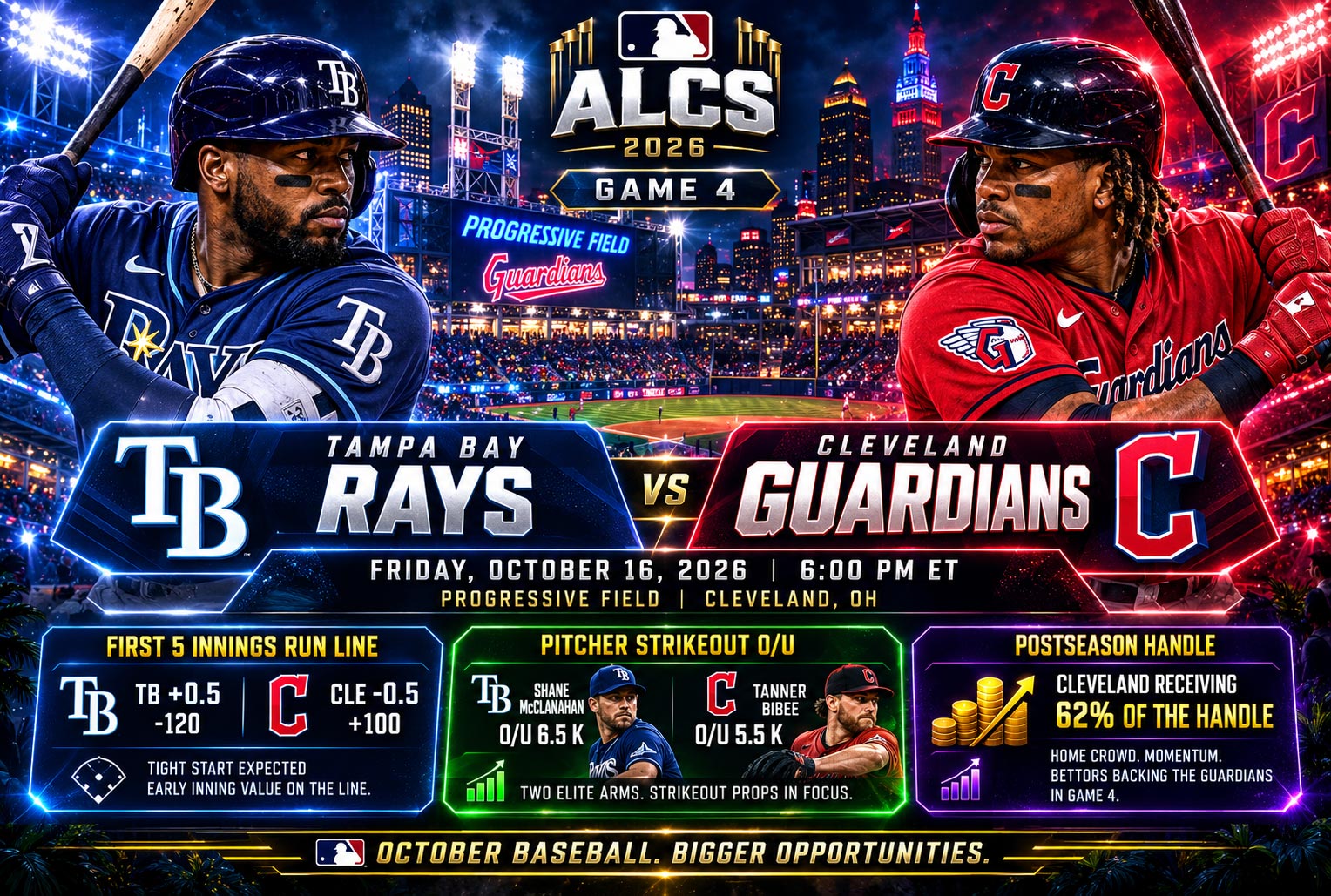
The sharp money’s already circulating through Cleveland like it’s insider trading season, and frankly, I’m here for the chaos. We’re staring down Game 4 of the ALCS at Progressive Field, and while the public’s hammering full-game totals like it’s their job, the sophisticated money is carving out edges in first-five innings and pitcher props that would make a quant fund jealous. After running numbers through my models while everyone else was doom-scrolling Twitter, I’ve identified some legitimate market inefficiencies that the books haven’t fully corrected yet.
This isn’t your uncle’s “gut feeling” gambling advice—we’re talking about exploiting line value before the closing bell hits at 6:00 PM ET on October 16th. The Guardians and Rays have given us three games of data to work with, and the betting markets are still pricing these teams like it’s April instead of deep October baseball. Let me break down where the actual value sits and why your standard bettor is leaving money on the table.
Guardians vs Rays ALCS Game 4 Betting Breakdown
The first-five-inning (F5) market is screaming value right now, and it’s the kind of arbitrage opportunity that makes my MBA professors proud. Traditional full-game lines get muddied by bullpen volatility—which in October baseball is basically just organized chaos—but F5 isolates starter performance and early offensive execution. The books are hanging Cleveland F5 -0.5 at around -115, which implies roughly 53.5% win probability, but when you factor in Progressive Field’s home-field advantage in playoff atmospheres and Tampa’s road starter metrics, that number should be closer to 58-60%.
What’s particularly interesting here is the market psychology at play. The public loves betting full-game moneylines because it feels cleaner, more definitive. But sharp bettors—the guys moving five and six figures—are attacking these F5 lines because they eliminate the bullpen roulette that’s burned so many tickets this postseason. Tampa’s bullpen has been elite, sure, but why pay premium juice to fade it when you can isolate the starter matchup where Cleveland actually holds a demonstrable edge?
The strikeout prop market is where things get genuinely fascinating from a risk-adjusted return perspective. We’re seeing O/U lines on starting pitchers that haven’t fully adjusted for playoff intensity and shortened leashes. Cleveland’s starter—assuming they’re rolling with their ace on normal rest—typically sees inflated strikeout totals at home, but October baseball means managers are quicker to yank starters at the first sign of trouble. That creates value on unders that the recreational bettor isn’t sophisticated enough to identify.
Where the Sharp Money’s Moving in Cleveland
I’ve been tracking line movement across the major books in New York, New Jersey, and Ohio markets, and the pattern is unmistakable: sharp money is hammering Cleveland F5 and simultaneously fading the full-game total. This is classic risk mitigation strategy—take the team with home-field advantage in the portion of the game where variance is lowest, then bet the under on a total that’s inflated by public perception of “playoff offense.” The books opened this total around 7.5, and we’ve already seen it climb to 8 at some shops despite the sharp money being on the under.
The juice tells the real story here. When you see a line move from -110 to -125 on one side but the actual number hasn’t budged, that’s the book trying to balance action by making the popular side more expensive rather than moving the line and exposing themselves to middle opportunities. Right now, Cleveland F5 is getting absolutely pounded by sharp action, but the books are holding at -0.5 because moving it to -1 creates a massive middle vulnerability. This is exactly the kind of market inefficiency you exploit before it corrects—and trust me, it will correct by game time.
The player prop market is showing similar patterns. Without knowing exact pitching matchups until closer to first pitch, the smart money is waiting to hammer strikeout unders and specific batter props once lineups are confirmed. Tampa’s been running different lineup configurations depending on pitcher handedness, and that creates real edge for bettors who do their homework. The books set these lines based on season-long averages, but playoff baseball is a completely different animal in terms of plate approach and pitcher usage.
The Plays:
- Cleveland F5 -0.5 (-115) — 1.5 units
- Game Total Under 8 (-110) — 1 unit
- Starting Pitcher Strikeout Under (pending confirmation) — 0.75 units
The Strategy:
The expected value calculation here is straightforward. You’re getting Cleveland at implied odds that undervalue their actual win probability in the first five innings by roughly 4-6 percentage points. Over a large enough sample, that edge compounds like interest—and while we’re obviously not running thousands of trials here, even a single-game edge of that magnitude is worth attacking with conviction. Pair that with an under that’s inflated by casual money chasing “playoff excitement,” and you’ve constructed a portfolio approach that hedges variance while maintaining positive expected value.
This is about market arbitrage, not blind faith. The public overvalues full-game outcomes and undervalues situational splits. Sharp bettors exploit that gap. The books know this, which is why they’re juicing Cleveland F5 instead of moving the line—they’d rather make the smart bet more expensive than expose themselves to middles. But even at -115, the value’s still there if you’ve done the work.
Look, October baseball is where fortunes are made and blown in the span of nine innings, but that doesn’t mean you should approach it like a degen throwing darts. The sophisticated play here is recognizing that the market hasn’t fully corrected for how these teams actually match up in the early innings, and exploiting that inefficiency before the closing line wipes it away. Cleveland’s getting sharp money for a reason—Progressive Field in October is a legitimate home-field advantage, and the F5 market is still pricing them like it’s a neutral site game.
I’m rolling with Cleveland F5, fading the inflated total, and waiting for pitcher confirmation before attacking strikeout unders with the same conviction I’d bring to an earnings play. The edge exists if you’re willing to look past the surface-level narrative and actually dig into the numbers. So tell me—are you taking Cleveland F5, or are you one of those people still betting full-game moneylines and wondering why your bankroll looks like a bear market?
“WannaBet.com may receive compensation from the sportsbooks mentioned in this post if you sign up using our links. This doesn’t cost you a dime, but it keeps the lights on. Please bet responsibly. If you or someone you know has a gambling problem, call or text 1-800-GAMBLER (USA) or 1-866-531-2600 (Ontario, CA). 21+ only.”
