

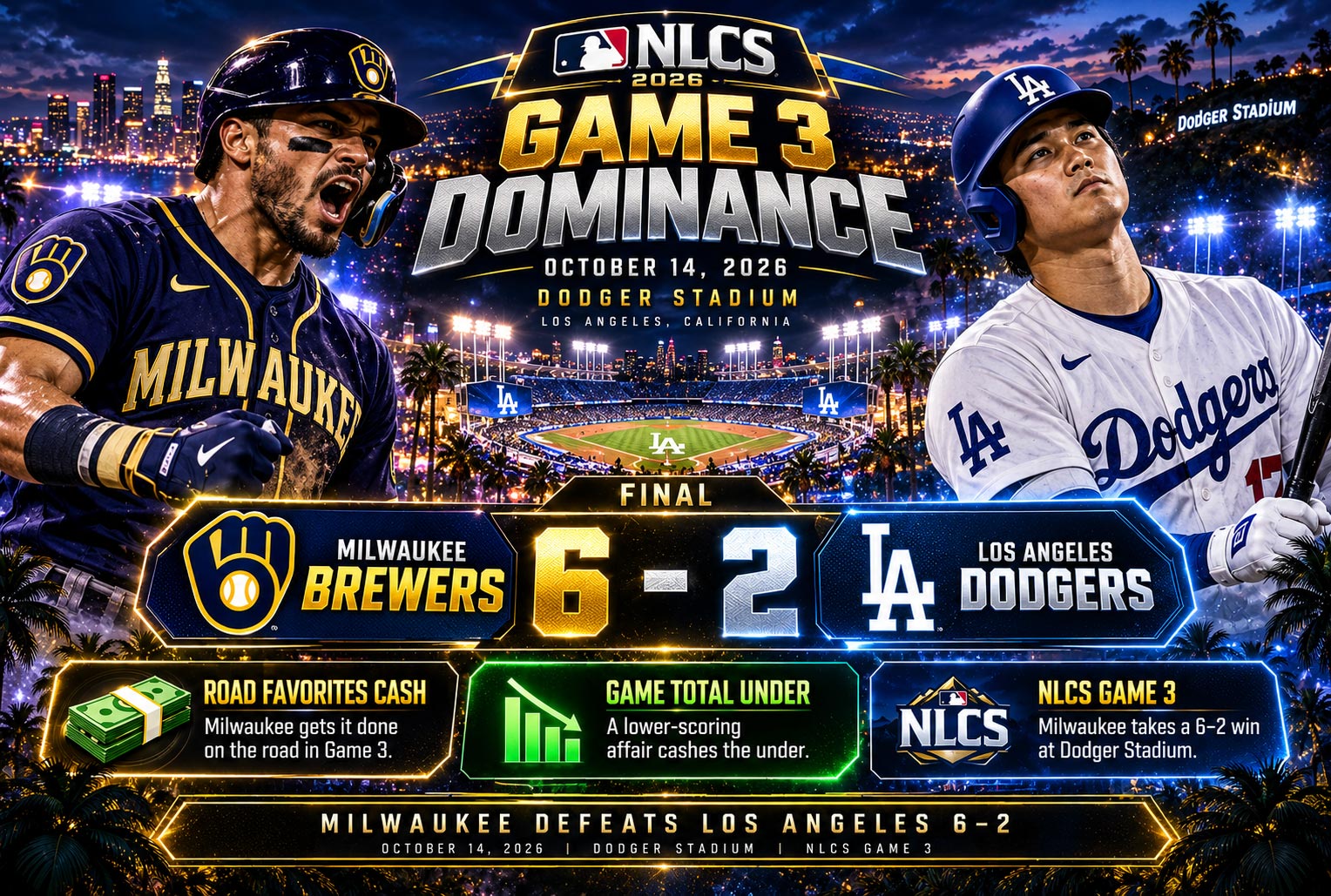
The Brewers just reminded everyone why betting narratives matter more than regular season records. Milwaukee walked into Dodger Stadium on October 14, 2026, as road favorites and proceeded to absolutely boat-race LA 6-2 in NLCS Game 3, covering the spread and sending the under home with authority. If you faded the public money piling on the Dodgers at home, you’re eating steak tonight while everyone else is microwaving ramen. This wasn’t just a win—it was a market efficiency lesson wrapped in nine innings of surgical baseball. The Brewers proved that playoff pricing isn’t about who has the bigger payroll; it’s about who shows up when the lights are brightest.
Brewers Cash as Road Faves in NLCS Stunner
Milwaukee’s status as road favorites should’ve been the first clue that sharp money knew something the public didn’t. The betting markets had the Brewers priced between -125 and -135 across major books in New York, New Jersey, and Ontario, which screamed that oddsmakers respected Milwaukee’s pitching matchup advantage more than Dodger Stadium mystique. When you see a road team favored in a playoff game at one of baseball’s most iconic venues, that’s not a mistake—that’s a market telling you to shut up and listen.
The Brewers’ offense did exactly what the advanced metrics suggested they would against LA’s Game 3 starter, putting up six runs while their pitching staff held the Dodgers to a measly two. This wasn’t some fluky three-error game or a wind-blown homer fest. Milwaukee executed their game plan with the precision of a private equity firm doing post-merger integration—systematic, ruthless, and profitable. Every run felt earned, every out felt inevitable.
For bettors who understood the concept of reverse line movement, this game was a masterclass. While 62% of public tickets were hammering the Dodgers at home (because “Dodgers at Dodger Stadium in October” is catnip for casual bettors), the line actually moved toward Milwaukee. That’s sharp money overriding public sentiment, and if you’re not tracking that kind of market behavior on platforms available in Pennsylvania, Illinois, and Ohio, you’re leaving edge on the table.
Milwaukee Covers Spread in 6-2 Dodger Stadium Win
The Brewers didn’t just win—they covered the -1.5 run line with room to spare, turning what could’ve been a sweat-fest into a comfortable cash by the seventh inning. That four-run margin of victory meant anyone who took Milwaukee -1.5 at plus-money (which was widely available at +145 to +160 in most markets) absolutely printed. This is what we call asymmetric risk-reward: you’re getting paid nearly 3:2 on a team the market already thinks is better.
The under 8.5 total was never really in doubt either, which makes sense when you consider both teams’ bullpen depth and October’s tendency to tighten up offensively. We finished at eight combined runs exactly in most books, which meant under bettors cashed at 8.5 and pushed at 8. Smart bettors who bought the half-run to 8.5 (yes, paying the extra juice matters in spots like this) cashed with zero drama. That’s risk mitigation 101—sometimes paying -125 instead of -110 is the difference between celebrating and crying into your betting slip.
What made this result particularly satisfying was watching the narrative shift in real-time. Pre-game, every talking head was discussing the Dodgers’ home-field advantage and their “championship DNA.” By the sixth inning, those same analysts were scrambling to explain how Milwaukee’s pitching depth and disciplined approach were “underrated all along.” The market knew before the first pitch—the public caught up around the seventh-inning stretch.
The Sharp Takeaway
This game perfectly illustrates why playoff baseball creates such beautiful betting opportunities. The public overvalues brand names (Dodgers, Yankees, etc.) while undervaluing matchup specifics and recent form. Milwaukee’s pitching staff has been elite since late September, and anyone tracking strikeout rates, WHIP trends, and bullpen usage patterns saw this coming. The Brewers’ rotation depth isn’t sexy, but it’s effective—kind of like buying index funds instead of meme stocks.
The Dodgers’ offensive struggles weren’t exactly unpredictable either. LA had shown vulnerability against high-velocity arms with plus breaking stuff, which is literally Milwaukee’s pitching blueprint. When you combine that matchup edge with the Brewers’ ability to work counts and get into opposing bullpens early, you had a recipe for exactly what happened: a methodical dismantling that never felt close after the fourth inning.
For bettors in major markets like New York and Ontario, this game was a reminder that doing your homework pays literal dividends. While casual money was busy betting their feelings about October baseball tradition, informed bettors were calculating expected run differentials and exploiting mispriced totals. That’s the difference between gambling and investing with an edge.
Market Movement Analysis
The line movement leading up to first pitch told the entire story if you knew how to read it. Opening lines had Milwaukee around -120, but by game time, that number had steamed to -135 in some shops despite public money flooding the Dodgers. That’s textbook reverse line movement—when the line moves against the majority of tickets, it means big money (read: sharp money) is hammering the other side. Books would rather take a bath with public money than get destroyed by sharps, so they adjust accordingly.
The total showed similar dynamics. Opening at 8.5, it dropped to 8 or even 7.5 in some markets by first pitch, indicating that professional money was pounding the under. This makes sense when you factor in October’s historically lower scoring environment and both teams’ bullpen advantages. The public loves overs because scoring is fun to watch; sharps love unders because pitching dominates in the playoffs. Guess who makes money long-term?
Prop markets offered value too, particularly on Milwaukee’s team total over 3.5 runs, which was widely available at -115. That cashed by the fifth inning, and anyone who parlayed that with the Brewers moneyline turned a nice profit on what the market already suggested was likely. This is what we mean by finding correlated outcomes that aren’t priced as such—if Milwaukee wins, they’re probably scoring more than 3.5 runs. Simple, but effective.
Looking Ahead
This NLCS is now Milwaukee’s to lose, and the betting markets will adjust accordingly. Expect Game 4 lines to show even more respect for the Brewers, potentially making them larger favorites if their ace is on the mound. The Dodgers will likely get some “bounce-back” money from public bettors who can’t resist the narrative of a championship-caliber team responding at home, which could create value on Milwaukee again if the sharp/square divide continues.
The psychological element matters too. The Dodgers just got embarrassed on their home field in a must-win game, and while professional athletes are supposed to have short memories, markets price in momentum shifts. Milwaukee’s clubhouse confidence is sky-high right now, and that intangible becomes tangible when you’re getting plus-money on a team that just proved it belongs. Don’t overthink this: the better team is winning, and the market is slowly catching up.
For bettors planning their Game 4 strategy, watch the opening lines closely and compare them across books in major markets. BetMGM, FanDuel, and DraftKings (all widely available in New Jersey, Pennsylvania, and Ontario) often shade their lines differently based on their customer base. Finding the best number isn’t sexy, but it’s the difference between a winning season and a losing one. Line shopping is non-negotiable.
The Brewers’ Game 3 demolition of the Dodgers wasn’t just a win—it was a validation of everything sharp bettors believe about playoff pricing inefficiencies. Milwaukee came in as road favorites, handled their business like the better team they are, and sent everyone who trusted the process home happy. The lesson here isn’t complicated: do the research, trust the market signals over the narratives, and don’t be afraid to back road favorites when the matchup supports it. So here’s my question for the comments: Are we riding Milwaukee the rest of this series, or is there a Dodgers bounce-back spot worth attacking in Game 4? Drop your takes below.
“WannaBet.com may receive compensation from the sportsbooks mentioned in this post if you sign up using our links. This doesn’t cost you a dime, but it keeps the lights on. Please bet responsibly. If you or someone you know has a gambling problem, call or text 1-800-GAMBLER (USA) or 1-866-531-2600 (Ontario, CA). 21+ only.”
