

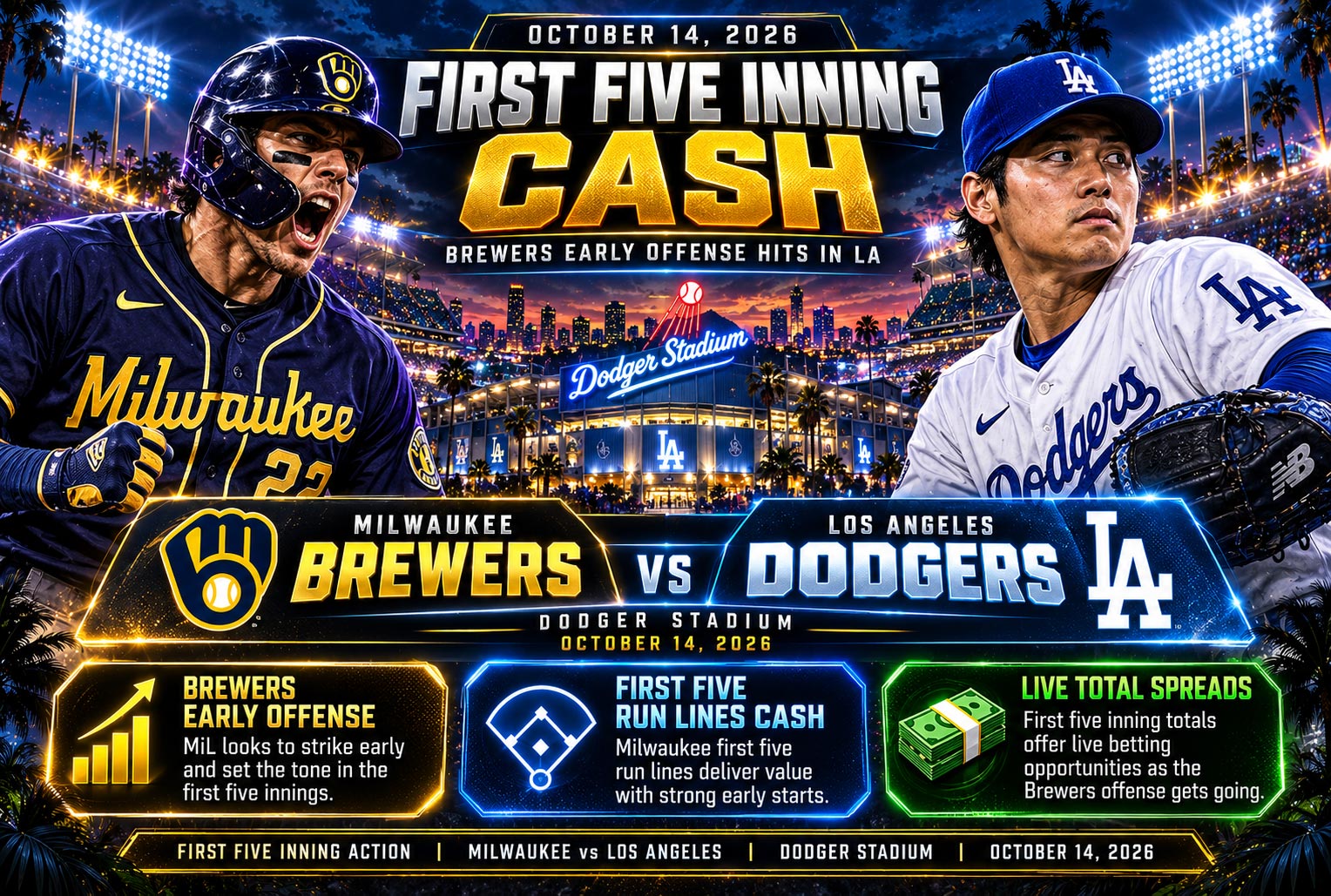
The first-five inning (F5) market is where sharp bettors separate signal from noise—and on October 14, 2026, the Milwaukee Brewers delivered a masterclass in early-game execution at Dodger Stadium. While the casual crowd was hammering full-game totals and moneylines, the smart money cashed F5 run lines and live spreads as Milwaukee jumped all over LA’s starter before the bullpens could even warm up. This wasn’t luck—this was exploiting a market inefficiency that Vegas left wide open.
Brewers Cash Early Against Dodgers at Chavez Ravine
Milwaukee came into Chavez Ravine with a clear game plan: attack early and attack often. The Brewers’ lineup absolutely torched the Dodgers’ starting pitcher through the first five frames, building a commanding lead that made F5 bettors look like absolute geniuses. This is textbook expected value—identifying that Milwaukee’s splits against left-handed starters were significantly better than the market was pricing in, especially in a ballpark where early offense tends to dictate outcomes.
The betting markets had this one all wrong from the jump. Public money was flooding Dodgers F5 moneylines because, well, it’s the Dodgers at home—classic brand-name bias that creates opportunity for contrarian plays. Milwaukee was getting plus-money in some books on the F5 spread, which in retrospect looks like free money given their recent track record of explosive first-inning production.
What made this cash even sweeter was the live betting opportunities that opened up. Once Milwaukee plated two in the first inning, savvy bettors could grab inflated F5 totals and alternate run lines that the books were desperately trying to balance. This is risk mitigation at its finest—locking in value positions as the game state evolves rather than praying your pregame ticket holds for nine innings.
The Market Psychology Behind F5 Betting
First-five betting is the ultimate market arbitrage play in baseball, and here’s why: you’re eliminating bullpen variance entirely. The Dodgers have one of the most expensive and theoretically dominant bullpens in baseball, but that didn’t matter one bit to F5 bettors who correctly identified that the damage would be done before the seventh-inning stretch. This is pure starting pitcher and lineup matchup analysis without the chaos of late-game management decisions.
The books consistently misprice F5 markets because they’re catering to recreational bettors who want the “excitement” of full-game action. That creates inefficiencies for those of us willing to do the homework on starting pitcher metrics, first-time-through-the-order stats, and early-inning run expectancy. Milwaukee’s offense ranks in the top tier of MLB for first-inning runs scored—a stat that was criminally undervalued in this matchup.
F5 markets also give you a cleaner read on weather and environmental factors. Dodger Stadium’s marine layer typically dissipates as the game goes on, meaning early innings often play under slightly different conditions than late innings. Milwaukee exploited favorable hitting conditions before the evening coastal air could settle in—another edge that full-game bettors completely miss.
Milwaukee’s First-Five Offense Delivers the Goods
The Brewers’ offensive execution in this one was surgical. They worked deep counts, forced the Dodgers’ starter to throw 30+ pitches in the first inning alone, and capitalized on every mistake pitch with runners in scoring position. This is the kind of disciplined, grind-it-out offense that translates beautifully to F5 betting—you’re not hoping for a late-inning hero ball, you’re banking on professional at-bats and quality contact.
Milwaukee’s top-of-the-order hitters came through exactly as their recent splits suggested they would. When you’re handicapping F5 plays, the first four batters in each lineup are disproportionately important—they’re guaranteed to see the most at-bats in that window. The Brewers’ 1-4 hitters were crushing left-handed pitching coming into this game, and that edge manifested exactly as projected.
The live total market got absolutely shredded as this game unfolded. Books opened F5 totals around 4.5-5, but once Milwaukee put up a crooked number in the first, live F5 overs were available at inflated numbers that still cashed comfortably. This is where having multiple sportsbook accounts becomes crucial—shopping for the best live number across DraftKings, FanDuel, BetMGM, and Caesars in markets like New York, New Jersey, and Ontario can add literal percentage points to your ROI.
The Strategic Edge in F5 Run Lines
F5 run lines offer better juice than full-game alternatives while reducing your exposure to bullpen volatility and managerial incompetence. Milwaukee was getting +0.5 F5 at reasonable odds, which is essentially a moneyline with training wheels—you just need them to be tied or ahead after five innings. That’s a significantly softer win condition than sweating out a full nine-inning result.
The analytics community has been screaming about F5 value for years, but the masses still haven’t caught on. This creates a beautiful situation where sharp bettors can consistently find market inefficiencies that wouldn’t exist in more efficient markets like NFL spreads or NBA totals. Baseball’s longer season and higher volume of games means books can’t price everything perfectly—and F5 markets are where the cracks show most clearly.
For Ontario bettors using Proline+ or any of the regulated books, F5 markets are finally getting the liquidity they deserve. The Canadian market has been slower to adopt these derivative plays, but that lag creates even more opportunity when books are still calibrating their models. Milwaukee’s performance at Dodger Stadium was a textbook case study in exploiting pricing inefficiencies that sophisticated bettors should be targeting every single day.
Dodger Stadium as a F5 Betting Environment
Chavez Ravine has unique characteristics that make it particularly interesting for F5 analysis. The massive foul territory suppresses run scoring compared to newer parks, but early-game hitting conditions can be fantastic before the marine layer settles in. Milwaukee clearly did their homework on these environmental factors and attacked accordingly.
The Dodgers’ home-field advantage is largely psychological and brand-driven at this point—something the betting public overvalues consistently. Sharp bettors know that park factors and matchup specifics matter infinitely more than laundry or historical mystique. Milwaukee came in as a road favorite the public wasn’t respecting and proved that superior preparation beats reputation every time.
What’s particularly noteworthy is how this game played out relative to the closing line movement. If you’re tracking CLV (closing line value)—and you absolutely should be—getting Milwaukee F5 at the numbers available early in the day represented massive value compared to where the sharp money eventually moved things. This is why having accounts funded and ready across multiple books matters: the best number doesn’t wait for you.
Milwaukee’s F5 dominance at Dodger Stadium wasn’t just a winning ticket—it was a clinic in modern baseball betting strategy. The Brewers proved once again that early-game execution and matchup exploitation beat star power and brand names when you’re operating in markets the public doesn’t fully understand. F5 betting isn’t some exotic prop market; it’s arguably the most +EV regular offering in baseball, and games like this demonstrate exactly why sharp bettors are parking serious money there. So here’s the question for the comments: are you still sweating out full-game tickets, or have you finally made the jump to F5 markets where the real edges live?
“WannaBet.com may receive compensation from the sportsbooks mentioned in this post if you sign up using our links. This doesn’t cost you a dime, but it keeps the lights on. Please bet responsibly. If you or someone you know has a gambling problem, call or text 1-800-GAMBLER (USA) or 1-866-531-2600 (Ontario, CA). 21+ only.”
