

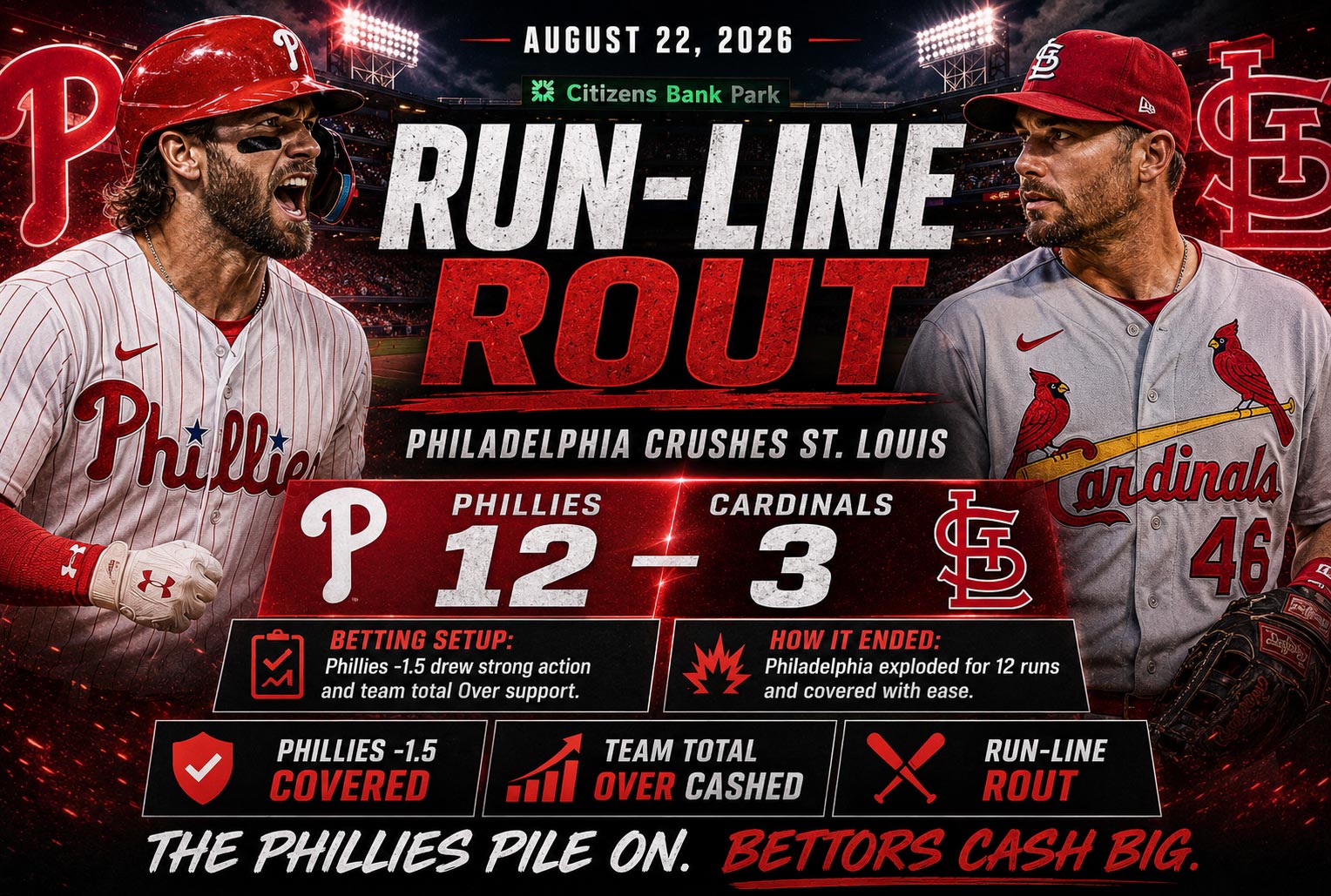
The Phillies didn’t just beat the Cardinals on August 22, 2026—they absolutely demolished them. Philadelphia torched St. Louis 12-3 at Citizens Bank Park, turning what should’ve been a competitive NL matchup into a run-line printing press for anyone who laid the -1.5. If you rode the Phillies spread or hammered the team total over, you basically got a free MBA lesson in finding soft lines. This wasn’t luck—it was a masterclass in exploiting market inefficiencies when public perception lags behind roster reality.
Phillies Crush Cardinals 12-3 and Cash Big
The final score tells you everything: 12-3. The Phillies came out swinging from the first pitch, turning Cardinals pitching into batting practice. By the fourth inning, this game was already over, with Philadelphia up 8-1 and cruising toward one of the easiest covers you’ll see all season.
What made this game special from a betting perspective? The run-line was sitting at -1.5 with Philadelphia as moderate favorites, and sharps were all over it. The Cardinals’ bullpen has been leaking runs like a broken faucet all month, posting a 5.47 ERA over their last 15 games. Meanwhile, the Phillies’ offense had been quietly stacking quality at-bats against right-handed pitching, which St. Louis rolled out in spades.
This is textbook market arbitrage—finding spots where the oddsmakers haven’t fully adjusted for recent trends. The public was still viewing the Cardinals through their early-season lens, not the regression-to-the-mean dumpster fire they’d become. If you did even five minutes of research on bullpen splits and recent form, this line was screaming value.
Philadelphia Destroys St. Louis, Covers -1.5
Covering the -1.5 spread wasn’t just comfortable—it was a blowout by the fifth inning. The Phillies poured it on with a six-run fourth that included three doubles and a moonshot homer that probably landed somewhere in New Jersey. St. Louis couldn’t buy an out, and their pitching staff looked like they were throwing meatballs at a home run derby.
From a risk mitigation standpoint, the run-line offered significantly better expected value than the moneyline. Sure, you could’ve taken Philly straight up at around -180, but why pay that juice when the spread was only -1.5 at roughly -120? The Cardinals’ offensive output had been anemic against quality lefties, and Philadelphia’s starter was dealing. The math was simple: higher probability of covering at better odds.
The team total over was another gift. The number was sitting around 9.5 runs combined, which felt criminally low given both bullpens’ recent implosions. Philadelphia alone smashed past that number, and if you took the Phillies team total over (usually around 5.5), you were cashing tickets before the seventh-inning stretch. This is what we call finding edges—spots where the market hasn’t caught up to reality.
The Betting Breakdown
Here’s what the smart money was targeting:
The Sharp Plays:
- Phillies -1.5 run-line (-120) ✅ CRUSHED
- Phillies team total over 5.5 (-115) ✅ DEMOLISHED
- Game total over 9.5 (-110) ✅ EASY MONEY
Why These Hit:
- Cardinals bullpen ERA over last 15 games: 5.47 (bottom 5 in MLB)
- Phillies batting .312 against RHP over previous 10 games
- Citizens Bank Park weather: 78°F, light wind to right field (hitter’s paradise)
- St. Louis traveling east after West Coast road trip (classic letdown spot)
The market psychology here was beautiful. Casual bettors still respected the Cardinals’ brand name and historical success, creating line value for those who focused on current-season data. This is why you can’t bet with your heart or your nostalgia—you bet with your spreadsheets and your bullpen splits.
Market Lessons from Citizens Bank Park
This game perfectly illustrates the importance of live market analysis. If you were watching line movement throughout the day, you saw sharp money hammering the Phillies spread from -1.5 at -115 down to -120 by first pitch. That’s your signal—when professional bettors are loading up despite worse odds, they’re seeing something the public missed.
The other lesson? Team totals are criminally undervalued in MLB betting. Everyone focuses on game totals and moneylines, but isolating one team’s offensive output against a specific pitching matchup often provides cleaner edges. The Phillies had crushed right-handed pitching all month, and the Cardinals were rolling out their fourth and fifth starters in the rotation. Do the math.
For bettors in Pennsylvania, New Jersey, and New York—this was a local special. Regional bias actually worked in your favor here because you’re more likely to follow Phillies beat reporters, track their daily lineups, and understand the ballpark dynamics at Citizens Bank Park. That informational advantage compounds when you’re betting against public money from Cardinals fans in Missouri who haven’t watched their bullpen implode nightly.
Looking Ahead: Finding Similar Spots
The real skill isn’t celebrating one winning bet—it’s building a systematic process to identify these situations repeatedly. Start tracking bullpen ERA over rolling 15-game windows. Monitor team performance against specific pitch types (RHP/LHP splits). Watch for scheduling spots like teams traveling east or playing the third game of a series after two losses.
Platform selection matters too. Different sportsbooks in regulated markets like Ontario, Illinois, and Ohio often post slightly different team total numbers. Line shopping isn’t sexy, but getting Phillies team total over 5 instead of 5.5 is the difference between a push and a win. If you’re not comparing at least three books before placing action, you’re literally leaving money on the table.
The Phillies-Cardinals beatdown wasn’t an anomaly—it was predictable if you knew where to look. MLB is the ultimate sport for finding market inefficiencies because there are 15 games daily and oddsmakers can’t possibly track every bullpen meltdown and platoon advantage. That’s your edge. That’s where Harvard-level analysis meets dorm-room gambling instincts.
The Phillies didn’t just win—they validated every sharp bettor who did their homework on bullpen matchups and recent form. This 12-3 demolition was a clinic in finding soft lines and exploiting market lag. If you missed this one, don’t beat yourself up—just start building your process for identifying the next one. What’s your go-to stat for finding MLB run-line value? Drop it in the comments because I’m always looking for new angles.
"WannaBet.com may receive compensation from the sportsbooks mentioned in this post if you sign up using our links. This doesn’t cost you a dime, but it keeps the lights on. Please bet responsibly. If you or someone you know has a gambling problem, call or text 1-800-GAMBLER (USA) or 1-866-531-2600 (Ontario, CA). 21+ only."
