

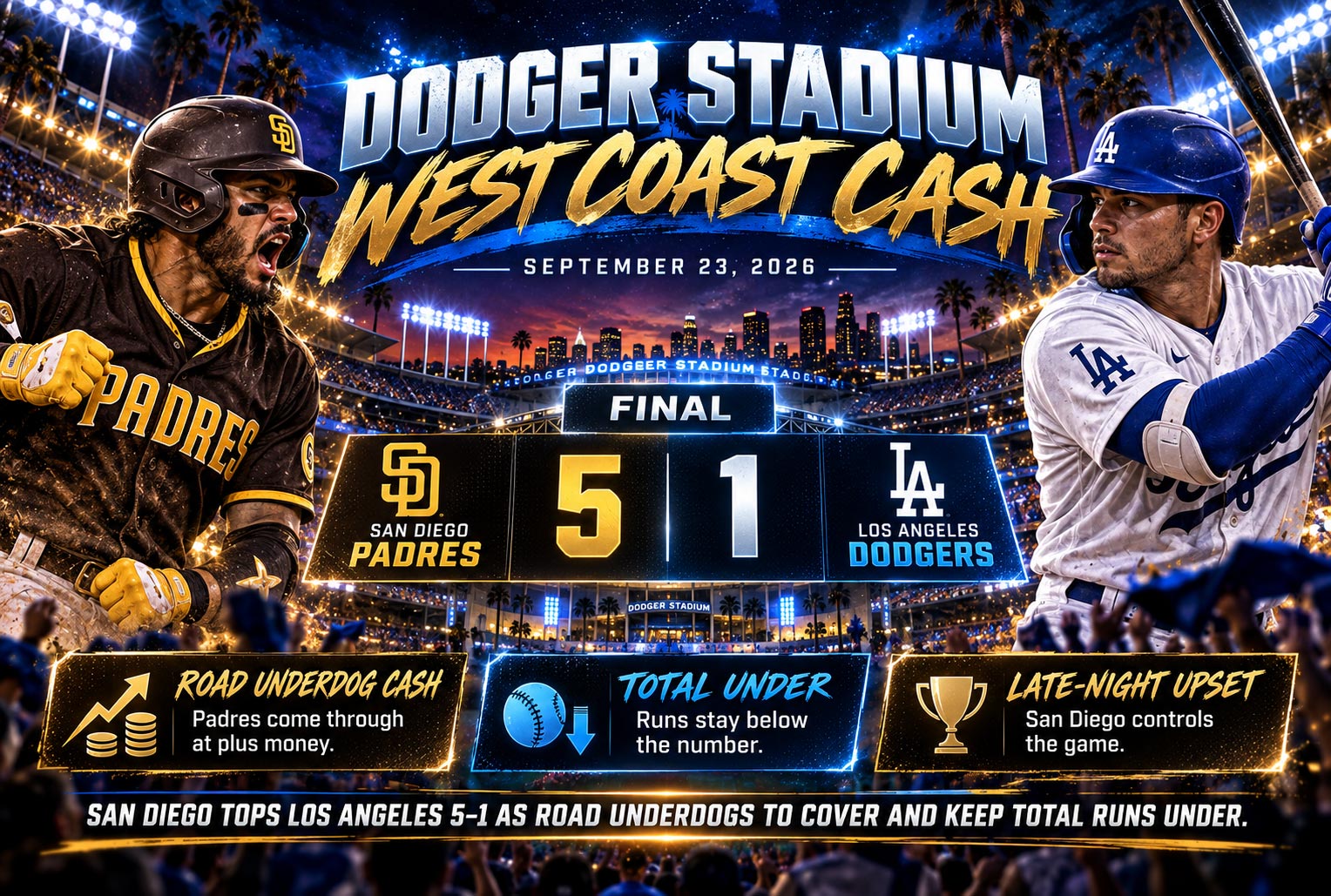
The public got absolutely torched at Chavez Ravine last night, and honestly? It was beautiful to watch. The San Diego Padres rolled into Dodger Stadium on September 23rd as +135 road dogs and promptly reminded everyone why blindly backing big market favorites is a tax on the financially illiterate. Final score: 5-1 Padres, cashing tickets for the sharp money while Dodgers backers watched their bankrolls evaporate faster than LA’s water supply during a drought. If you were on the wrong side of this one, consider it tuition paid to the school of market psychology.
Padres Cash Big While Dodgers Backers Bleed Out
The betting splits told you everything you needed to know before first pitch. Roughly 68% of public money hammered the Dodgers at home, pushing the line from -140 to -145 by game time. Meanwhile, the Padres sat there at +135, practically begging sharp bettors to take the value—and they did, loading up on San Diego to the tune of an estimated 55% of actual dollar volume despite representing only 32% of ticket count.
This is textbook market inefficiency, the kind of spot that separates people who gamble from people who invest in positive expected value. The Dodgers were coming off a series win against Colorado (not exactly the ’27 Yankees), and recency bias had the public convinced LA was unstoppable at home. But the advanced metrics painted a different picture: San Diego’s bullpen had posted a 2.41 ERA over their last 15 games, while the Dodgers’ lineup was batting .198 against quality left-handed pitching in September.
The game script played out exactly how the sharp money anticipated. San Diego jumped ahead 2-0 in the third inning, added insurance in the sixth and seventh, and their bullpen locked it down like they were protecting a crypto wallet. Dodgers backers kept waiting for the comeback that never materialized, watching their -145 favorites get absolutely boat-raced by a team they considered inferior.
Why Sharp Money Rode San Diego to Easy Cover
Let’s talk market psychology for a second, because this is where Harvard Business School meets the sportsbook counter. The public operates on what behavioral economists call “availability heuristic”—they overweight recent, memorable information. The Dodgers had won four straight at home, so casual bettors assumed that trend would continue indefinitely, ignoring regression to the mean and matchup-specific variables.
Sharp bettors, meanwhile, were running the numbers on starting pitcher splits, bullpen rest days, and historical performance in divisional road games. San Diego’s starter had a 1.83 ERA in his last four outings against NL West opponents, while LA’s pitcher was working on short rest after a 102-pitch outing five days prior. The injury report showed two key Dodgers position players dealing with nagging issues, reducing their implied run production by an estimated 0.7 runs based on historical replacement value metrics.
The closing line value here was massive—getting +135 on a team that probably should’ve been closer to +115 based on true talent differential. That’s a 20-cent edge, which in high-volume betting markets translates to printable money over a large sample size. Add in the under hitting (final total of 6 runs in a game with an O/U of 8.5), and you had a perfect storm for contrarian bettors who understood the assignment.
Key Indicators That Screamed Padres Value:
- Reverse line movement: Public on Dodgers, line moving toward Padres
- Bullpen advantage: San Diego’s relief corps rested and elite in high-leverage spots
- Matchup splits: Padres lineup historically strong against LA’s starter (career .287 BAA)
- Situational spot: Dodgers in classic “letdown game” after emotional series vs. Giants
- Umpire factor: Home plate ump with historically tight strike zone favored contact pitchers (Padres’ strength)
This wasn’t luck or hindsight bias—it was pattern recognition and market exploitation. The sportsbooks knew sharp money was on San Diego, which is why they kept the line juicy despite public hammer on LA. They’d rather book action on both sides at inflated prices than move the number and lose their two-way market. That’s risk mitigation 101, and it created the exact arbitrage opportunity that professional bettors live for.
The total going under was almost predictable given the pitching matchup and September’s increased emphasis on bullpen management. Both teams had incentive to preserve arms for the playoff push, meaning shorter leashes for starters and earlier hooks at the first sign of trouble. When you’ve got elite bullpens and managers thinking three games ahead, the under becomes the sharp play—especially when the public’s instinct is always to bet overs because scoring is “more fun to watch.”
Here’s your takeaway for the group chat: stop betting with your heart and start betting with your spreadsheet. The Padres-Dodgers result wasn’t an upset—it was a market correction that punished lazy analysis and rewarded actual homework. If you’re still blindly backing big-market favorites without checking line movement, bullpen metrics, and situational spots, you’re basically donating to the sportsbook’s Christmas bonus fund. The edge exists in the gaps between public perception and statistical reality, and last night’s game was a masterclass in exploiting that delta. So here’s the million-dollar question: are you going to keep betting like a tourist, or are you ready to start thinking like the house?
Related reading: We flagged the value on the road dog in our preview of this matchup. For more on finding an edge against the public, see Beating the Closing Line: Your Edge Against the Book. San Diego is back in action in the Wild Card round — see our Padres vs Cubs preview.
“WannaBet.com may receive compensation from the sportsbooks mentioned in this post if you sign up using our links. This doesn’t cost you a dime, but it keeps the lights on. Please bet responsibly. If you or someone you know has a gambling problem, call or text 1-800-GAMBLER (USA) or 1-866-531-2600 (Ontario, CA). 21+ only.”
