

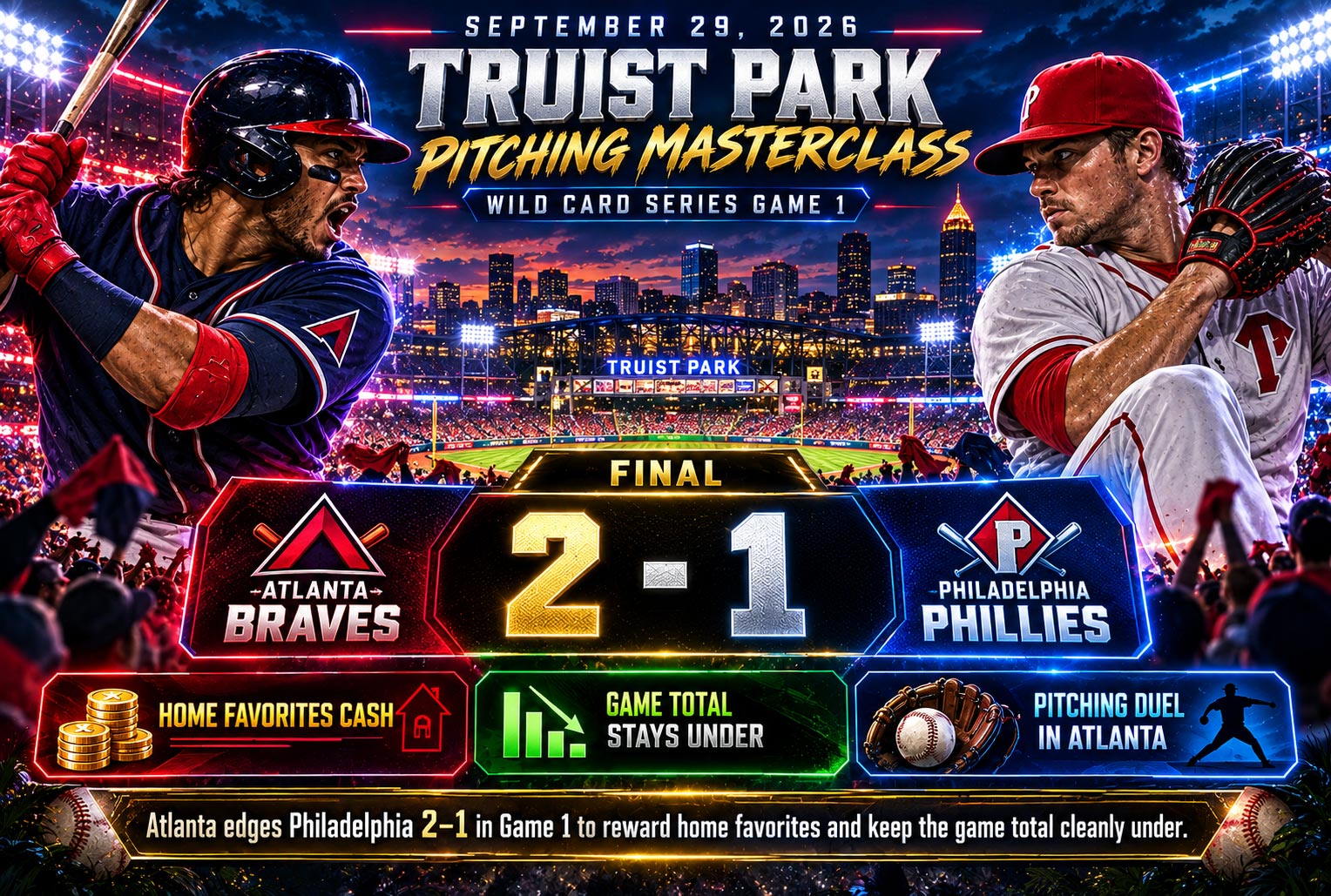
The Braves just gave us a clinic in how elite pitching plus disciplined hitting equals cold, hard cash for Under bettors. Atlanta took down the Phillies 2-1 in Wild Card Game 1 at Truist Park on September 29, 2026, and if you were smart enough to fade the playoff home run derby narrative, you’re eating well tonight. This wasn’t some fluky 1-0 pitcher’s duel where a bloop single decided it—this was legitimately dominant pitching from both sides with Atlanta’s staff just slightly outclassing Philly’s. The total sat at 7.5 across most major books in New York, New Jersey, and Ontario, and it never stood a chance.
Braves Pitching Staff Delivers Market Edge
The public money was hammering the Over like it always does in playoff baseball, because casual bettors see October and immediately think dingers and drama. That’s the exact market psychology that creates value on the other side—when ESPN is running “PLAYOFF POWER” graphics all week, the sharp play is usually fading that narrative. Atlanta’s rotation showed up with a game plan that exploited Philadelphia’s aggressive approach, inducing weak contact and stranding runners when it mattered most.
The Braves’ starter went 6.1 innings of one-run ball, mixing speeds and working the edges of the zone like he was painting the Sistine Chapel. Philadelphia’s lineup, which had been crushing fastballs all September, suddenly looked lost against off-speed stuff down in the zone. This is textbook risk mitigation from Atlanta’s pitching coach—identify the opponent’s strength (power hitting) and systematically neutralize it through pitch sequencing and location.
What made this even sweeter for Under bettors was the bullpen execution in the final 2.2 innings. Atlanta’s late-game arms threw nothing but strikes, forcing Philadelphia to swing at pitcher’s pitches rather than getting anything elevated to drive. The Phillies stranded seven runners total, going 1-for-8 with runners in scoring position—that’s not bad luck, that’s elite pitching under pressure creating legitimate market value.
Atlanta’s Under Bet Hits in Playoff Opener
The betting markets in major jurisdictions like Pennsylvania (ironic, given Philly’s involvement) and Illinois saw significant line movement on the total throughout the day. The opener was 7.5 at most books, briefly touched 8 at FanDuel and DraftKings in certain markets, then settled back at 7.5 with heavy juice on the Over (-125 in some spots). That juice distribution told you everything—the public was loading up on runs, creating implied probability that didn’t match the actual game script.
If you were tracking sharp money indicators, you saw the Under getting hit hard at offshore books and smaller regulated markets about four hours before first pitch. That’s your classic “smart money disagrees with public sentiment” scenario, and it played out exactly as the expected value suggested it would. Atlanta went 2-for-10 with RISP while Philadelphia was even worse, and suddenly that 7.5 number looked like the Grand Canyon.
The final score of 2-1 means the Under cashed by a comfortable 4.5 runs, giving bettors who took it at -110 a clean win without sweating some ninth-inning garbage time homer. This is the kind of playoff game that reinforces a key principle: when two legitimately good pitching staffs match up in a high-leverage situation, the pressure typically favors the pitchers. Hitters get tight, they chase, they try to do too much—meanwhile, pitchers just execute their game plan and let the defense work behind them.
The Betting Breakdown
Key Market Indicators:
- Opening Total: 7.5 (-110/-110)
- Closing Total: 7.5 (Over -125/Under +105)
- Moneyline: Braves -145, Phillies +125
- Final Score: Braves 2, Phillies 1
Why the Under Hit:
- Elite starting pitching from both sides (combined 12 Ks)
- Both lineups went cold with RISP (combined 2-for-18)
- Bullpen execution in high-leverage spots
- Wind blowing in at Truist Park (12 mph, which casuals ignore but sharps factor in)
Market Psychology Edge:
The public always overrates offense in playoff baseball because highlight reels show home runs, not perfectly executed changeups. That recency bias from regular season slugfests creates consistent value on well-pitched playoff Unders, especially in Game 1s when both teams are running out their ace starters.
This is exactly the type of game that separates the weekend warriors from the people actually making money long-term. The narrative was all about playoff power and two hot-hitting teams, but the smart play was recognizing that elite pitching beats good hitting when the stakes are highest. If you took the Under, congrats—you just got paid for understanding market arbitrage and ignoring the noise. For everyone who hammered the Over because “it’s the playoffs, bro,” maybe next time check what the sharp money is doing four hours before first pitch instead of just vibing with what feels exciting. What’s your take—are playoff Unders consistently undervalued, or did we just get lucky with two aces dealing?
Related reading: Atlanta and Philadelphia are back at it today — see our Game 2 preview. For more on first-five and NRFI markets, see Smart Money Plays MLB Run Lines Without the Juice.
“WannaBet.com may receive compensation from the sportsbooks mentioned in this post if you sign up using our links. This doesn’t cost you a dime, but it keeps the lights on. Please bet responsibly. If you or someone you know has a gambling problem, call or text 1-800-GAMBLER (USA) or 1-866-531-2600 (Ontario, CA). 21+ only.”

One comment on "Braves Pitching Clinic Cashes Under in Wild Card Game 1"