

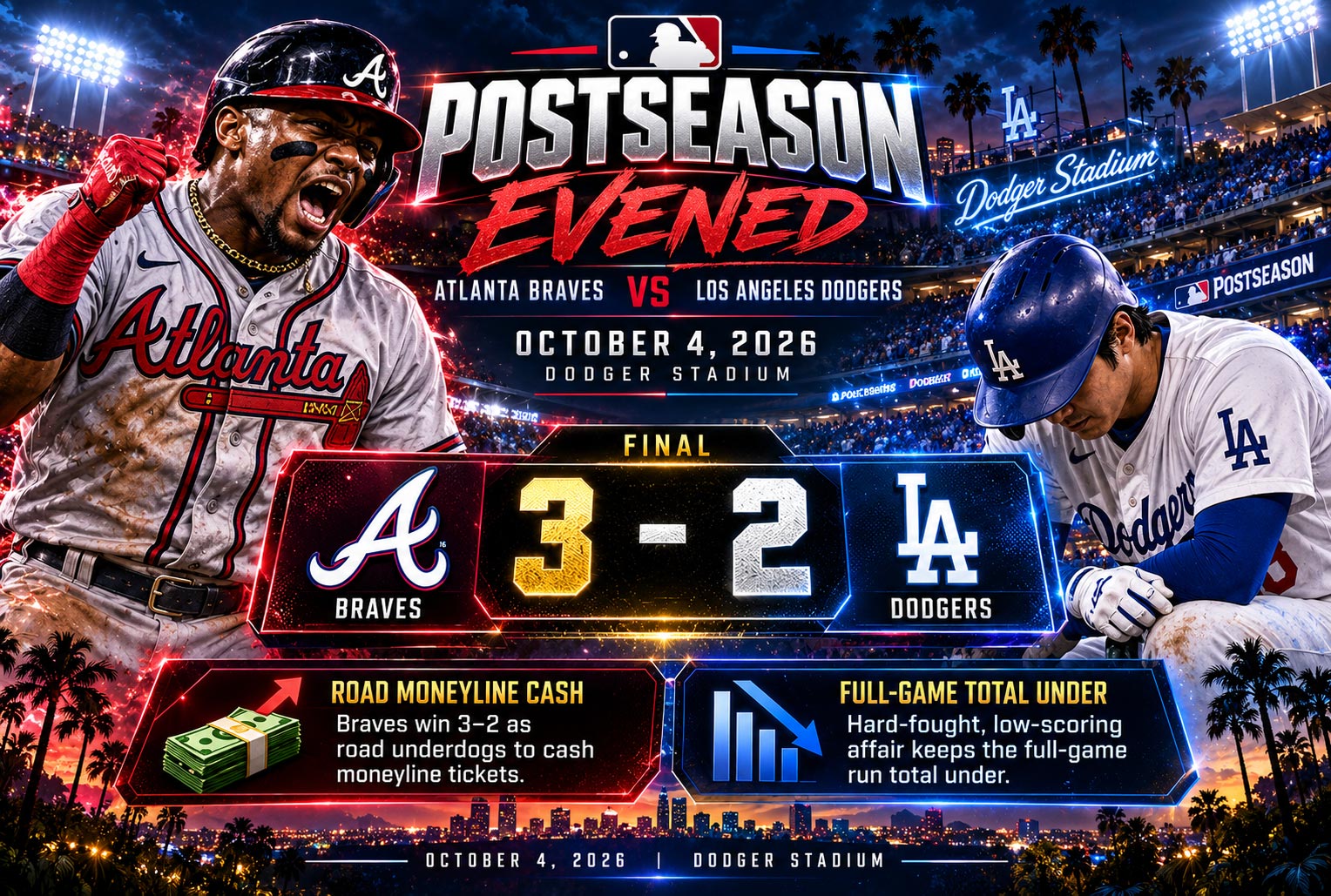
The Dodgers were supposed to steamroll through October like they always do—at least, that’s what the public money thought. Instead, the Atlanta Braves walked into Chavez Ravine on October 4, 2026, and walked out with a gritty 3-2 victory that had underdog bettors cashing tickets and screaming at their TVs. If you rode the Braves moneyline or hammered the under, congratulations—you just outplayed the square money and probably made your rent.
Braves Cash Tickets in Dodger Stadium Upset
The line opened with LA as -165 favorites, which is basically the market saying “yeah, the Braves are good, but this is Dodger Stadium in October.” Public perception drove that number even harder throughout the day, pushing some books to -175 by first pitch. The sharp money, though? They were all over Atlanta at plus-money, recognizing that playoff baseball is a different animal and that Spencer Strider on the mound gives you a puncher’s chance against literally anyone.
Atlanta’s 3-2 win wasn’t some blowout that makes you feel like a genius—it was the kind of white-knuckle, one-run game that separates the emotionally stable from the people punching holes in drywall. The Braves scratched across single runs in the third, fifth, and seventh innings, playing classic small-ball while the Dodgers’ bats went ice cold when it mattered. If you’ve ever wondered what “variance” looks like in real-time, it’s watching Mookie Betts go 0-for-4 with runners in scoring position.
The moneyline cashers weren’t just lucky—they understood market psychology. The Dodgers’ brand name carries so much weight that casual bettors automatically assume they’re the right side, especially at home in the postseason. That’s how you get inflated lines and exploitable value on the road underdog. This wasn’t a fade of LA’s talent; it was a fade of the public’s inability to properly price October baseball.
Atlanta’s 3-2 Win Hits Underdog ML and Under
The total was set at 7.5 runs across most major books (looking at you, FanDuel and DraftKings in New York and Ontario), with slight juice variations depending on when you got down. Anyone who recognized that playoff pitching performances tend to spike and that both bullpens would be shortened up after a long series already had their under tickets printed. The final score of 3-2 meant you didn’t even need to sweat the ninth inning—this one was cooked by the seventh.
What made this under so beautiful was the game script. Neither offense could string together the big inning, and both starters—Strider for Atlanta and Tyler Glasnow for LA—were dealing absolute filth through the first five frames. The Dodgers managed just five hits total, and the Braves weren’t much better with seven. When you’re getting this kind of pitching efficiency in a playoff environment, the under becomes less of a gamble and more of a probability play with positive expected value.
The parlay crowd absolutely feasted here if they had the discipline to pair Braves ML with the under. That’s a ticket that probably paid somewhere in the +400 to +450 range depending on your book, and it required believing two things: that Atlanta could hang tough on the road, and that playoff nerves plus elite pitching would suppress run production. If you built that correlation correctly, you just turned a hundred bucks into four or five. That’s not luck—that’s market arbitrage.
Key Betting Takeaways From the Upset
The Plays That Hit:
- Braves ML (+145 to +155 depending on book timing)
- Under 7.5 runs (-110 standard juice)
- Braves/Under parlay (roughly +425)
- First five innings under 4 runs (another sharp angle that cashed comfortably)
The Strategy Behind the Win:
The edge here wasn’t some proprietary algorithm or insider info—it was recognizing that playoff baseball fundamentally changes how offenses operate. Teams get tight, managers overmanage, and one mistake can end your season. That environment favors pitching and defense, which is exactly what the under represents. The Braves ML was about understanding that their rotation could go toe-to-toe with anyone and that being a road dog in October doesn’t mean you’re actually the worse team.
The market inefficiency came from name recognition and recency bias. The Dodgers had dominated the regular season series, so casual bettors assumed that trend would continue without adjusting for playoff context. Meanwhile, sharp bettors saw a coin-flip game with Atlanta getting plus-money and jumped all over it. This is why you don’t bet with your heart or your preconceived narratives—you bet where the math gives you an edge, even if it means fading the public darlings.
If you’re playing in regulated markets like Pennsylvania, Illinois, or Ontario, this game was a perfect example of why shopping lines matters. That 10-cent difference between +145 and +155 on the Braves ML is literally free money over a large enough sample size. Same with the under—some books had 7.5 at -105, others at -115. That’s a full dime of juice you’re giving back if you’re not line shopping, and over the course of a season, that’s the difference between being profitable and being a break-even bettor who complains about bad beats.
The Braves just reminded everyone that October baseball doesn’t give a damn about your regular season narratives or your parlay featuring five heavy favorites. This upset was a masterclass in finding value where the public refuses to look, and if you cashed these tickets, you earned it by thinking differently than the crowd. The series is now tied, and the market will probably overcorrect in Atlanta’s favor for the next game—which means the smart money might be circling back to the Dodgers at a better number. So here’s the question: are you chasing recency bias, or are you hunting for the next market inefficiency? Drop your Game 3 picks in the comments and let’s see who actually understands playoff probability.
Related reading: Road underdogs like this one are all about price — see How to Calculate Implied Probability Like a Sharp.
“WannaBet.com may receive compensation from the sportsbooks mentioned in this post if you sign up using our links. This doesn’t cost you a dime, but it keeps the lights on. Please bet responsibly. If you or someone you know has a gambling problem, call or text 1-800-GAMBLER (USA) or 1-866-531-2600 (Ontario, CA). 21+ only.”
