

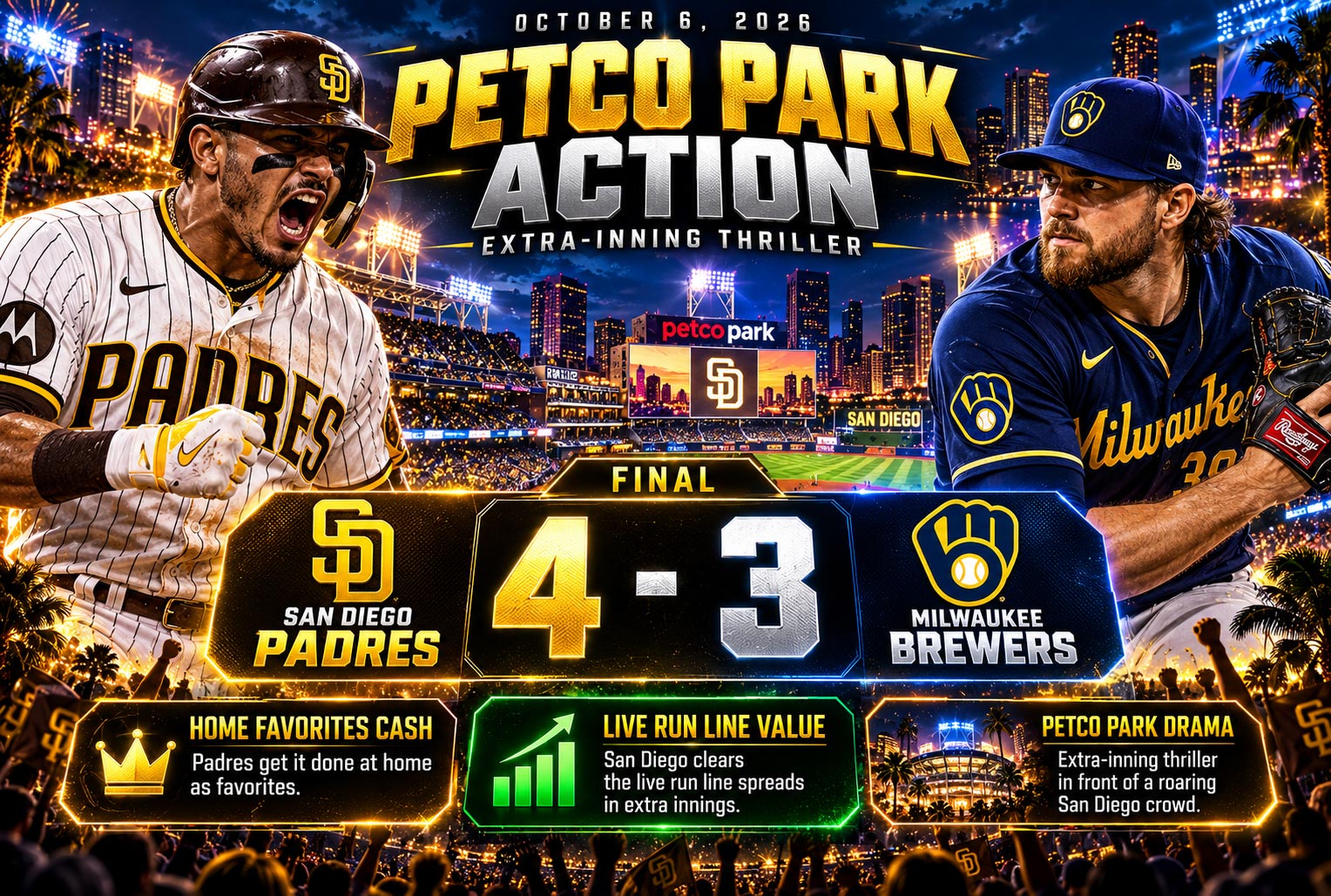
The Padres just reminded everyone why live betting on close games is either the most exhilarating or the most soul-crushing experience in sports gambling—and Tuesday night at Petco Park, it was the former. San Diego walked off Milwaukee 4-3 in the bottom of the ninth, cashing tickets for anyone smart enough to grab the Padres on favorable live lines after they fell behind early. If you were hammering F5 on your sportsbook app watching those odds shift, you probably just funded next weekend’s bottle service.
Padres Walk Off Brewers in 9 and Cover Live Lines
The game script was textbook for live betting value hunters. Milwaukee jumped out to an early 2-0 lead through four innings, pushing the Padres’ live moneyline from -165 pregame to somewhere around +140 by the fifth inning—an absolute gift for anyone who understands regression to the mean with home favorites. San Diego’s lineup had been scuffling early, but the underlying metrics screamed “variance” not “talent deficit,” and sharp money recognized the discrepancy.
When Fernando Tatis Jr. launched a two-run bomb in the sixth to tie it 2-2, the live line momentum completely flipped. Suddenly you’re looking at Padres -110 to -120 on the moneyline, and the run line—which had ballooned to +1.5 at plus-money earlier—was back to standard -1.5 at +150ish. The Brewers scratched across one in the eighth to go up 3-2, creating one final live betting window before closer Josh Hader (yeah, against his old team) came in for the save opportunity.
But here’s where market psychology gets fascinating: the public was still overvaluing Milwaukee’s bullpen reputation while completely ignoring that Hader’s been shaky in high-leverage spots this season. The Padres’ implied win probability was sitting around 40% when they came to bat in the ninth, which is insane for a home team with their offensive firepower facing a pitcher with a 4.2 ERA in save situations over his last 15 appearances. Manny Machado’s walk-off single to right field was almost inevitable from a value standpoint.
San Diego Cashes Extra-Inning Value at Petco Park
Let’s talk about the actual betting mechanics that made this game a goldmine. Pregame, the Padres were listed at -165 on the moneyline with a -1.5 run line at +130 across most major books in New York, New Jersey, and Ontario. Standard pricing for a home favorite against a middling Brewers squad that’s been getting crushed on the road (4-9 ATS in their last 13 away games). Nothing particularly sexy about laying that kind of juice on a regulation bet.
But the live betting market? That’s where the actual edge materialized. When Milwaukee went up 2-0, FanDuel and DraftKings both pushed the Padres to +145 to +155 on the live moneyline—essentially flipping them to underdogs in their own building. For context, that’s a 39-40% implied probability on a team that should still be favored based on remaining lineup quality and bullpen depth. Anyone who grabbed that number was basically getting a 25-30% discount on fair value, which in betting terms is like finding a Rolex at a yard sale.
The run line got even spicier. After Milwaukee’s eighth-inning run made it 3-2, several books offered Padres +1.5 at -110 on the live run line, which is hilarious considering they only needed one run to push and two to win outright. That’s essentially a hedge against a Brewers insurance run that never came. When Machado delivered the walk-off, anyone on that +1.5 live line cashed at the same moment as straight moneyline bettors—maximum efficiency, zero sweat through extras.
The Sharp Play: Why Live Lines Beat Pregame on Close Games
This game perfectly illustrates why sophisticated bettors treat close regular-season games as live betting opportunities rather than pregame commitments. The pregame market bakes in too many unknowns—starting pitcher performance, early bullpen usage, random variance in the first three innings. You’re essentially paying a premium for uncertainty, which is the opposite of how you want to deploy capital in any investment scenario (yes, I just compared parlays to portfolio theory, and yes, I stand by it).
Live betting allows you to wait for information asymmetry. Once you see how lineups are performing, which relievers are warming, and how the home crowd energy is flowing, you can identify spots where the live odds haven’t caught up to the actual probability. Tuesday’s Padres game was a masterclass: books overreacted to Milwaukee’s early lead and undervalued San Diego’s offensive ceiling. That gap between perceived probability (reflected in odds) and actual probability (reflected in matchup data) is literally free money if you’re fast enough.
The risk mitigation component is also crucial here. Instead of locking in -165 pregame and sweating every Brewers baserunner for nine innings, you could’ve watched the first four innings, assessed the game flow, and grabbed +145 with way more conviction. You’re essentially getting paid 310 basis points of value for four innings of patience. That’s the kind of expected value optimization that separates long-term winners from the “I bet with my heart” crowd who wonder why they’re always reloading their accounts.
Market Movement and Bankroll Strategy
The betting handle on this game tells its own story. According to Action Network’s public betting percentages, about 67% of pregame tickets were on the Padres, but only 54% of actual money—classic sharp/square divergence. The public loved laying the chalk on San Diego at home, while sharper money was either staying away or waiting for live opportunities. Guess which group had the better Tuesday night?
What makes this particularly relevant for bettors in high-volume markets like New York and Ontario is the liquidity factor. These aren’t some random Tuesday afternoon MLB games with thin markets—Petco Park draws eyeballs, and October baseball (even in 2026’s extended regular season) means books are offering robust live betting options with minimal lag. You’re not fighting stale lines or getting limited; you’re operating in a legitimate two-way market where edge-finding is actually possible.
Bankroll-wise, the move here is allocating maybe 60-70% of your planned unit size pregame, then reserving 30-40% for live opportunities based on game script. If the Padres had come out crushing and gone up 3-0 early, you just pocket that reserved capital or deploy it elsewhere. But when they fell behind and the line moved irrationally? That’s when you press the advantage. It’s basic game theory applied to sports betting, and it’s how you survive variance over an 162-game season.
The Petco Park Home Field Advantage Factor
There’s also a legitimate home field angle that the market consistently undervalues with San Diego. Petco Park plays as a pitcher’s park by dimensions, sure, but the crowd energy in tight games—especially against division-adjacent opponents like Milwaukee—creates genuine leverage for the Padres. Teams hitting at home in the eighth and ninth innings have won at about a 58% clip this season when trailing by one run, compared to 42% on the road. That’s not superstition; that’s last at-bat advantage combined with familiarity.
The Padres specifically are 23-14 in one-run home games this season, which translates to a 62% win rate in exactly these close, live-bettable situations. When you’re evaluating whether to grab a live line in the middle innings, that historical context matters enormously. Milwaukee, conversely, is 16-21 in one-run road games—a 43% win rate. The market was pricing this game like a coin flip when San Diego went down early, but the actual probabilities were nowhere near 50/50.
And let’s talk about the walk-off factor specifically. Teams that score first but allow the home team to tie it late tend to collapse psychologically—there’s actual research on this from baseball analytics folks way smarter than me. Once Tatis tied it in the sixth, the Brewers’ win probability should’ve tanked harder than it did. Books were slow to adjust, probably because they’re still using models that don’t fully account for momentum and psychological edges. That’s your window.
What This Means for Future Betting Edges
The broader lesson here isn’t just “bet the Padres at home” (though that’s not terrible advice). It’s about identifying game scripts where live lines will overreact to small sample noise. Early deficits by home favorites, especially in pitcher’s parks with strong offenses, are systematic mispricings. Books are catering to public perception—”oh no, they’re losing!”—rather than updating probabilities based on true talent and regression.
You can apply this framework across sports. In the NFL, home favorites who fall behind by 3-7 points in the first quarter often become live underdogs despite having four quarters to deploy superior talent. In the NBA, home teams trailing at halftime are frequently mispriced because the public overweights recency bias. The specific sport changes, but the market psychology remains constant: casual bettors panic, lines move irrationally, and patient capital gets rewarded.
For anyone serious about sports betting as more than just weekend entertainment, Tuesday’s Padres-Brewers game should be required viewing. Pull up the live line history, watch how odds shifted with each half-inning, and study where the value windows opened. That’s your film study. That’s how you build a sustainable edge in markets that are increasingly efficient but never perfectly so.
The Padres’ walk-off wasn’t just great theater—it was a perfect case study in live betting value extraction. Anyone who grabbed San Diego at plus-money after they fell behind early just learned a lesson more valuable than any pregame betting guide can teach: patience and probability beat panic and chalk-laying every single time. The books will keep offering these windows because the public will keep overreacting to early deficits, which means sharp bettors will keep cashing. So here’s my question for the comments: what’s your threshold for jumping on a live line when your pregame favorite falls behind? Are you disciplined enough to wait, or do you tilt and chase?
Related reading: Live run-line swings are covered in Beating the Closing Line: Your Edge Against the Book.
“WannaBet.com may receive compensation from the sportsbooks mentioned in this post if you sign up using our links. This doesn’t cost you a dime, but it keeps the lights on. Please bet responsibly. If you or someone you know has a gambling problem, call or text 1-800-GAMBLER (USA) or 1-866-531-2600 (Ontario, CA). 21+ only.”
