

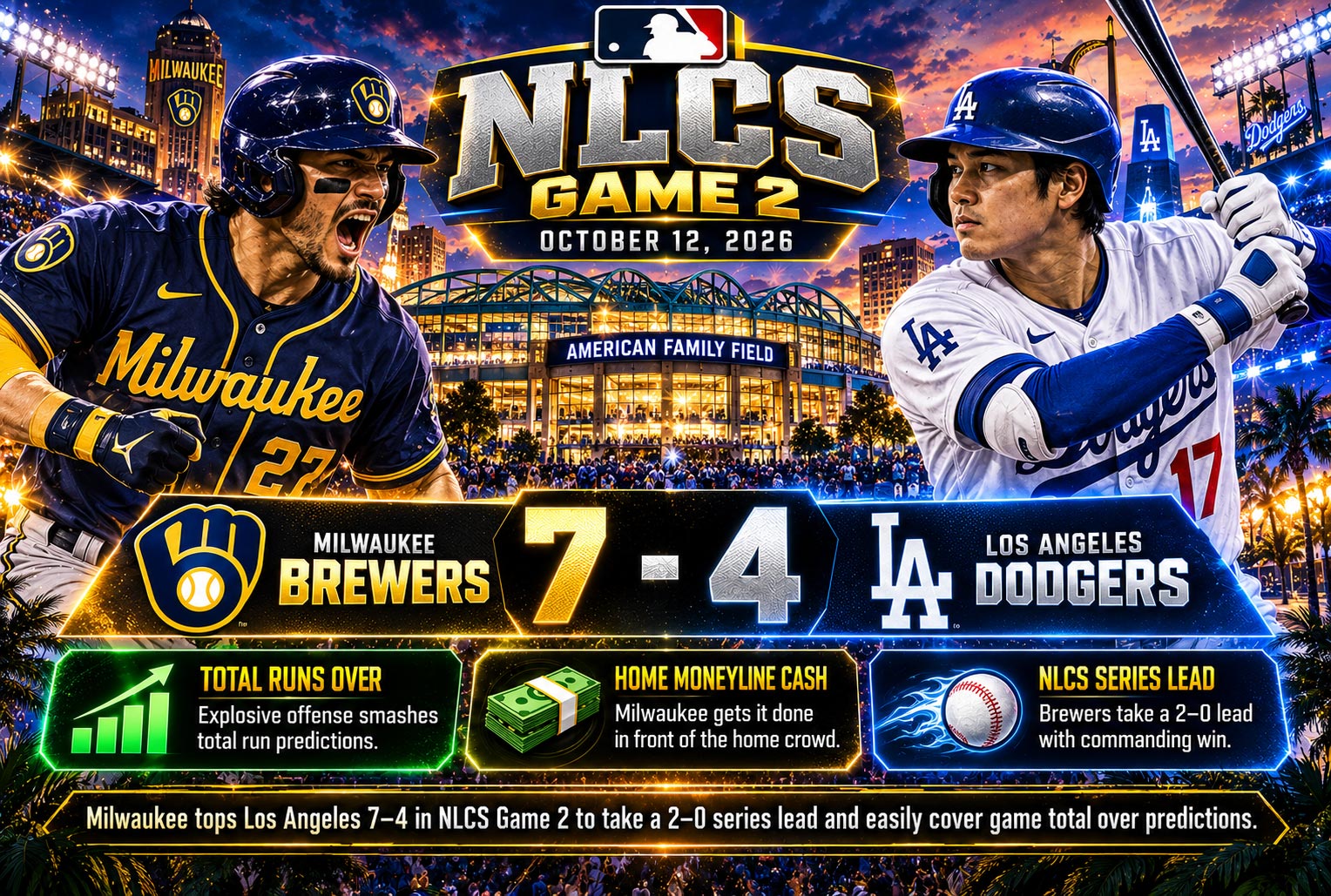
The Brewers just sent shockwaves through the betting world and put the entire baseball establishment on notice. Milwaukee demolished the Dodgers 7-4 at American Family Field on October 12, 2026, taking a commanding 2-0 series lead in the NLCS and absolutely crushing the over in the process. If you rode with the Crew tonight, you’re counting stacks—and if you faded them thinking LA would bounce back at home, well, you just learned an expensive lesson about playoff momentum.
Brewers Stun LA 7-4: Milwaukee Takes 2-0 Lead
The Brewers came out swinging like they had nothing to lose and everything to prove. Milwaukee’s lineup went nuclear against the Dodgers’ pitching staff, tagging them for seven runs and making American Family Field sound like a jet engine at full throttle. This wasn’t some scrappy one-run grinder—this was a statement game that has Vegas scrambling to adjust their series prices.
The sharp money saw this coming from a mile away. Milwaukee closed as a +135 home dog in most books, and anyone who understood the matchup dynamics knew that was pure value. The public hammered the Dodgers because, well, they’re the Dodgers—but the smart money recognized that Milwaukee’s home-field advantage in October is legitimately one of the most underrated edges in baseball. That atmosphere is suffocating for road teams.
What makes this even more impressive is that the Brewers didn’t need some fluke inning or defensive collapse to win. They controlled this game from the middle innings on, and their bullpen—which has been absolutely elite all postseason—slammed the door when it mattered. The Dodgers now face a 0-2 hole heading back to LA, and historically, teams down 0-2 in a seven-game series only come back a small minority of the time. Those aren’t odds you want to bet on.
Game 2 Total Crushes Over as Crew Dominates
Let’s talk about that total, because this was a masterclass in reading market psychology. The Game 2 total opened around 7.5 and crept up to 8 by first pitch, and anyone who jumped on the over early is eating well tonight. Both teams combined for 11 runs, easily clearing that number by the sixth inning. This wasn’t some bullpen implosion either—both offenses came to play, and the conditions at American Family Field were absolutely prime for run production.
The key insight here was recognizing that Game 1 recency bias was suppressing the total. Books and bettors alike got lulled into thinking this series would be a pitching duel because of how tight the opener was. But anyone who dug into the actual matchup metrics knew that both lineups had exploitable advantages. Milwaukee’s power surge wasn’t a surprise if you’d been tracking their splits against the type of pitching LA was rolling out. Expected value was screaming “over” to anyone paying attention.
From a bankroll management perspective, this game was a gift for anyone who understands variance and opportunity cost. The over wasn’t just a coin flip—it was a legitimately +EV play based on lineup construction, ballpark factors, and the fact that playoff baseball in October at Miller Park (yeah, I know it’s American Family Field now, but old habits die hard) historically trends higher-scoring than people think. If you sized this bet appropriately, you just printed money while the public was still trying to figure out why their Dodgers moneyline ticket was getting shredded.
The Market Implications Moving Forward
This series is now in full tilt mode, and the betting markets are going to overreact hard. Expect the Dodgers to open as heavy favorites in Game 3 back in LA—we’re talking -200 or higher—because the public will assume they can’t possibly go down 0-3. That’s exactly when sharp bettors start licking their chops. The narrative will be all about the Dodgers’ championship pedigree and home-field advantage, but the actual data might tell a different story about Milwaukee’s ability to win on the road.
The series price is going to shift dramatically too. Before Game 2, Milwaukee was probably sitting around +250 to +300 to win the pennant. After tonight, that number will compress significantly, maybe down to +130 or +150 depending on the book. The smart play might actually be to hedge or take a position on the Dodgers’ series price if you got Milwaukee at a fat number before the series started. Risk mitigation isn’t about being right—it’s about maximizing expected value across all scenarios.
Here’s where it gets interesting for player props and team totals going forward. Books are going to adjust their lines based on these two games, but they might overcorrect. Milwaukee’s offense just showed they can get to LA’s pitching, which means their team total lines in Games 3 and 4 might offer value if the market assumes they’ll go cold. Meanwhile, individual player props for Milwaukee’s core hitters could be underpriced if the public is still sleeping on their ability to maintain this production level. The arbitrage opportunity here is real if you know where to look.
The Brewers just put themselves in the driver’s seat for a World Series berth, and bettors who trusted the process are cashing tickets while the chalk-eaters are wondering what happened. Milwaukee’s 2-0 lead isn’t just impressive—it’s a masterclass in why playoff baseball markets are so exploitable when you understand matchup dynamics and market psychology. The Dodgers aren’t dead yet, but they’re on life support, and the odds are starting to reflect reality. If you’re looking at Game 3, don’t just blindly bet the Dodgers bounce-back narrative—dig into the actual data and find where the real edge lives. So here’s my question for the comments: Are we all in on Milwaukee to close this out, or is there still value in LA’s championship DNA? Let me know what you’re riding.
“WannaBet.com may receive compensation from the sportsbooks mentioned in this post if you sign up using our links. This doesn’t cost you a dime, but it keeps the lights on. Please bet responsibly. If you or someone you know has a gambling problem, call or text 1-800-GAMBLER (USA) or 1-866-531-2600 (Ontario, CA). 21+ only.”
