

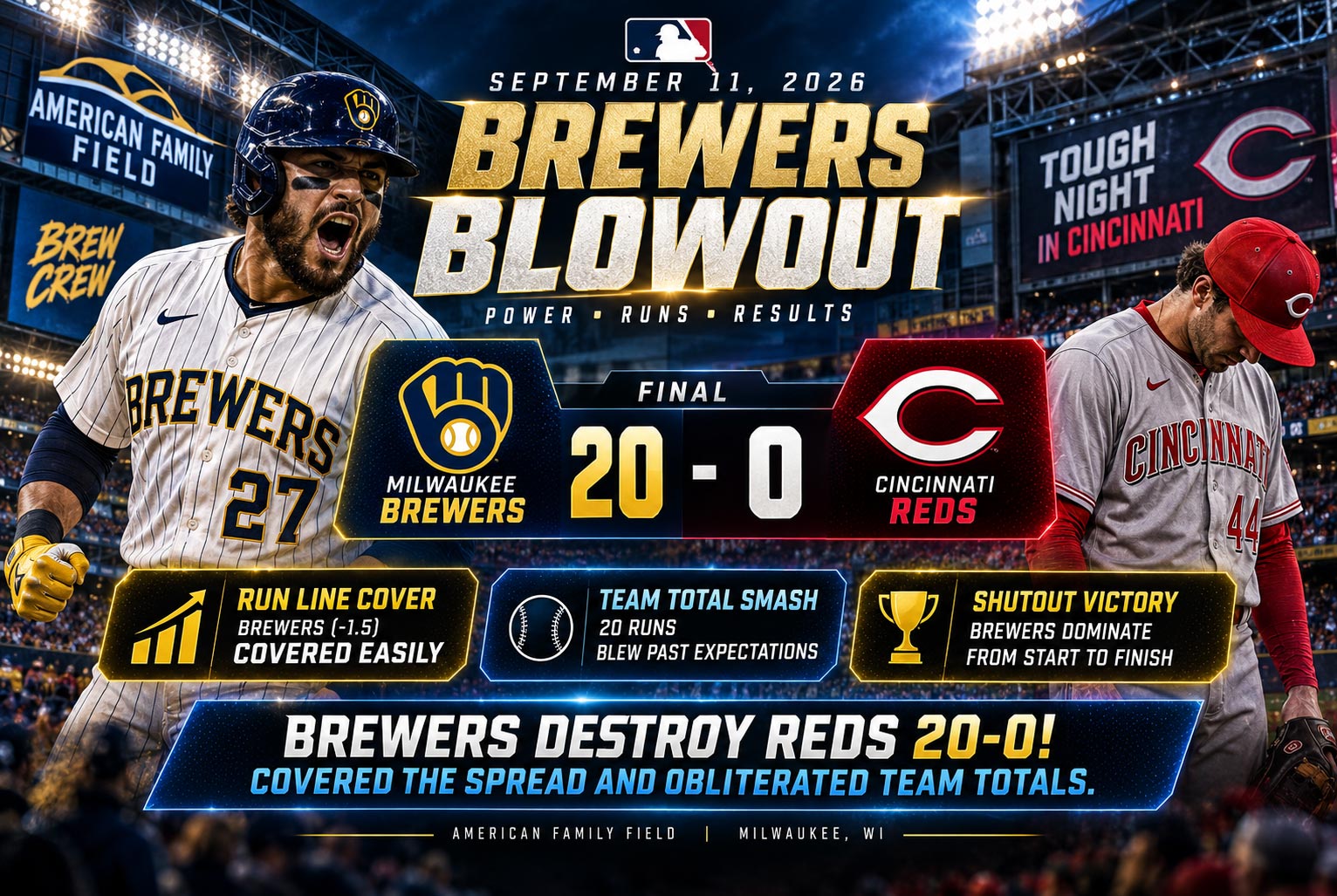
When a game goes from "competitive sporting event" to "live batting practice," bettors who loaded up on team totals basically get handed free money. That’s exactly what happened on September 11, 2026, when the Milwaukee Brewers absolutely demolished the Cincinnati Reds 20-0 at American Family Field. If you had Milwaukee team total over 4.5 runs (which was sitting around -110 pre-game), you were cashing by the third inning and probably already planning what you’d do with your winnings.
This wasn’t just a win—it was a systematic dismantling that turned every Brewers-related bet into an ATM machine. The -1.5 run line? Covered before most people finished their first beer. The game total over? Smashed by Milwaukee alone. These are the nights that remind us why team totals deserve more love in your betting strategy, especially when you can identify mismatches that Vegas hasn’t fully priced in.
Brewers 20-0 Rout Turns Team Totals Into Easy Money
The Brewers put up a 20-spot without the Reds even getting on the board, which is the kind of statistical anomaly that makes you want to check if you’re still dreaming. Milwaukee’s offense went full video-game mode, and anyone who bet their team total over was basically printing money from the second inning onward. The typical Milwaukee team total was hovering around 4.5-5.5 runs depending on your book, which they eclipsed before the game was even halfway done.
Here’s where the risk-reward calculation gets interesting: team totals generally offer better juice than full game totals because you’re isolating one variable. When you bet Brewers over 4.5 runs at -110, you don’t care if Cincinnati scores 0 or 10—you just need Milwaukee to show up. In a blowout scenario like this, that bet becomes a first-half winner, and you’re sitting pretty while everyone else is sweating the full game total.
The beautiful thing about team totals in lopsided matchups is the margin of safety. Even if the Reds had scored 5-6 runs, Brewers bettors would’ve still cashed comfortably. That’s the edge: you’re not betting on a close game going your way; you’re betting on one team’s ability to execute regardless of what happens on the other side. Milwaukee’s 20-run explosion was extreme, but even a "normal" 8-2 win would’ve crushed the over.
Why Milwaukee’s Blowout Was a Bettor’s Dream Cash
This game was a masterclass in identifying exploitable mismatches before the market catches up. Cincinnati came into this game with bullpen issues and a pitching staff that was basically held together with duct tape and prayers. Sharp bettors who did their homework knew that Milwaukee’s lineup—stacked with guys who rake at home—was primed for a huge night. The books set the Brewers team total conservatively because they’re pricing in "normal" outcomes, but baseball variance means occasionally you get nuclear explosions like this.
The run line at -1.5 was probably sitting around -150 to -170 pre-game, which is actually solid value when you’re confident in a blowout. Yes, you’re laying juice, but you’re also getting insulation against a 5-4 game that still covers. When Milwaukee jumped out to an early lead and never looked back, that -1.5 became a first-inning lock. This is why understanding game script matters: once a team gets up big, they keep their foot on the gas in baseball, unlike football where teams coast.
The psychological aspect here is underrated too. After Milwaukee went up 8-0, Cincinnati essentially waved the white flag, bringing in mop-up arms who threw batting practice fastballs. Meanwhile, Milwaukee kept their regulars in long enough to pad stats, which is exactly what you want when you’ve got team total overs or player props in play. The Reds’ bullpen became a layup line for Brewers hitters, and every run after the 10th was just icing on the cake for bettors who loaded up.
The Plays That Printed
Pre-Game Bets That Cashed:
- Brewers Team Total Over 4.5 (-110): Covered by the 4th inning. This was the no-brainer play if you identified the Reds’ pitching weakness.
- Brewers Run Line -1.5 (-160): Expensive juice, but when you’re confident in a blowout, laying the runs makes sense. Milwaukee covered this by 18.5 runs.
- Game Total Over 8.5 (-110): Milwaukee scored 20 by themselves. Even the most conservative over bettors were celebrating.
Live Betting Opportunities:
- After Milwaukee went up 5-0 in the 2nd inning, books were still offering Brewers team total over 9.5 at decent odds. That’s market inefficiency at its finest.
- First 5 Innings overs became instant locks once the floodgates opened. Books couldn’t adjust lines fast enough.
Player Props That Hit:
- Any Milwaukee hitter’s total bases prop was basically free money. When a team scores 20, multiple guys are going deep and racking up extra-base hits.
Market Psychology: Why Books Get Burned
Sportsbooks use historical data to set lines, which means they’re pricing in "average" scenarios based on season-long performance. But baseball is a sport of extreme variance—you can’t just assume every game will play out like the median outcome. When a team like Cincinnati shows up with a compromised pitching staff against a hot-hitting Milwaukee lineup at home, the "average" goes out the window. Sharp bettors exploit this by identifying spots where the line doesn’t reflect current conditions.
The public typically hammers favorites on the moneyline because it feels safe, but that’s where you’re paying maximum juice for minimum return. Milwaukee was probably around -200 to -250 on the moneyline, which means you’re risking $250 to win $100. Compare that to Brewers team total over 4.5 at -110, where you’re risking $110 to win $100 with way more upside if things go nuclear. The expected value calculation isn’t even close—team totals offer better risk-adjusted returns in clear mismatch spots.
Books also know that most casual bettors don’t dig into bullpen depth charts or recent pitcher performance trends. That information asymmetry is your edge, and it’s exactly the kind of market inefficiency that separates sharp bettors from the crowd. When you’re doing homework that 95% of bettors aren’t, you’re essentially betting with inside information that’s hiding in plain sight.
The ATM Effect: When Everything Hits
There’s a special feeling when a game goes so far in your favor that every bet you touched turns green. This Brewers blowout was one of those rare nights where team totals, run lines, player props, and game totals all cashed simultaneously. It’s the betting equivalent of hitting a royal flush—statistically unlikely but absolutely beautiful when it happens. These nights don’t come often, which is exactly why you need to maximize them when the setup is obvious.
The "ATM effect" happens when market inefficiency meets extreme performance. Books can’t price in 20-0 blowouts because they’re statistical outliers, but when you identify the conditions that make outliers more likely (terrible bullpen, hot offense, home field advantage), you can position yourself to capitalize. Milwaukee’s demolition of Cincinnati wasn’t just luck—it was a predictable outcome if you were paying attention to the underlying metrics.
This is also why bankroll management matters. If you identified this as a smash spot and loaded up appropriately (without going full degen and betting the mortgage), you could’ve had a monster night. The key is recognizing when edges compound: team total over + run line + player props all pointing the same direction means you’ve found a true mismatch. Those are the nights that make up for all the bad-beat one-run losses you suffer through the rest of the season.
Replicating Success: Finding the Next 20-0
You can’t predict exactly when the next 20-0 blowout will happen, but you can identify conditions that make extreme outcomes more probable. Look for teams with elite offenses facing depleted bullpens, especially in home games where the favorite historically mashes. Check recent pitcher performance—if a team’s rotation is getting shelled and their bullpen is overworked, that’s blood in the water. Milwaukee’s destruction of Cincinnati wasn’t random; the pieces were all there if you knew where to look.
Another angle: late-season games where one team is eliminated and the other is fighting for playoff position. Motivation matters in baseball more than people think. A team that’s already planning their golf trips isn’t going to battle back from a 5-0 deficit, which means blowouts are more likely to stay blowouts. The Reds were basically checked out, while Milwaukee was still playing meaningful baseball—that competitive imbalance creates betting opportunities.
Timing your bets matters too. Pre-game lines offer the best value before the market adjusts, but live betting can be profitable if you’re quick. Once Milwaukee went up 3-0, you could’ve grabbed boosted team totals or alternate run lines at plus money. Books overreact to early scoring sometimes, creating middle opportunities where you can bet both sides and guarantee profit. The key is having accounts at multiple books in your jurisdiction (shoutout to New York, New Jersey, and Ontario bettors who can shop lines across 10+ operators).
The Brewers’ 20-0 annihilation of the Reds is exactly why team totals deserve a permanent spot in your betting arsenal. While casual bettors were laying heavy juice on Milwaukee moneylines, sharp players who identified the pitching mismatch and loaded up on team total overs basically got handed free money. These blowouts don’t happen every day, but when the setup is obvious—elite offense versus depleted pitching, home field advantage, meaningful games versus checked-out opponents—you need to strike with conviction.
The lesson here isn’t just about this one game; it’s about developing the analytical framework to spot similar opportunities before the market catches up. Team totals offer better risk-adjusted returns than moneylines in mismatch spots, and they insulate you from the unpredictability of close games. Do your homework on bullpen depth, recent performance trends, and situational motivation, and you’ll find these ATM games more often than you’d think.
Hot take for the comments: Should books be setting team totals higher when one squad is clearly overmatched, or is the current pricing model exactly what creates the edge for sharp bettors? Drop your thoughts below—and if you caught this Brewers explosion, brag about it because nights like this are why we do this.
"WannaBet.com may receive compensation from the sportsbooks mentioned in this post if you sign up using our links. This doesn’t cost you a dime, but it keeps the lights on. Please bet responsibly. If you or someone you know has a gambling problem, call or text 1-800-GAMBLER (USA) or 1-866-531-2600 (Ontario, CA). 21+ only."
