

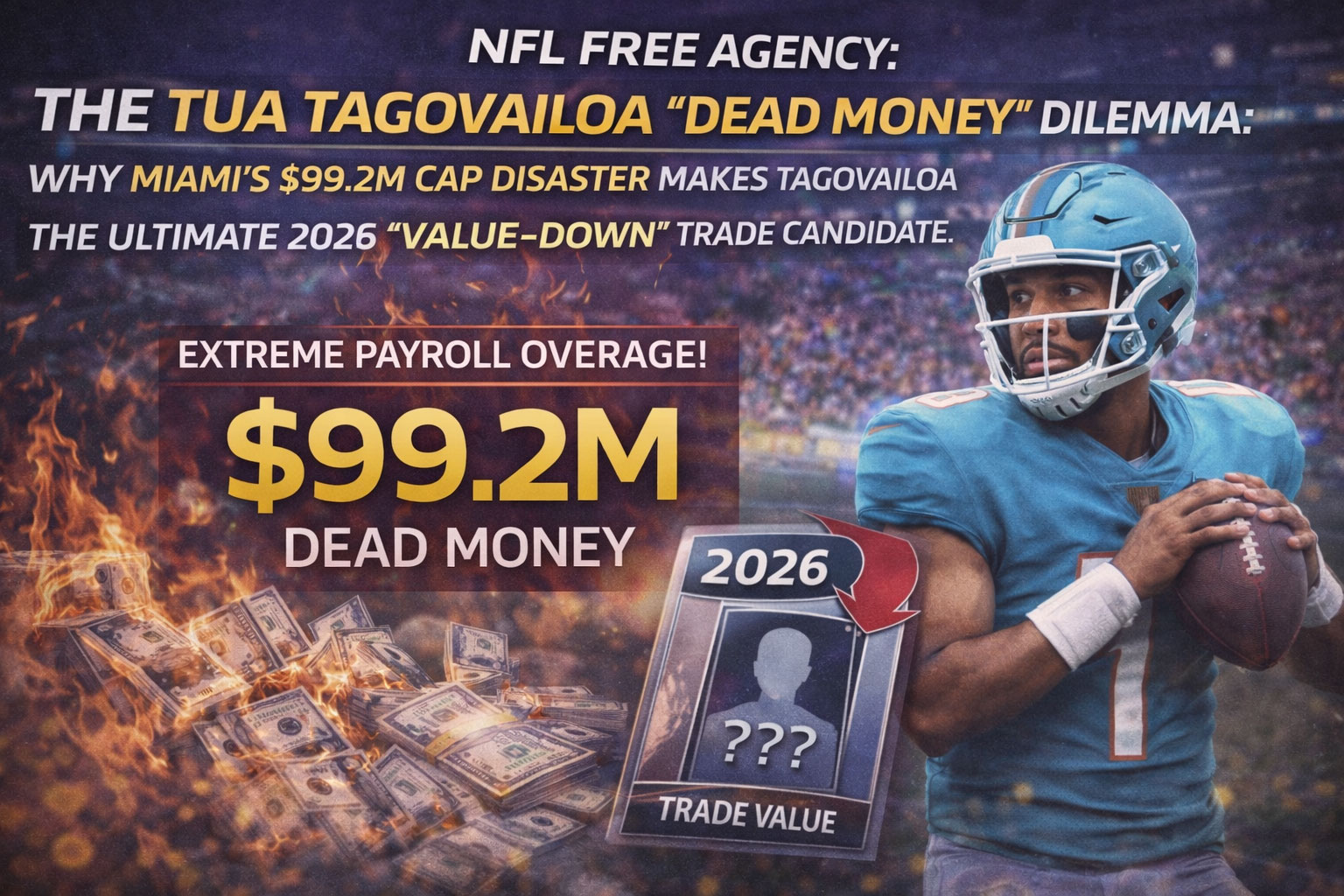
Look, I’ve seen some bad contracts in my time running numbers in the back of a Harvard dorm room, but the Dolphins’ handling of Tua Tagovailoa’s extension might be the most catastrophic risk management failure since, well, the last time someone bet their rent money on a Thursday Night Football over. Miami went all-in on their injury-prone QB with a four-year, $212.4M extension that seemed reasonable at the time—until you actually read the fine print and realized they structured it like a Ponzi scheme that’s about to collapse. The dead money accelerations on this deal are so brutal that Stephen Ross probably needs therapy just thinking about 2026. This isn’t just a bad contract; it’s a masterclass in how NOT to structure guaranteed money, and it’s about to make Tua the most fascinating "sell-low" asset in NFL history.
Miami’s $99M Cap Nightmare: Tua’s Trade Value
The Dolphins are currently staring down a potential $99.2M dead cap hit if they move on from Tua after the 2025 season, which is the kind of number that makes front offices spontaneously combust. For context, that’s more dead money than the GDP of a small island nation and roughly equivalent to flushing three Pro Bowl edge rushers down the toilet. The contract structure basically turns Tua into an untradeable asset until 2026, when the dead money finally becomes manageable enough to consider an exit strategy.
Here’s where the MBA brain kicks in: this is a classic case of sunk cost fallacy meets liquidity trap. Miami committed so much guaranteed money upfront that they’ve essentially locked themselves into a minimum two-year window where trading Tua would be financial malpractice. The signing bonus proration and guaranteed salary structure means any pre-2026 trade would accelerate dead cap charges that would cripple their ability to field a competitive roster. It’s like doubling down on a bad hand because you’re already pot-committed—except the pot is $99 million and the hand is a QB who can’t stay healthy.
But 2026? That’s when things get spicy. If Tua has another concussion-riddled season in 2025, or if a rookie QB prospect emerges that Miami falls in love with, suddenly that dead money becomes palatable enough to pull the trigger. We’re talking about a potential $40-50M cap savings scenario where Miami could finally escape the contract without completely destroying their roster construction. The "value-down" trade becomes the optimal play when the alternative is continuing to pay premium QB money for replacement-level production wrapped in bubble wrap.
Why the Dolphins Are Stuck With Dead Money Hell
The fundamental problem here is that Miami’s front office treated Tua’s extension like a "sure thing" when the underlying asset (his health and consistency) was anything but. They guaranteed $167M of a $212M deal for a quarterback who’s missed significant time in three of his four seasons and has legitimate concerns about long-term durability. It’s the equivalent of writing naked calls on a volatile stock—great upside if it works, absolute devastation if it doesn’t. And right now, the theta decay on this position is killing them.
The contract structure reveals either supreme confidence or supreme incompetence, and honestly, it’s probably both. By frontloading the guarantees and spreading the cap hits, Miami essentially bet the franchise on Tua becoming a top-10 QB who could carry them through 2028. The problem? The market has already repriced that probability significantly downward after another injury-plagued season. This is what happens when you ignore implied volatility and historical injury patterns because you’re desperate to lock in your guy before the price goes up.
From a cap management perspective, this is dead money hell because it eliminates optionality—the most valuable asset any NFL front office can have. Miami can’t pivot to a cheaper veteran, can’t realistically draft and develop a rookie without eating catastrophic dead cap, and can’t trade Tua without basically admitting organizational failure while simultaneously hamstringing their rebuild. They’re trapped in a negative expected value scenario where every option sucks, just some suck less than others. By 2026, the "value-down" trade becomes the least-worst option: admit you were wrong, eat $30-40M in dead cap, and try to salvage what’s left of your competitive window with a cheaper alternative.
The Tua situation is basically a real-time case study in how guaranteed money can transform from competitive advantage to organizational albatross in about 18 months. Miami thought they were locking in market efficiency by extending him before the QB price explosion continued; instead, they created a stranded asset that’s going to haunt their cap sheet until at least 2026. The smart money says they ride this out through 2025, pray Tua stays healthy and productive, then seriously evaluate their options when the dead money becomes survivable. But if another concussion happens, or if his play continues to be merely "good enough" rather than elite? 2026 becomes the year Miami finally cuts their losses and trades him for whatever they can get—probably a second-round pick and cap relief. It’s not the outcome anyone wanted, but it’s the outcome the contract structure basically guarantees. Sometimes the house wins, and sometimes the house is stuck paying $99M to a QB who’s already on another roster. Wild times in South Beach, folks. What’s your play here—do the Dolphins run it back in 2025 or start shopping Tua this offseason regardless of the dead money hit?
WannaBet.com may receive compensation from the sportsbooks mentioned in this post. For more NFL offseason cap analysis, see our breakdown of the Kyler Murray decision day and the Alvin Kamara cap designation and what it means for the Saints. if you sign up using our links. This doesn’t cost you a dime, but it keeps the lights on. Please bet responsibly. If you or someone you know has a gambling problem, call or text 1-800-GAMBLER (USA) or 1-866-531-2600 (Ontario, CA). 21+ only.
