

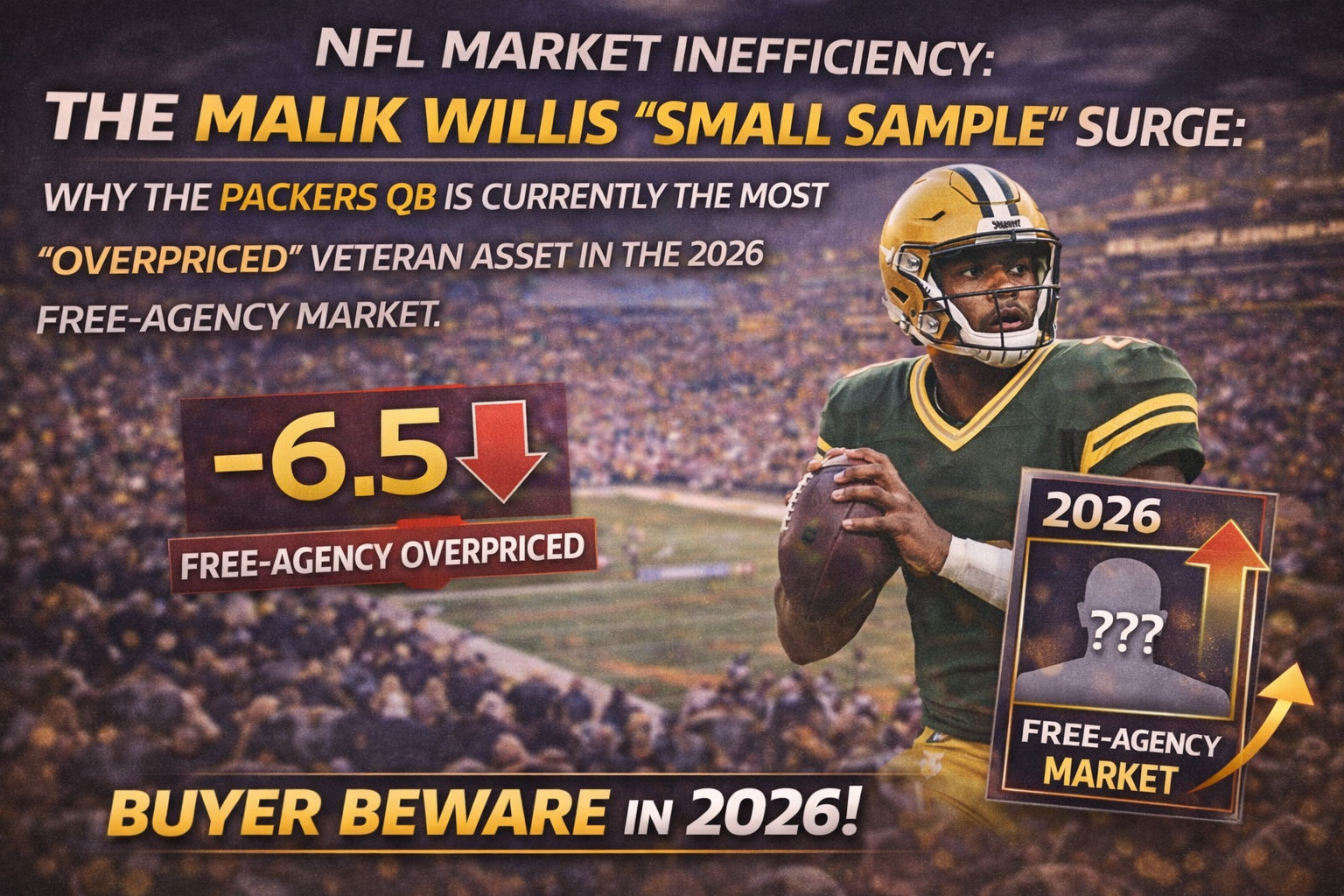
Look, I get it. You see a backup QB throw three touchdowns in garbage time against prevent defense and suddenly your group chat is blowing up about "finding the next Brock Purdy." But here’s the thing about small sample sizes in the NFL—they’re the sports betting equivalent of your buddy who hit one five-leg parlay and now thinks he’s Billy Walters. The Malik Willis situation in Green Bay is creating one of the most exploitable market inefficiencies we’ll see heading into 2026 free agency, and if you understand basic regression to the mean, you’re about to make bank fading the public hype. This isn’t about hating on Willis as a person—it’s about recognizing when the market has completely lost the plot and is pricing in outcomes that have like a 5% chance of actually happening.
The Malik Willis Trap: Why Small Samples Cost Millions
The entire Malik Willis narrative is built on approximately 150 snaps of NFL football where he looked competent—not elite, literally just competent—and now some team is going to hand him $25-30 million guaranteed because their GM watched three games and convinced himself he’s discovered market inefficiency. This is the same cognitive bias that makes recreational bettors smash the over on a running back who had one 150-yard game against the Panthers’ 32nd-ranked run defense. The expected value here is absolutely cooked because you’re extrapolating from a dataset smaller than my little sister’s attention span during a Knicks game.
Here’s what actually happened: Jordan Love got hurt, Willis came in against backups and prevent schemes, didn’t completely shit the bed, and suddenly he’s being discussed in the same breath as guys who’ve started 40+ games. The market is pricing Willis like he’s a proven commodity when in reality, we have less statistical evidence of his NFL viability than we do for most rookie draft picks. At least with rookies, you’ve got three years of college tape and combine metrics—with Willis, you’ve got a couple games where Matt LaFleur schemed him into checkdowns and play-action bootlegs that my mom could’ve executed.
The real kicker? Some desperate franchise—looking at you, Tennessee or Las Vegas—is going to convince themselves they’re getting a steal because "the Packers developed him" and "he’s got upside." This is textbook sunk cost fallacy meets FOMO meets a GM trying to save his job. The efficient market hypothesis completely breaks down in NFL free agency because you’ve got 32 decision-makers operating with imperfect information, massive ego, and ownership groups that read three tweets and think they understand player evaluation. Willis is about to get paid like a QB2 with QB1 potential when the data suggests he’s barely a viable QB3.
Regression to the Mean: Fade the Hype, Find Value
If you understand anything about statistical regression, you know that extreme outcomes in small samples almost always trend back toward the average over larger datasets. Willis’s "success" in Green Bay is the definition of an outlier performance that’s being treated as a new baseline, which is like assuming your friend who went 8-2 on NFL picks one weekend has suddenly cracked the code. The smart money here isn’t betting on Willis to maintain that level—it’s fading the inevitable crash when he gets exposed over a full season.
From a betting perspective, this creates massive opportunity in 2026. Whatever team signs Willis is going to have inflated win totals, their division odds will be juiced based on QB optimism, and props on Willis himself will be priced like he’s a borderline Pro Bowler. This is where you attack. The sportsbooks in New York, Jersey, Pennsylvania, Illinois, and Ohio are going to set lines based on public perception and recent performance bias—exactly the kind of market inefficiency that sharp bettors exploit. You’ll be able to hammer unders on team wins, fade them in division races, and probably get plus-money on "Will Willis be the Week 1 starter in Week 10?" props.
The comparable here is every other backup QB who had a hot streak and got paid: Matt Flynn, Mike Glennon, Brock Osweiler, Teddy Bridgewater post-Saints. The hit rate on these guys is maybe 10%, yet teams keep making the same mistake because humans are wired to overvalue recent information and underweight base rates. The base rate for backup QBs with limited starting experience who get big contracts? Absolutely abysmal. But the market will price Willis like he’s the exception, which means you fade it hard and collect when reality sets in around Week 6 of 2026.
The Malik Willis situation is a masterclass in how NFL front offices and betting markets both fall victim to the same cognitive biases—recency bias, small sample size fallacy, and the desperate human need to believe we’ve found hidden value where everyone else missed it. Some team is going to give this dude $60-80 million total value based on performances you could count on one hand, and when it inevitably goes sideways, the betting opportunities will be absolutely nuclear. The real edge here isn’t just fading Willis himself—it’s understanding that the market systematically overprices these "small sample surge" guys and positioning yourself to exploit it across win totals, division odds, and player props. So here’s my question for the comments: which desperate franchise pulls the trigger first on Willis, and what’s the over/under on games started before he’s benched? I’m setting the line at 8.5 and smashing the under.
"WannaBet.com may receive compensation from the sportsbooks mentioned in this post if you sign up using our links. This doesn’t cost you a dime, but it keeps the lights on. Please bet responsibly. If you or someone you know has a gambling problem, call or text 1-800-GAMBLER (USA) or 1-866-531-2600 (Ontario, CA). 21+ only."
