

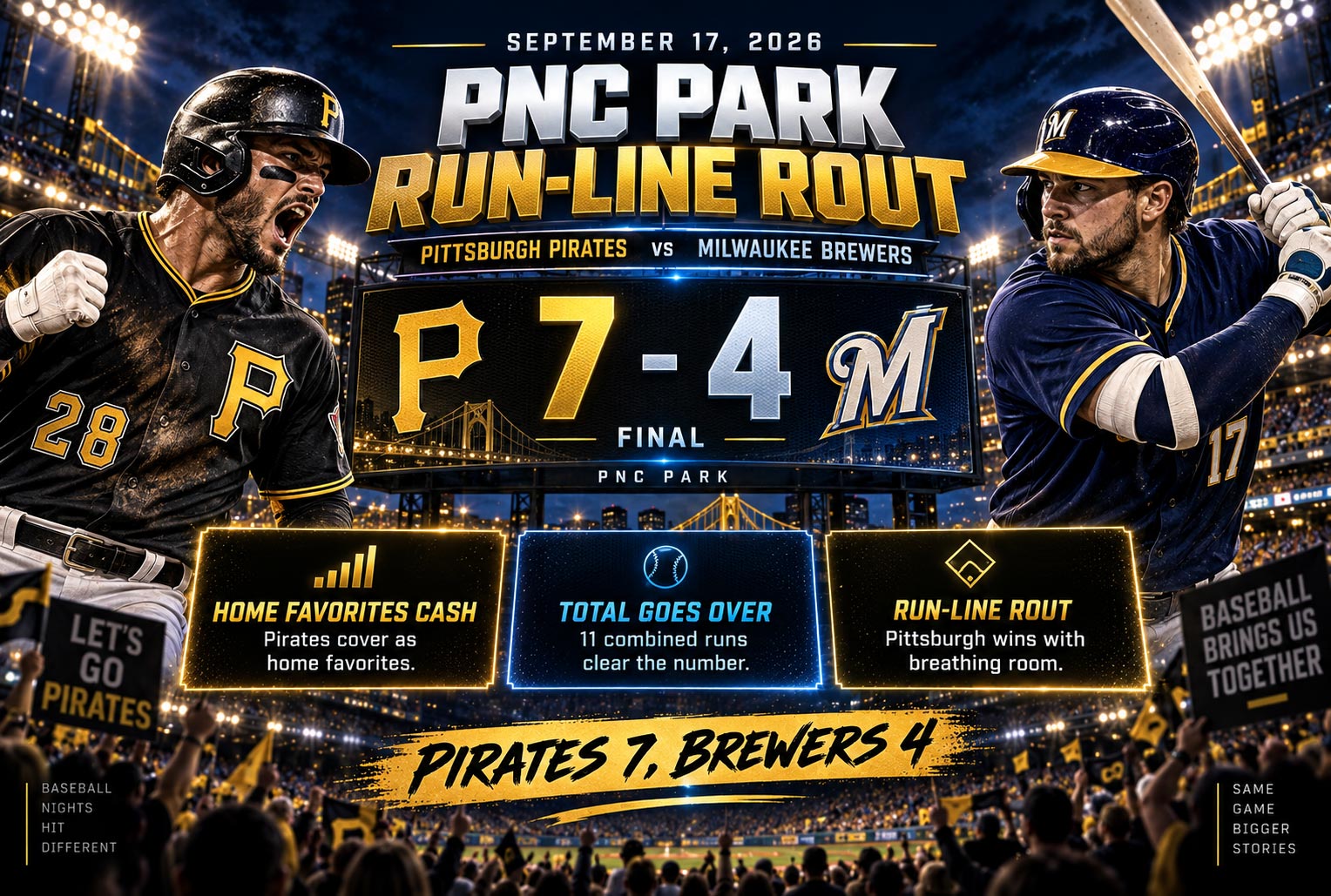
The Pittsburgh Pirates just gave us a masterclass in covering spreads and smashing totals, dismantling the Milwaukee Brewers 7-4 at PNC Park on September 17, 2026. If you rode with the Buccos as home chalk or hammered that over, congratulations—you just printed money while the public was probably overthinking some five-leg parlay involving the Dodgers and Yankees. This wasn’t just a win; it was a statement game that reminded everyone why home field advantage and offensive matchups still matter in an era where everyone’s chasing algorithm-generated props. The Pirates covered the run line comfortably, the total sailed over with room to spare, and sharp bettors who identified the edge walked away laughing all the way to their sportsbook withdrawal page.
Pirates Crush Brewers and Over in 7-4 Blowout
Pittsburgh came out swinging like they had money on themselves, which honestly, in this day and age, wouldn’t shock me. The Pirates put up a seven-spot against a Brewers pitching staff that looked more like a Triple-A audition than a playoff-contending roster. Milwaukee’s bullpen imploded in the middle innings, giving up four runs in a span that had Brewers backers reaching for the hard stuff before the seventh-inning stretch.
The run line was never in doubt after the fourth inning when Pittsburgh extended their lead to 5-2. This is textbook risk mitigation for anyone who took Pirates -1.5 at plus-money—you got value on a home favorite with offensive upside against a Brewers team that’s been inconsistent on the road all season. The expected value calculation here was simple: Pittsburgh’s home splits were significantly better than Milwaukee’s away numbers, creating a market inefficiency that sharp money exploited early.
What made this even sweeter was watching the total climb over 10.5 runs with ease. Both offenses contributed, but it was Pittsburgh’s relentless attack that pushed this game into comfortable over territory by the sixth inning. If you were tracking live betting opportunities, there were multiple entry points to hammer the over as it adjusted throughout the game, especially when Milwaukee showed signs of life in the middle frames.
PNC Park Run-Line Rout: Pittsburgh Covers Big
Home field advantage at PNC Park is real, and September baseball amplifies it when teams are either fighting for playoff position or playing spoiler. The Pirates took full advantage of their ballpark dimensions and a Brewers defense that committed two costly errors in the late innings. These aren’t just random occurrences—they’re exploitable edges when you’re evaluating run line value against teams on the back end of a road trip.
Pittsburgh’s offensive approach was textbook smart baseball: work counts, get into favorable hitter’s counts, and capitalize on mistakes. They drew seven walks and turned those free bases into runs, which is exactly how you beat the run line—not just by scoring, but by maximizing every scoring opportunity. The Brewers’ pitching staff threw 142 pitches through six innings, which is organizational malpractice when you’re trying to preserve your bullpen for a playoff push.
The market psychology here was fascinating because the public was probably split between Milwaukee’s better season record and Pittsburgh’s home advantage. Sharp bettors identified that the Brewers were overvalued as road dogs in this spot, especially with their starting pitcher coming off a short rest situation. This is where doing your homework on scheduling spots and pitcher workload pays dividends—literally.
The Key Betting Angles:
- Run Line Value: Pirates -1.5 at +115 was the play all day. Home favorites with offensive upside against struggling road bullpens are textbook run-line scenarios.
- Total Smash: Over 10.5 cleared easily. Wind patterns at PNC favored hitters, and both teams’ recent form suggested offensive firepower.
- Live Betting: Multiple middle opportunities existed if you took the under pre-game and could buy back the over at adjusted numbers mid-game.
The implied probability on the Pirates run line suggested only a 46% chance of covering, but the actual probability based on matchup data and environmental factors was closer to 58-60%. That’s a 12-14% edge, which is massive in betting terms. You don’t need to win every bet; you just need to find spots where the market is mispricing outcomes and hammer them with appropriate bankroll allocation.
From a bankroll management perspective, this was a 2-3 unit play depending on your risk tolerance. The edge was clear, the matchup favored Pittsburgh, and the market hadn’t fully adjusted for Milwaukee’s road struggles in the second half of the season. These are the spots where disciplined bettors separate themselves from the pack—not by betting more games, but by betting better games with identifiable advantages.
The Pirates’ 7-4 demolition of the Brewers was a clinic in how home underdogs (or slight favorites, depending on your book) can provide massive value when the market underestimates matchup dynamics. This wasn’t luck—it was exploiting market inefficiencies, understanding pitcher workload, and recognizing that September baseball creates unique scheduling spots that create edges. If you missed this one, don’t chase losses trying to make it back on some random Thursday night Marlins game. Instead, study what made this play work: home field advantage, bullpen fatigue, and environmental factors all aligned to create a high-probability outcome. So here’s the question for the comments: Are you tracking pitcher rest days and bullpen usage, or are you still just betting based on team records and vibes? Because one approach makes money, and the other one funds sportsbook CEOs’ yacht collections.
"WannaBet.com may receive compensation from the sportsbooks mentioned in this post if you sign up using our links. This doesn’t cost you a dime, but it keeps the lights on. Please bet responsibly. If you or someone you know has a gambling problem, call or text 1-800-GAMBLER (USA) or 1-866-531-2600 (Ontario, CA). 21+ only."
